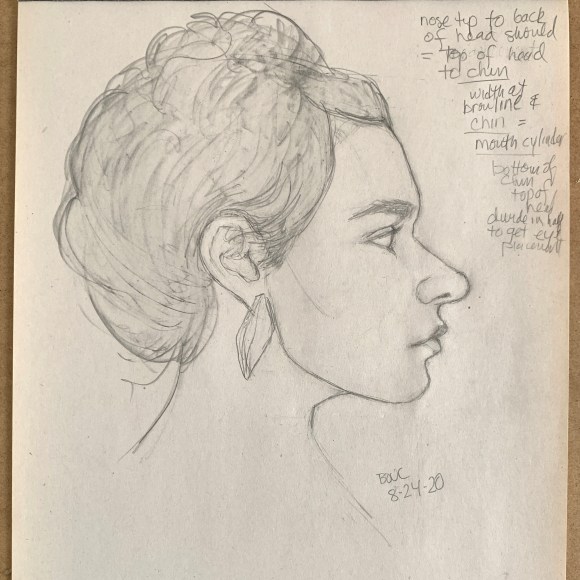
Third attempt to get this twisty-necked lady right. Graphite on newsprint, 12×9″
I’m continuing to work with the Loomis Method, which is really helping me. As you can see below, I got a little closer and her nose and jaw got little smaller each time I tried to draw her.
Second Attempt at drawing Raquel
First Attempt at drawing Raquel
You can see the model I was working from on Sktchy here. I’ve been working on this project since August but got sidetracked by the election and now that I can concentrate again I’ll be catching up on posting my work over the next week or two.
Mugshots of 10 of the 11 morons arrested for plotting to kidnap the governor, graphite on paper, 14″ x 8.5″
When I saw the mugshots of the morons that plotted to kidnap Michigan’s governor, I had to draw them. (I know, I’m weird.)
The strange thing about drawing someone is that in the process you begin to see their humanity, develop compassion for them, see the sadness in their eyes, recognize that they have mothers who may or may not have loved them. But still….
Christiane Vex, Sktchy, graphite 10×10″ To see the photo reference, visit Sktchy, here and click the drawing.
I recently finished a 4-week class on Sktchy’s Art School, “Drawing the Human Head with Mike Creighton” based on the Loomis method. I highly recommend Mike’s class if you struggle with making people look like actual human people, let alone looking like very specific people.
This was the last portrait sketch I did before beginning on some intensive head drawing study. More about that coming up on my next posts, but wanted to get this one from over a month ago posted first. You can see the reference photo by clicking on my sketch on Sktchy here.
This commissioned portrait of a darling little girl was really fun to paint but had some challenges, like trying to invent the pajamas hidden by the highchair straps. It took several drawings (including one of a baby skull I found on Google) before I was ready to move ahead with the painting as you can see in the process steps below.
Emi’s face was actually easier to paint than the pajamas, and I was tempted to keep working on them, probably forever, but the friend who commissioned the painting was happy with it as is, so I am too.
Below is some of the work in progress steps. Please note that the lighting changed the colors in some of the photos.
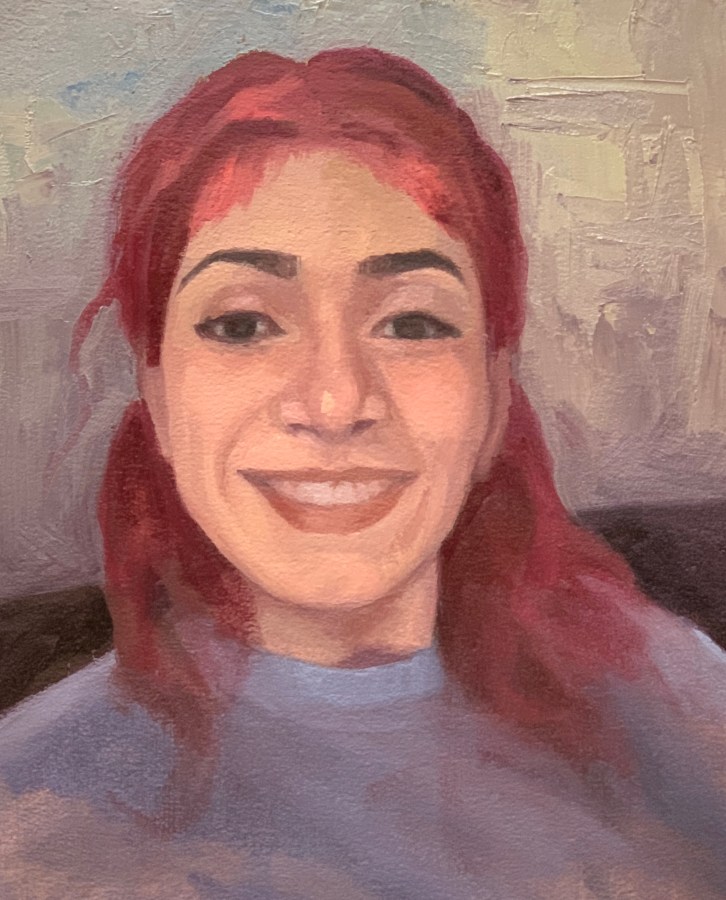
Portrait of Dayris, Oil on Arches Oil Paper, 10″x8.5″
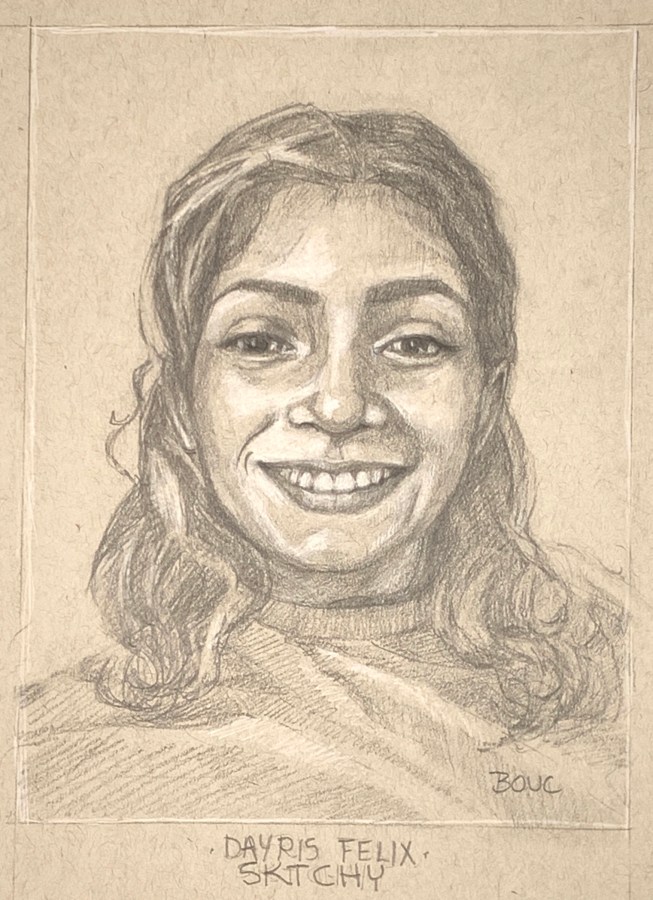
I’ve had so much fun painting and sketching the lovely Dayris from Sktchy in oil (above), and before that, in pencil and then doing a digital sketch in Procreate (below). Also below you’ll find a slide show of the work in progress. Doing the two initial drawings really helped me quickly get a pretty accurate drawing for the oil painting. You can see her reference photo on Sktchy here.
Initial pencil drawing of Dayris, 12×9″
Digital Sketch of Dayris in Procreate
Below are the steps in the process of making the portrait.
Initial pencil drawing of Dayris, 12×9″
Digital Sketch of Dayris in Procreate
Umber underpainting
Some background and shirt
Some paint on face
Icky background in with palette knife
More work on background, still icky
Background better but not happy with shirt or hair
Almost done
Scraped off shirt and some hair to redo
Portrait of Dayris, Oil on Arches Oil Paper, 10″x8.5″
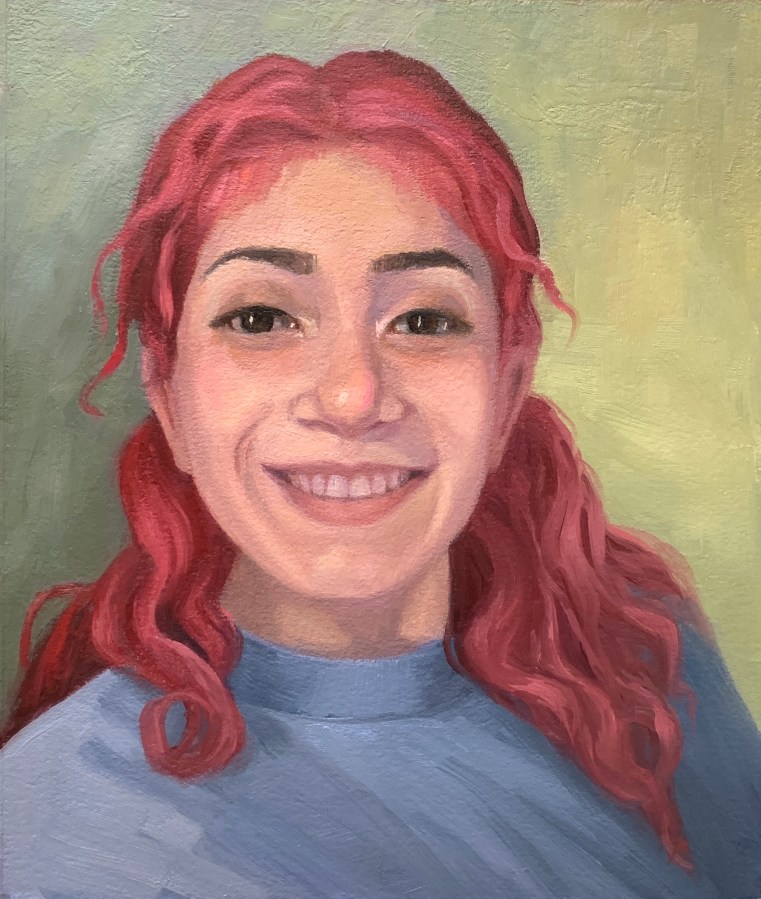
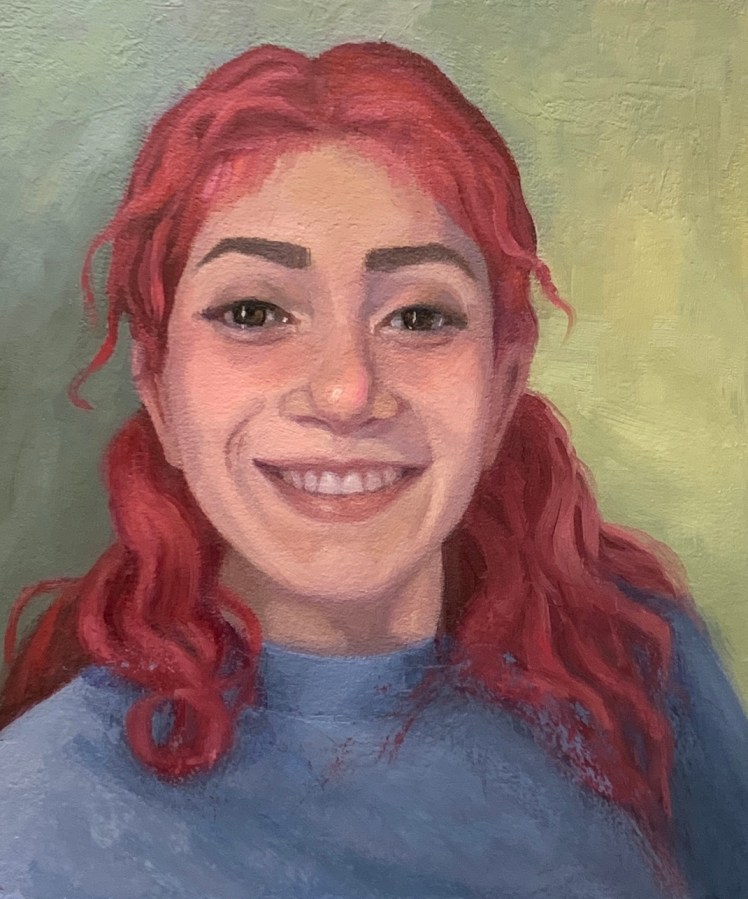
Hannah W from Sktchy, 14×11” oil on Arches Oil Paper.
Learning to paint (well) for me means a constant but gradual process of 1) learning from my mistakes and 2) having “layers of the onion” lifted from my eyes until I at last can see something that was previously mysteriously hidden from me. (You can see the reference photo for this painting on Sketchy here.)
This painting taught me once again how much harder painting can be when you don’t start with an accurate drawing, going directly to drawing with paint and then correcting, correcting, correcting.
Getting the drawing right and capturing a likeness can be as “simple” as recognizing the big shapes, contours, divisions of space and observing where things line up with each other. Getting the values right can be as “simple” as observing where the light comes from, how it lands on the large and small planes of the face or any object, and asking myself where the darkest and lightest areas are and how this plane compares. Getting good color “just” means accurately observing the overall and predominant range of colors (saturated or grayed, warm or cool) and then asking is this the spot “warmer or cooler, more or less saturated, lighter or darker.”
I can ask myself these questions over and over, but until yet another layer of the onion is lifted, I just can’t see the answer. When that happens my brain tells me it’s too hard and just jumps ahead with a lazy guess, which then sets off another round or layer of correction, correction, correction. But I do learn from my mistakes and each next painting is an opportunity to put what I learned from them into practice and hopefully remove one more layer until at last I will be able to truly see!
Portrait of Dennis J. from Sktchy, Gouache, 12×9 inches
I’m returning to using Sktchy for my reference photos of people for portrait practice since there is such a wide range to choose from. I’m not abandoning my series of “people Facebook thinks I should know,” but those are less useful for portrait practice, which I’m wanting to do right now.
Can you tell those splotches on his face are light coming in from a window through maybe lace curtains? I can’t post the original Sktchy reference photo off that site, but you can see it by clicking or swiping on my Sktchy painting on Sktchy here if you’re interested.
One thing I love about gouache is that it limits me to working on a painting for only one or two sessions. Unlike oils that can go on being repainted forever, gouache fairly quickly says, “Sorry, no more paint, no more layers, you’re done.” It teaches me to get the drawing down, go for the values and then lay down brush strokes of color and let them be.
Facebook Thinks I Should Know Him #8, Oil on Arches Oil Paper, 11×14″
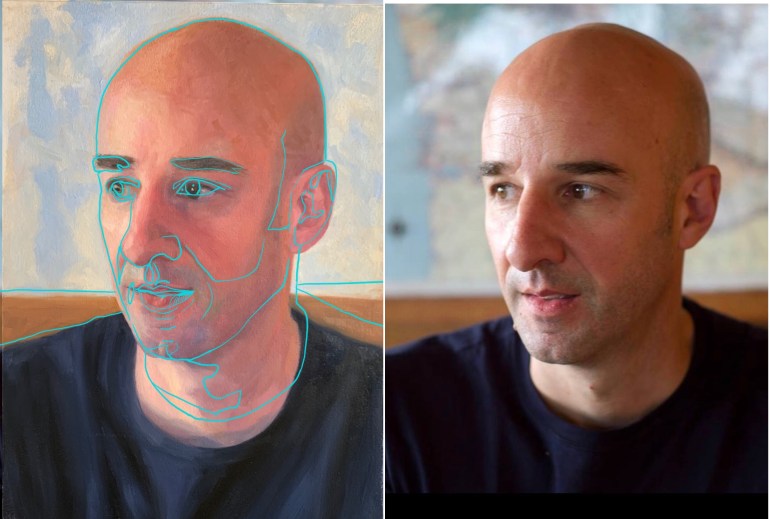
Facebook was right, this handsome guy is the wonderful European artist and art teacher, Martinho Correia, who I follow on FB now. This painting taught me (again!) how important the initial drawing is to the outcome of a portrait. I tend to start with much gusto and hubris* and just go for it. Then I reach a point where the portrait is nicely painted but something isn’t quite right.
Left: Traced photo on top of painting, Right: Original Facebook photo
In this case, as you can see above, when I used Procreate on the iPad to layer a tracing of the photo over my painting, the right eye, mouth and ear were slightly out of place and I’d made the t-shirt neckline too low. However, I was also delighted that given the sloppy drawing start, I’d gotten as close as I did (see below).
Initial drawing in thinned burnt umber paint
Of course I should have checked my drawing way back in the beginning, not after I’d so carefully rendered that misplaced right eye. If I’d been painting digitally it would have been so easy! But there’s no “select” and “move” commands in oil painting so I repainted and adjusted over and over until I reached the point of “good enough” (aka “I’m so done and over this it!”).
Embarrassing video of the process created from photos taken at the end of each afternoon’s painting session.
*Hubris is from Greek, where it meant “excessive pride, violating the bounds set for humans” and was always punished by the gods. We no longer have the Greek gods, so in English it just refers to over-the-top self-confidence.
“What, Me Worry?” (People Who Facebook Says I Should Know #7). Oil on Arches Oil Paper first covered with acrylic matte medium to reduce absorbency, 10.5 x 10.5 inches
It was fun to get back to this series of portraits of people who Facebook thinks I should know. I have no idea why Facebook suggested this nice, young British chap since we don’t seem to have any “friends” or interests in common.
What Me Worry? Image of Mad Magazine’s Alfred E. Neuman
The whole time I was painting I kept thinking of Alfred E. Neuman (“What, Me Worry?)” from Mad Magazine, which made me laugh. And now, comparing the photos (you can see reference photo on easel below), I can see this young man’s face should actually be rounder, more like Alfred’s.
Sketch and value structure underpainting in burnt umber and beginning of adding paint
Above are some steps in the process from the initial sketch through the beginning of adding color. Below is the set up with the reference photo on my iPad on the easel and my paint mixed up and ready on the palette.
Photo reference, palette and work in progress including taming his ears













 Jana Bouc, Artist