Categories
Art supplies Art theory Oil Painting Painting

The Color Temperature of Light: Lighting Still Lifes

Cool light, warm light with blocks, oil study
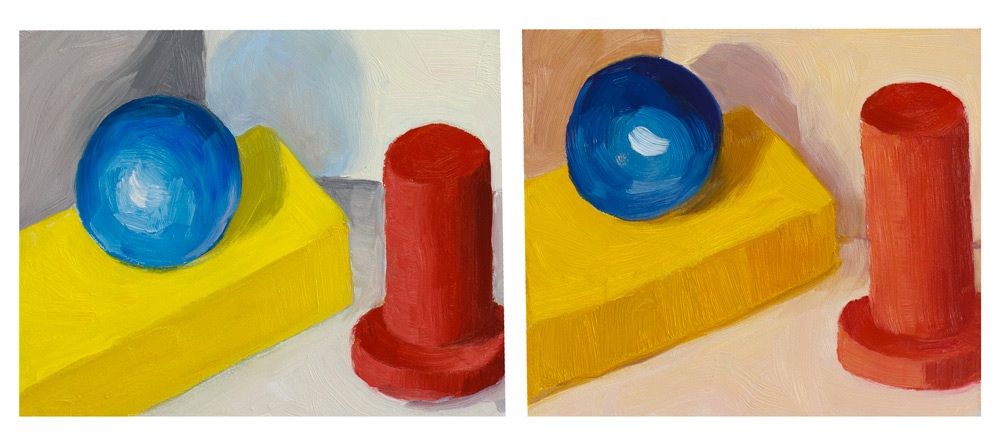
Cool light on the left; warm light on the right; same objects with white background; oils

When painting outdoors, lighting is controlled by the sun, clouds, atmosphere, and time of day. But in the studio you get to choose your lighting source from window light to bulbs of all kinds. In an article about color in the March 2011 Artists Magazine, Scott Burdick suggests an experiment to compare the effect of cool and warm light sources: Set up a still life of primary-colored objects and paint it twice; once under a warm light and again under cool light. That’s what I did in the studies above.

While I’m not sure I captured every nuance (or get the drawing just right), it’s interesting to see how different the same-colored objects and white background cloth look under different “temperatures” of light.

Warm Light. Left: Stroke counting; Right: One-colored shadow

I did these two studies in Peggi Kroll-Roberts‘ studio, with the subjects lit by 150 watt incandescent bulbs which have an even warmer color temperature than the bulbs I used in my two top studies. The actual goal of the study on the left was to paint the scene (cantaloupe and watermelon slices) with as few brush strokes as possible. The assignment for the one on the right was to group and paint the shadows with one color only.

Lighting technical stuff:

Categories
Art theory Oil Painting Painting Still Life

Limited Palettes 2-Color Studies

Clockwise from top left; all also include white: Cadmium Lemon Yellow + Sevre Blue; Cad. Yellow + Viridian; Cad. Yellow Pale + Permanent Rose; Ultramarine + Perm. Aliz., oil on 12x12" panel

Following in the footsteps of Kathryn Law’s 36 (!) color studies inspired by the Peggi Kroll-Roberts Limited Palettes video, I returned to doing more of my own. As Kathryn explains on her post, it’s all about learning what your colors can do.

The four at top I did yesterday, after switching back to regular oils (mostly Winsor & Newton). Below are some that I did previously using Holbein Aqua Duos water-soluble oils that I fell out of love with.

Dioxazine Violet & Quinacridone Red
Dioxazine Violet & Quinacridone Red; warm light, cool shadows

Dioxazine Violet & Cad Yellow Deep, V.1

Dioxazine Violet & Cad Yellow Deep, V.2

Ultramarine Blue & Cadmium Orange; cool light, warm shadows

Phthalo Green and Cad Lemon Yellow; warm lights, cool shadows

This is a really fun exercise. The idea is to discover about all the variations of value and hue that you can make with just two colors (plus white) and to experiment with using both cool and warm colors for the light or the shadows. It can be done with any medium (with watercolor you’d use two colors and vary the amounts of water instead of adding white).

Doing exercises like this is also a great way to have fun with paint when time is short or if there’s a big scary painting that you’re not quite ready to begin.

Categories
Landscape Oil Painting Outdoors/Landscape Painting Places Virtual Paint-Out

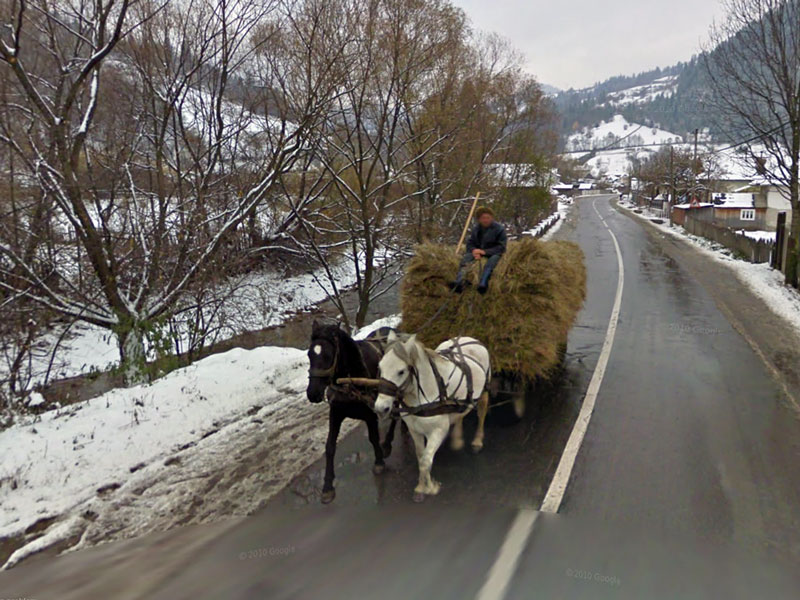
Romanian Winter Hayride (Virtual Paintout)

Romanian Winter Hayride, oil painting on panel, 9x12"
Romanian Winter Hayride, oil painting on panel, 9×12″ (SOLD)

After rambling around Romania, seeing beautiful summery farmland, busy cities, and a shepherd walking his sheep down a village street, suddenly it was Christmas with nativity scenes in front yards and this wonderful snowy hayride (virtually, of course via Google Streetview for the Virtual Paintout).

Romanian Winter Hayride Reference Photo
Bicaz-Chei, Romania: Winter Hayride Reference Photo

Yesterday I’d tried painting a different Romania scene (below) but soon realized I was laboring joylessly on a hopeless painting, fighting paint the consistency of toothpaste. I gave up, scraped off the panel (glad I’ve gotten smarter about when to cut my losses), and returned to Google’s wonderful new MapCrunch.com where I found the above photo.

Categories
Art theory Oil Painting Other Art Blogs I Read Painting Still Life

My Super Bowl (of apples) Sunday

Super Bowl of Apples, oil on panel, 8x8"

I don’t really “get” football although I have fond memories of men (my father and others) gleefully yelling at televised games. I didn’t want to feel left out of the Super Bowl Sunday festivities so I celebrated in my own way: painting a Super Bowl of apples.

I love this old “Metlock California Pottery” bowl which I think might have been my grandmother’s. I use it for my big lunch salads nearly every day. It’s also a great popcorn bowl.

Plane Divisions chart, from Hensche Colour Study pdf
Plane Divisions chart, from Hensche Colour Study pdf*

At last weekend’s workshop with Peggi Kroll-Roberts, one important bit of guidance she gave me was that “every plane has a color change and/or value change” and she diagrammed for me how to visual the planes of the cylindrical object I was painting (an old teapot), similar to Fig. C above. She encouraged me to see and paint those changes in value and color and I tried to do that with the apples.

I learned so much at the workshop and hope to return to her next session in March. It was also great finally meeting my friend Kathryn Law in person (she attended the workshop too). Kathryn has already posted her terrific workshop paintings with commentary on her blog. You can see her Workshop Day One here and Day Two here.

*The diagram above was from a  source completely unrelated to Peggi Kroll-Roberts. I extracted it from the lengthy .pdf file “Colour Study,” downloadable from the website, Oil Painting Thoughts and Ideas about Henry Hensche’s approach to color study.

Categories
Art theory Oil Painting Painting Still Life

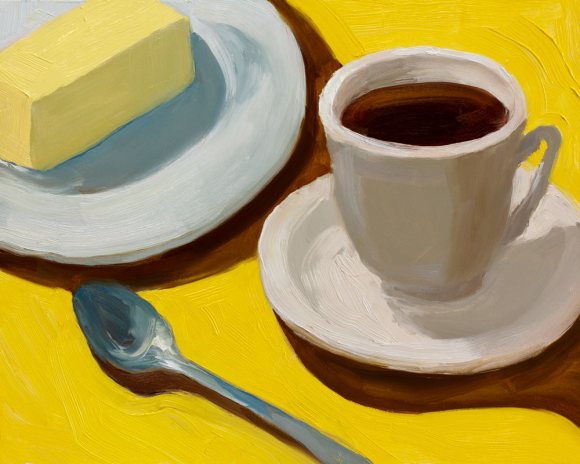
Tea and Butter, Surface Quality Study #2

Tea and Butter, Surface Quality Study #2, oil painting on panel, 8x10"
Tea and Butter, Surface Quality Study #2, oil painting on panel, 8×10″

This is my second study based on Peggi Kroll Robert’s “Surface Quality” video. In order to paint along with her in the video, I tried to use the same elements: a yellow table (or cloth in my case), a cup of tea, a spoon and a cube of butter on a plate. (This time I made sure the cat couldn’t get to the butter!)

I learn so much from Peggi’s videos, whether I’m watching her paint or just listening. Each time I play one of the DVDs I hear or see or understand something I missed the first time. I’m so excited I get to paint with her in person at her studio in Angels Camp, CA.

I’m also excited that I’m going to spend the weekend workshop with fellow artist-blogger Kathryn Law, whose friendship and support over the past couple of years I treasure but whom I will be meeting in person for the first time.  Kathryn has also been working with Peggi’s videos and you can see her “Surface Quality” study here.

Categories
Art theory Oil Painting Painting Still Life

Tea and Lemon, Surface Quality Study #1

Tea and Lemon, Surface Quality Study #1, oil painting on panel 8x10"

This painting is a study based on the exercise in Peggi Kroll-Roberts “Surface Quality” video. I watched the video, then turned it off and painted from my still life set up, trying to incorporate the lesson: paint the darks with thin paint (so that they recede, don’t reflect light that hits lumpy edges, and don’t draw attention to themselves) and paint the light areas with rich, thick paint (and of course mix the correct colors and values).

When Peggi demonstrated this exercise she used a cube of butter (in her still life, not to paint with! though her paint is very buttery). I had to replace the butter with the yellow lemon because while I brewed the tea in the other room, my cat had a little feast, licking my only cube of butter into a misshapen mess.

There are some passages in this painting I like very much, such as the lemon, its leaves and blossom, the tea, and the way the tin in back is kept all in shadow.

I did buy another cube of butter to try the exercise again, and that will post tomorrow while I’m off at Peggi’s workshop.

Categories
Art theory Oil Painting Outdoors/Landscape Painting People Photos Places

Sit Stay Cafe Girl Sketch in Oils

Sit Stay Cafe Girl, oil on panel, 10x8"

When I painted this oil sketch I had three inspirations: First was the Peggi Kroll Roberts video focusing on designing value patterns by simplifying and grouping values, even when the colors are different (e.g. the red umbrella and green trees above are very different colors but approximately the same values).

Curan: Afternoon in the Cluny Garden
Curran: Afternoon in the Cluny Garden

My second inspiration was the Curran painting above that I saw at the Impressionists show at the DeYoung Museum. I fell in love with this painting because of the colors, strong values and abstract qualities and brought home a print. Charles Courtney Curran was an American artist who studied with the Impressionists in Paris in the 1880s and then returned to the U.S. His other work I’ve seen online doesn’t appeal to me at all, too sugary and romantic.

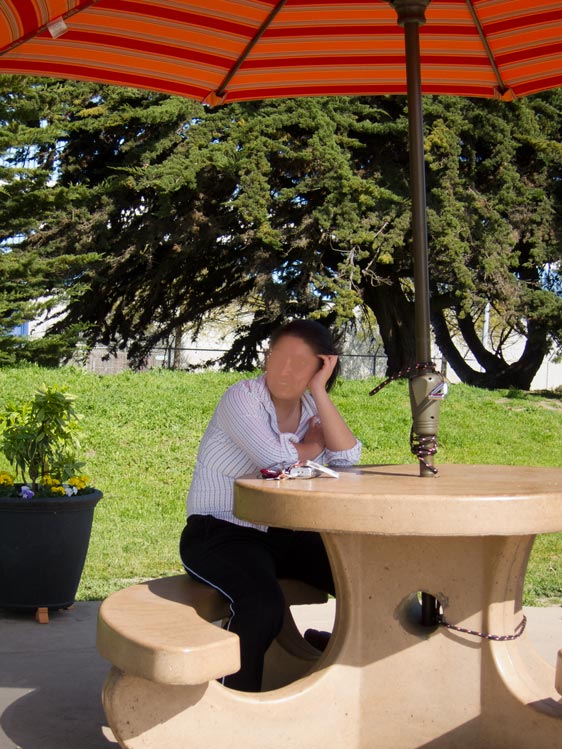
Original photo reference with face blurred for anonymity

I was also inspired by my reference photo (above) that I took at the Sit Stay Cafe at Pt. Isabel’s dog park where I was lunching, sketching and taking photos to test a new camera last summer.

The tired young woman was very kind about allowing me to sketch and take photos of her. She told me she also liked to paint. Since I didn’t ask for permission to post her picture online I blurred her face in Photoshop first.

Categories
Landscape Oil Painting Outdoors/Landscape Painting Photos Places Plein Air Sonoma

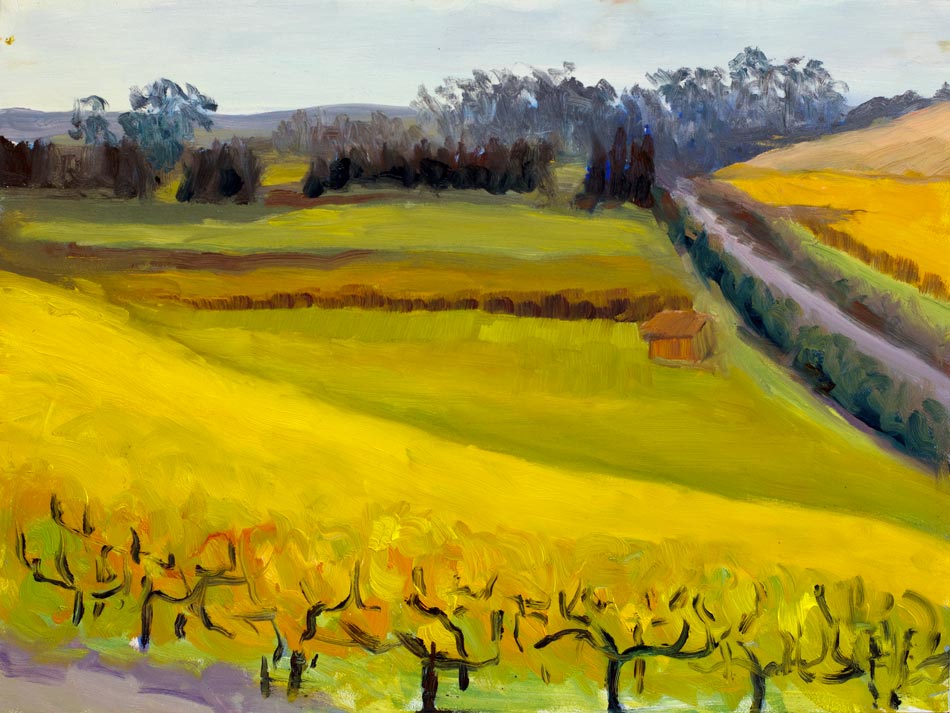
Viansa Vineyard: Final Touches on Final Plein Air 2010

Viansa Vineyard, 11/2010-1/2011, Oil painting, 9x12"
Foggy Morning at Viansa Vineyard, 11/2010-1/2011, Oil painting, 9x12"

My plein air group had our last meeting of the season in November at Viansa Winery in Sonoma. I’d made a good start on the painting plein air, but it needed work. Today I got tired of looking at the unfinished painting and completed it (above), using both brushes and palette knife.

I’d set up my easel at the edge of the parking lot and had a great view of the vineyard. But there were so many interesting things to see that I included all of them in my original painting below (except maybe the cars and the birds and bees—that’s some progress I suppose).

Viansa Vineyard, unfinished plein air

There are some passages in the painting I liked, especially the top fourth, but there were some problems too: the strong yellow diagonal line leading you out of the painting, the bright gold triangle top right, the green line of bushes beside the purple road, both of which weren’t needed even though they were there in real life.

Viansa photo reference

This is the photo I took at the beginning of the painting session. The sun and fog and clouds kept changing but the overall impression I had of the day was sunny.

A previous Viansa painting can be seen here. It’s nice to see the progress I’ve made since then.


Categories
Art theory Oil Painting Painting

Painting Value Studies with Peggi Kroll-Roberts DVDs

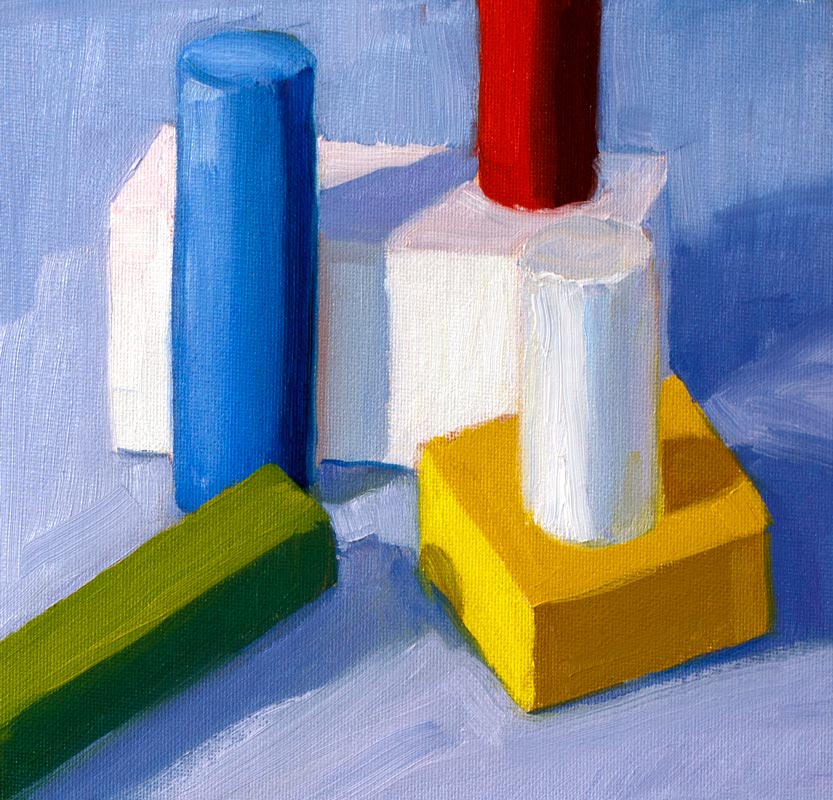
Block Study 5, from value to color
Block Study 5, from value to color, oil on canvas, 9x9"

After viewing and savoring my Peggi Kroll-Roberts DVDs, I’m doing the exercises she teaches in them, starting with value studies. To keep it simple and focus on values I used colored blocks for my subject. Above is the last study of the day in which I tried to apply to color what I’d learned by doing the gray-scale value studies below.

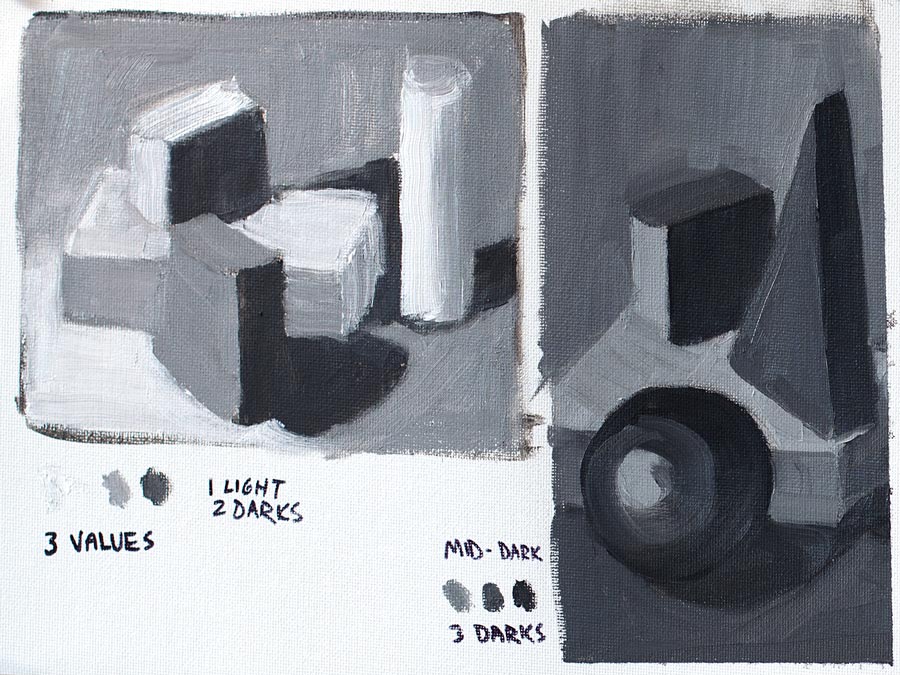
Value Study with blocks # 1
Value Study with blocks # 1, oil on canvas, 9x12"

One of the huge new (to me) things I learned from the Simple Value Plan DVD is that when you make a value plan for a painting, you can choose a range of values for the painting, such as making it high-key (mostly light) or  low-key (predominantly dark), rather than copying the values as you see them. Kroll-Roberts compares this to playing music in different keys.

She recommends making a value plan before starting a painting by simplifying and grouping shapes in the image into two or three values, with 1/3 light and  2/3 dark or vice versa for a more interesting design. In the study above on the right I used only mid to dark grays, for a low-key, predominantly dark study.

Value Study with blocks #2
Value Study with blocks #2, oil on canvas, 9x12"

Another tool she demonstrates is to first mix a value scale and put it at the bottom of your value plan study as I did above on the bottom right, and select your values from that scale. You can see the 3 blobs of paint at the bottom of most of these studies that indicate the values I intended to use.

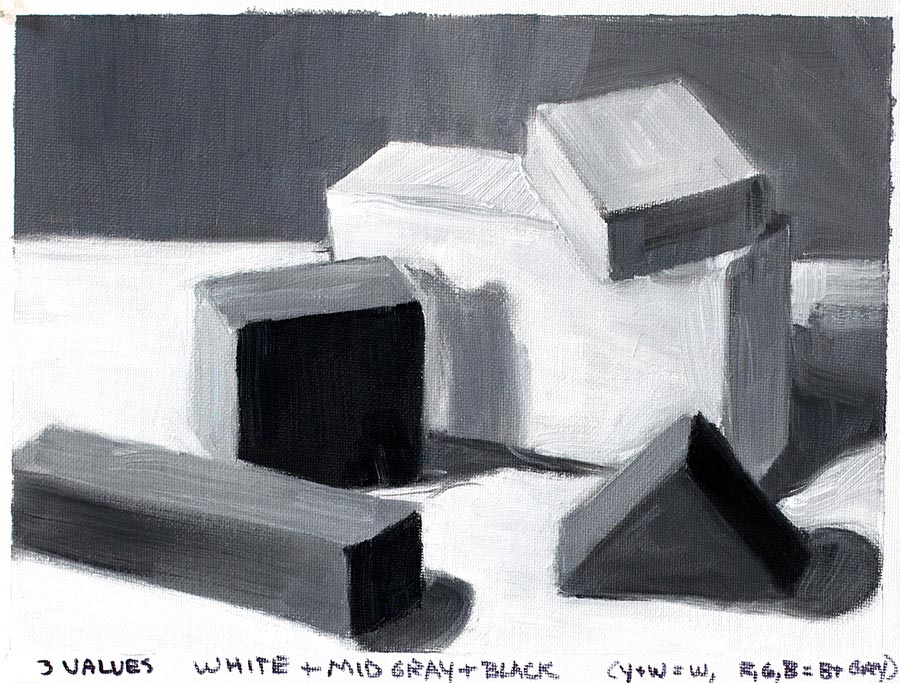
Value study with blocks #3
Value study with blocks #3, oil on canvas, 9x12"

Above I wanted the study to use the full value scale, black, white and mid-gray. I noted the colors of the blocks and how I was interpreting their values (yellow and white blocks and beige table top = white/gray; red, green and blue = gray/black,  depending on if they were in light or shadow). I did some more adjusting of value once I had it blocked in so there are more than 3 values.

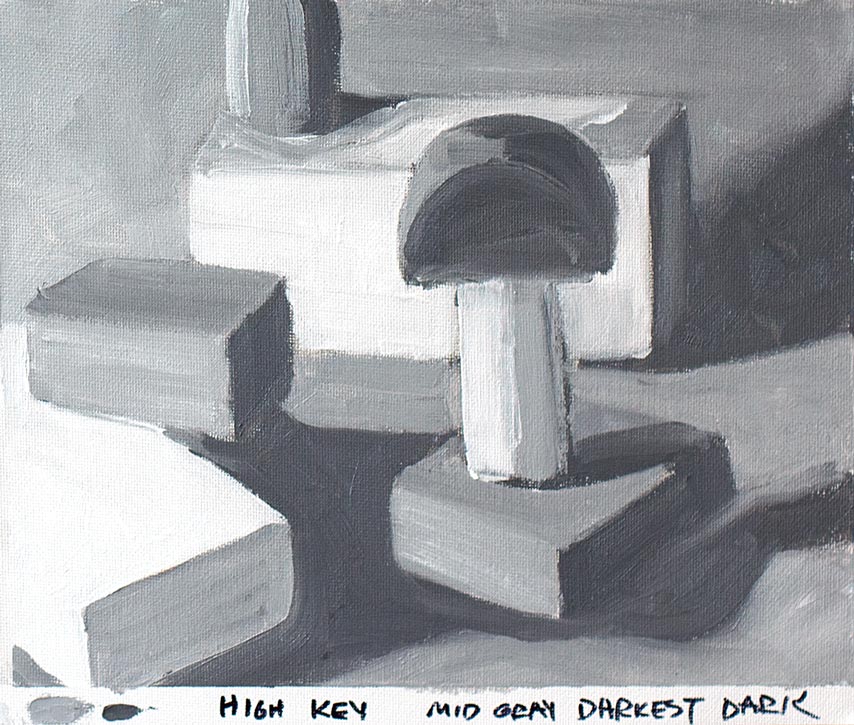
Value Study with blocks #4 - High Key
Value Study with blocks #4 - High Key, oil on canvas, 9x12"

On Peggi’s DVD High Key Value, she demonstrates creating a high key (mostly light values) painting by simply selecting the values that are mostly very light. I tried doing that with this study, and I think it works, but could have used an even lighter “darkest dark.”

Categories
Lighting Oil Painting Painting Still Life Studio

Pomegranate Pom-apalooza

Pomegranate Revealed, oil on board, 9x12"

Happy New Year! Thanks for hanging out with me this past year! Even though I’ve had a nasty cold all week I managed to get in some pomegranate painting between nose blowing, naps, and chicken soup breaks, but not nearly as much as I’d hoped to do over my year-end vacation.

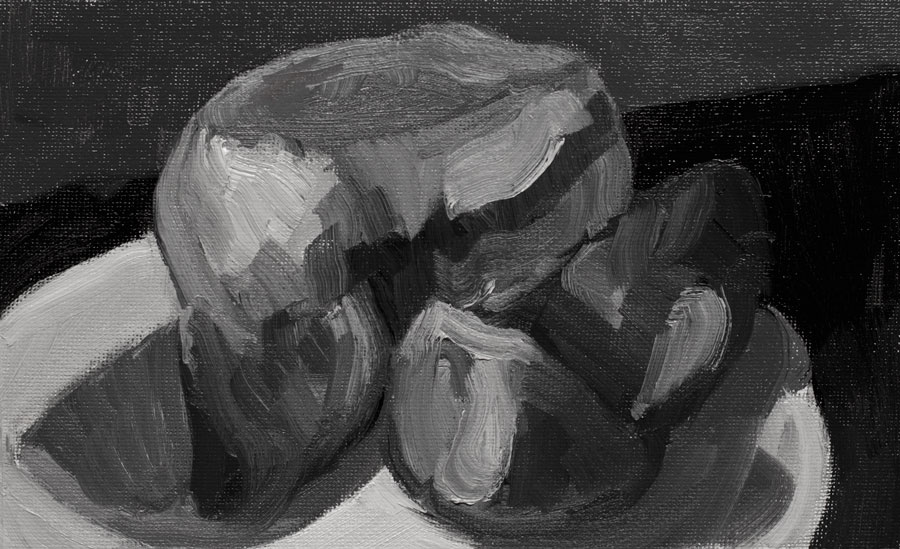
Pomegranate value study in oils
Pomegranate value study in oils, 8x5"

I only had enough energy to be in the studio for a couple of hours a day but fortunately the pom waited nicely for me. I started by doing a value study in oils (above), trying to sort out where the darkest darks and lightest lights are and just how dark and light they are.

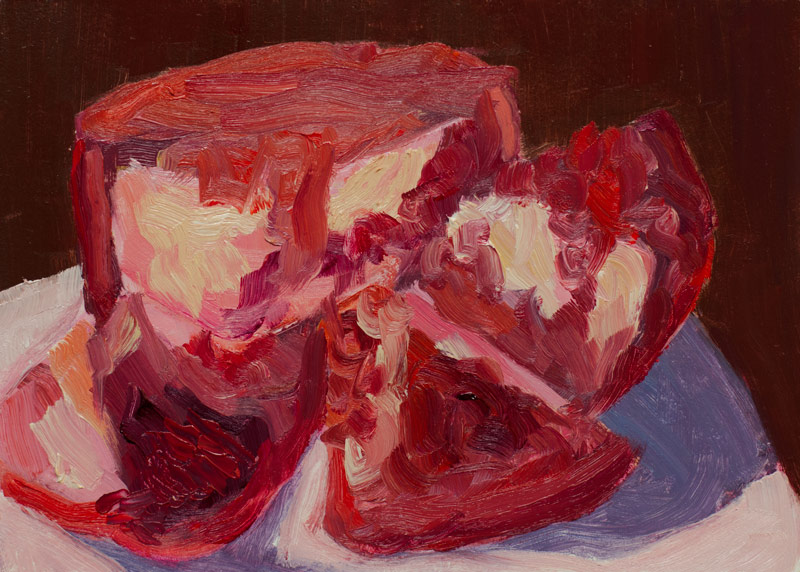
Pomegranate quick study, oil on board, 5x7"

I did a small study next since I knew I didn’t have more than an hour or so of painting energy. I had fun with this and feel like I’m starting to find a way to get loose and sketchy with oils.

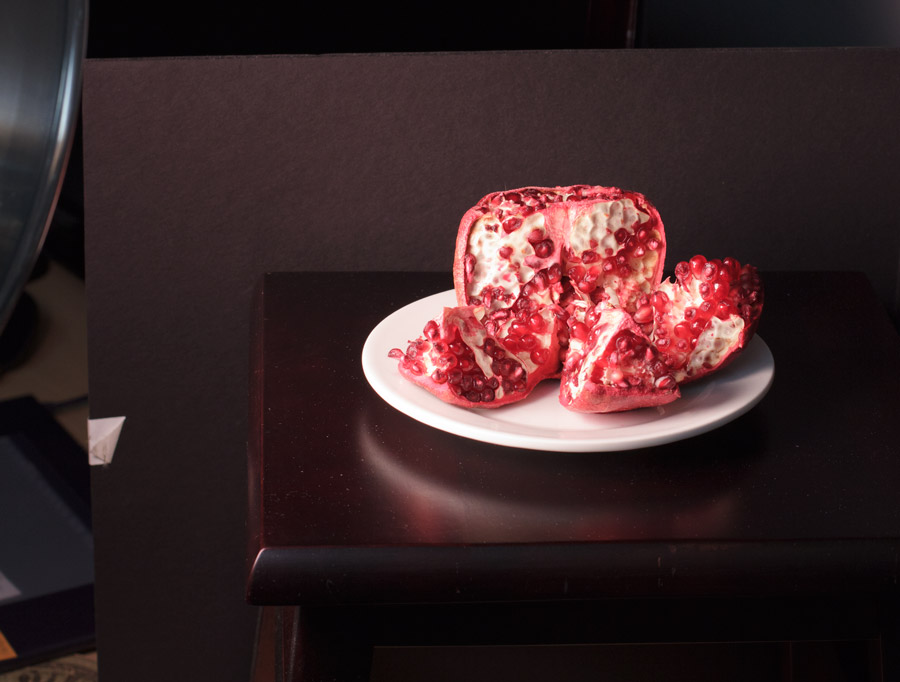
Pom photo under Reveal bulb
Pom under Reveal bulb

I used a GE Reveal light bulb in my lamp which gave everything a pinkish-lavender cast and that’s why I named the painting “Pomegranate Revealed.” GE says they are “specially made to filter out the dull yellow rays produced by standard incandescent bulbs.” I’d bought it originally thinking it would simulate daylight but it doesn’t at all. I usually use a fluorescent 5000K bulb 40 watt bulb (equal to 150 watts) which does a better job of producing clean light.

Pomegranate Revealed - Cropped to 8x10"
Cropped in Photoshop to 8x10"

When I compared the final painting and the studies I realized I liked the original composition with less background better so I experimented with cropping the painting in Photoshop. It’s not hard to cut the board down if I decide to crop it for real.

What do you think? Do you like this cropped version or the “final” version at the top of the post better?