Categories
Art supplies Bookbinding

Journal Binding How-To Sheet & My Shrinking Sketch Kit

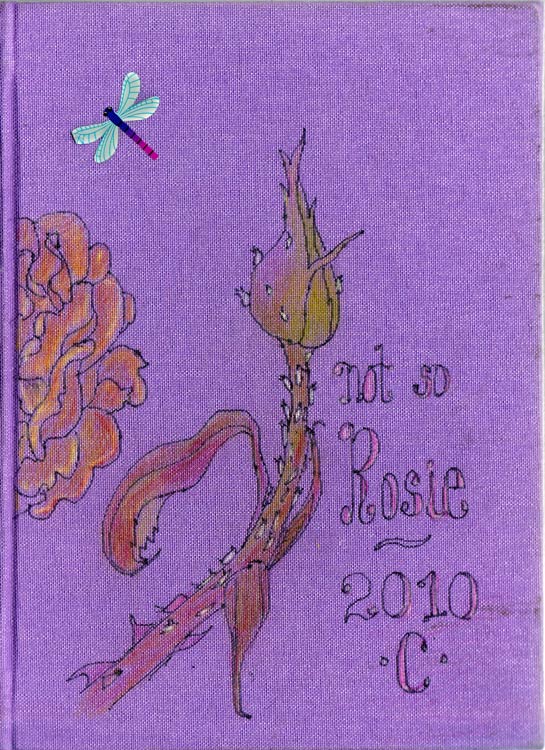
Not So Rosie Journal Cover

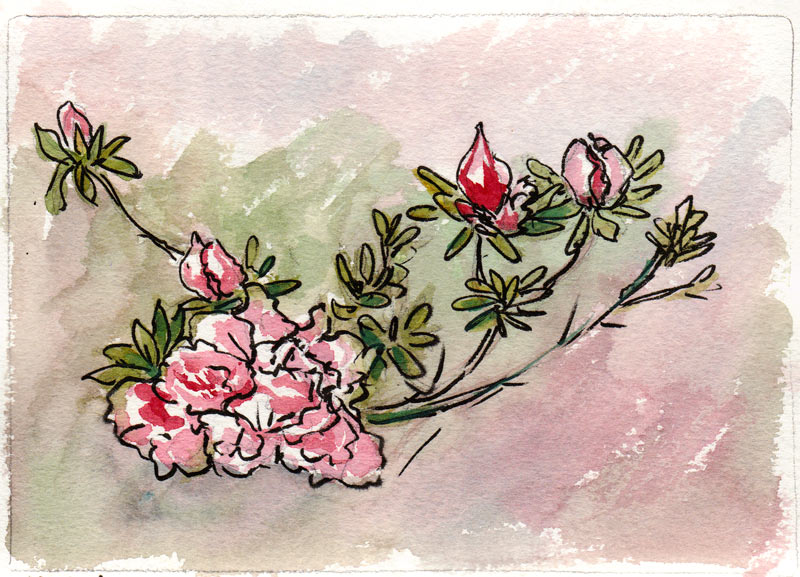
This is the cover of the journal I’ve just filled. I name my journals and I’d planned on calling this one “Rosie” because I started it at the same time my roses started blooming like mad in June. But given the struggles I’ve gone through, written about, and resolved in this journal, I named it “Not So Rosie” instead.

If you wonder what those weird white bumps are on the rose bud, when I put the tiny rose bud under my magnifying lamp to draw it I discovered it was covered with aphids. Yick! I enjoyed drawing it anyway until I noticed an aphid jumping ship and landing on my drawing table. I declared the artwork and the journal done, dumped the roses and spent a little time admiring my newly bound journal (below), its blank pages full of promise.

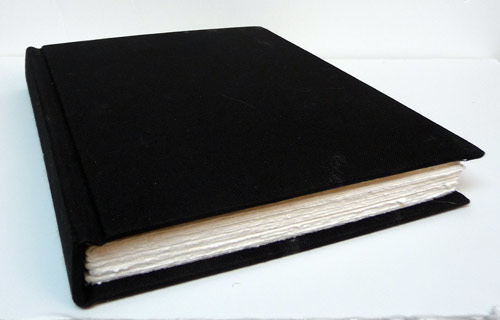
This is the fourth case-bound sewn-signature journal I’ve bound. With each one I’ve made fewer mistakes and learned more. I’ve continued to update my illustrated instruction sheet I wrote for myself, simplifying and correcting it. So many people have helped me that I wanted to share what I’ve learned in case it might help someone else. If you’d like a copy, it’s available to download on my website’s “Comments & Resources page.

Meanwhile, my sketch kit has been shrinking. A friend brought back a tiny, $13 watercolor travel palette from a recent journey to Minnesota that included a stop at famous Wet Paint. I had to call them and order one for myself.
Mini-Sketch Kit
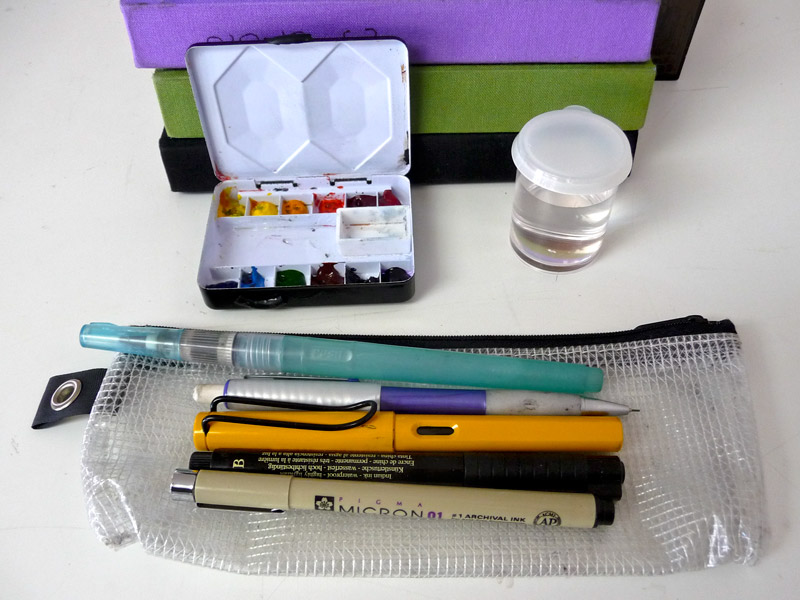
Mini-Palette and Sketch Kit

The palette is 2 1/2″ x 3 1/2″ and has a ring on the bottom for easy holding. I found it a little hard to open and so super-glued 2 little wedge-shaped pieces of a rubber washer on the front edge of the lid and base which gives me a better grip to snap it open. Another customization suggested by Cathy was gluing an empty watercolor pan inside for holding water (sticking up on the right side).

My favorite pens are (from the front) a Micron Pigma, a Lamy Safari fountain pen filled from a jar of Platinum Carbon ink (waterproof and safe for fountain pens), a Pitt Artist Brush Pen, a Papermate Titanium .07 pencil with F lead, and a Niji Waterbrush. All of this fits nicely in a little zipper pencil case, including the palette.
Journal and sketch kit ready to go
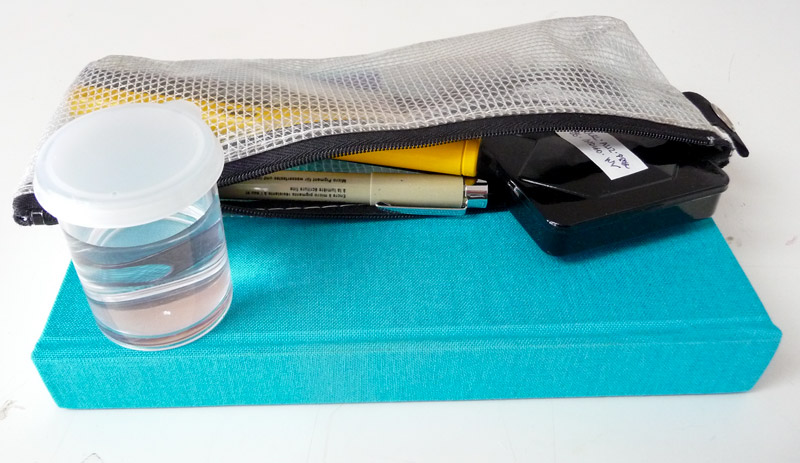
Newly Bound Journal and sketch kit ready to go

This little water container is surprisingly spill proof, and about the size and shape of a film canister. I can actually do just fine with the water in my water brush and/or the bottle of drinking water I carry around. The tape on top of the palette is a list of the pigments I’ve filled it this time.
Categories
Animals Bookbinding Colored pencil art Drawing International Fake Journal Month Life in general People Sketchbook Pages

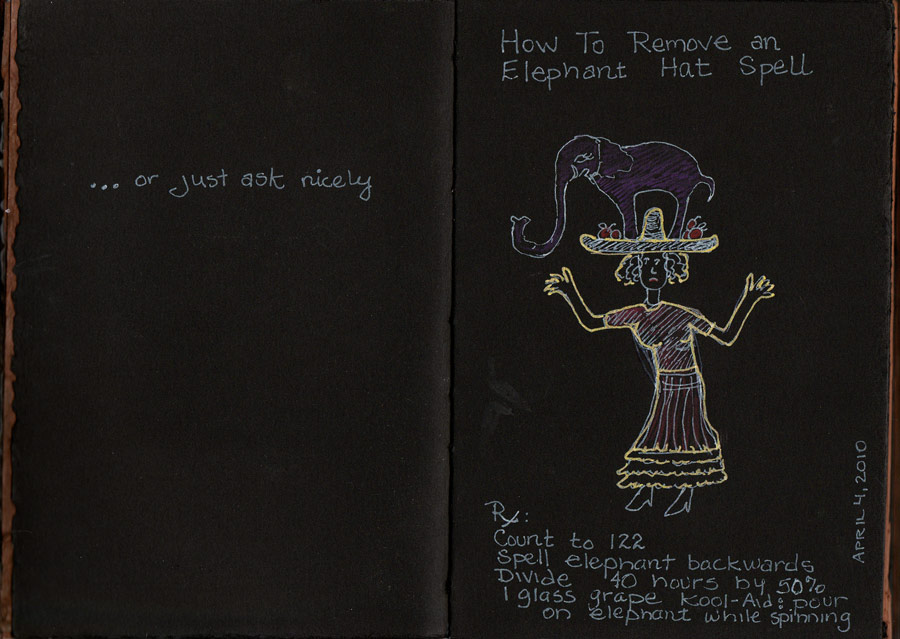
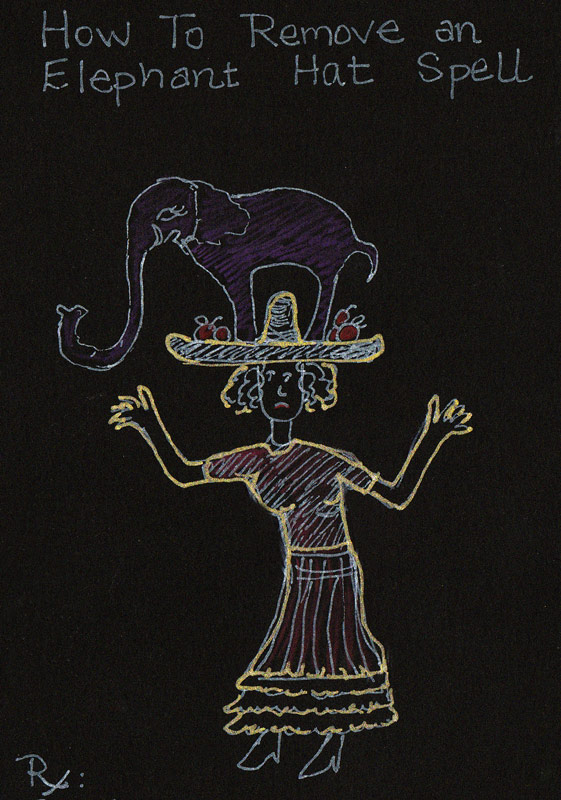
Janas (fake) Journal: How to Remove an Elephant Hat Spell

How to Remove an Elephant Hat Spell, Gel pen & colored pencil on black Canson drawing paper
How to Remove an Elephant Hat Spell, gel pens & colored pencils

For International Fake Journal Month 2010 I bound a journal with dark papers which, as you can see by the title below, is being filled with useful spells and unspells. I say that in passive voice because it is an alternate Jana who is filling it, one with great wisdom and special skills.

Janas (FAKE) Journal 2010, Book of Spells & Unspells
Janas(Fake)Journal, Book of Spells & Unspells

The papers I used to cover the book board is made of some kind of bark I think. It was in the special paper drawer at Dick Blick. Here is the full spread of the Elephant Hat spell page:

Elephant Hat Spell, full spread

In case you’re wondering when one might need such a spell, it recently came in handy for me. At my day job I was used to changing hats constantly, putting on the desktop publishing hat, then the  finance hat, swapping that with the web-work hat, then the customer relations hat, database, marketing, etc.  Such is life in a small non-profit during difficult financial times.

But then the hats got sticky and I couldn’t get them off; I was wearing all the hats all the time. And one morning I noticed that one of the hats had a huge, heavy elephant on it. I was sinking fast. I needed help. I tried the Elephant Hat Removal Spell. Then I asked nicely.

I got the help I needed:  Half of those hats have been handed off and my schedule has been reduced to half time. The elephant disappeared and the hats are now a comfortable fit—when worn one at a time.

Categories
Animals Art supplies Book review Bookbinding Drawing Ink and watercolor wash Life in general Painting Sketchbook Pages

A Frog and a Journal Named Froggie

Frog, ink and watercolor

I was listening to Ruth Reichl‘s book “Not Becoming My Mother and Other Things She Taught Me Along the Way” while I sketched on a rainy Sunday, feeling a bit mopey. That book was the perfect antidote to mopeyness.

After her mother’s death, Reichl finds her mother’s journals and discovers the story of  how her quirky mother tried to make sure her daughter wouldn’t suffer the unfulfilled life she’d had, restricted by the roles available to women of her generation.

The book is full of humor, love and amazing stories. I’m grateful that my public library has great audio books available to download for free. It ends with this great quote:

…and the most important thing I learned is that you are the only one who can make yourself happy. It is never too late to find out how to do it.” ~Ruth Reichl

I drew the frog above (from a photo on my monitor) to practice before I drew the frog on the cover of my journal (below) which I’ve named Froggie:

Froggie Journal, india ink on book cloth
Froggie Journal, India & gold gel ink

The Legion Multimedia Aquarelle paper the book is bound with is holding up even better than I expected. It’s nice and smooth for writing and drawing with ink from various pens, and accepts watercolor beautifully and even allows for lifting off and repainting and other kinds of abuse.

I love spending time with my journal which is like a dear friend, a place to come for solace when I need to write and sort things out, a library for recording visual and emotional discoveries, ideas, thoughts, and experiments.

Categories
Art supplies Bookbinding

New Journals Bound, New Problems/Questions

Newly Bound Journals

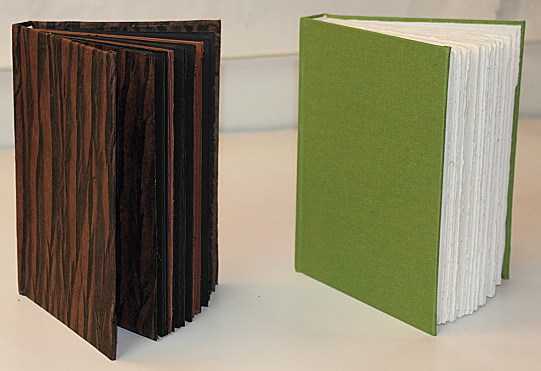
On the left is the new journal I bound for International Fake Journal Month and on the right is my next all purpose journal that I bound with Legion Multimedia 140 pound watercolor paper.

Since it had been a few months since my epic journal binding learning experience, I had to replay many of the videos and look at my notes to figure things out. And I made a bunch of new mistakes to learn from.

I have one big, confusing question. (UPDATE: See Comments for answer from Roz and note from Shirley) When I punched sewing holes I followed Roz’s video, along with Shirley’s tip to use a phone book to support the signatures. I punched four holes just like Roz did in her video demo, instead of the five I punched last time. But when it was time to sew the signatures together I couldn’t figure out how an even number of holes could work. When you have an odd number of holes and you start on the outside of the folded signature you always end up on the outside at the end of each row so you can attach each signature to the next. But with four, if you start on the outside you end on the inside. I’m guessing Roz was preparing a different sort of book.

Fortunately I had torn down extra sheets, thinking I’d bind two journals but I put aside the set I’d punched with four holes and punched five holes in the second set. Either I’ll find out how to bind with four holes or I’ll go back and make one more hole in each signature before binding them.

I also used Shirley’s tip to glue up the binding board and then place it down on the book cloth instead of putting glue all over the cloth and that was sooo much easier.

Some new mistakes I’ve learned from this time:

  • MEASURE TWICE, CUT ONCE! (or in my case measure 3 times just to be sure).
  • After gluing down the board pieces to the book cloth, I should have burnished them with the bone folder to ensure a consistently strong bond (a few small wrinkles showed up in the cover where it didn’t bond 100%).
  • Don’t make the book so thick; use fewer signatures so it is lighter and less tiring to hold when sketching standing up.
  • When you use “self-endpapers” that doesn’t mean adding yet another folded sheet, making the book even thicker. It means just gluing the book block directly to the covers (I think–correct me if I’m wrong). I had picked an ancient map print to use as end papers in the green journal but decided I didn’t like it at the last minute. I liked Shirley’s idea of just using colored drawing paper instead.
  • Make the  sewing thread long enough so you don’t have to join it in the middle (thus having to once again struggle with knot-tying from diagrams that are totally confusing).
  • Don’t use white thread and white headband ribbons on black books.

Now I’m coming to the end of my journal bound with 90 lb Arches cold press paper. I will be sad to put “The Mutt” as I named it, on the shelf, as it has become a trusted friend and companion. And I really came to enjoy the paper, once I started using my Lamy Safari fountain pen to draw with.

Soon I’ll be getting to know a new journal, with new paper and new possibilities. I think I shall name it Froggie, given its green color, warts, and all. Someday maybe I’ll make a journal that is elegant and give it a posh name but for now, mutts and toads R Us.

Mechanical FrogAnd I’ll write more about the black/brown journal in April when I start using it for International Fake Journal Month.

Categories
Bookbinding Drawing Flower Art Ink and watercolor wash Life in general Sketchbook Pages

Having a Weird Day, Broken Things

Broken faucet filter, ink & watercolor
Broken Pur faucet filter, ink & watercolor

I went to my dance class early this morning but burglars had broken into the studio in the wee hours and stolen the sound equipment and the computer. The teacher tried to switch to a Stretch/Strengthen class since it’s hard to dance without music but the police told us we had to leave.

So I came home to work, determined to get in a lunch-time walk in the sun (it’s spring at last!). But there was more weirdness. In between web-based staff meetings and conference calls I finalized a fancy email newsletter for the organization and sent it out to 2,000 people. Half an hour later I learned that an important link in the newsletter was broken. I learned more than I ever wanted to know about sub-domains and URLs, fixed the link, and sent it out again. So far no complaints. But no walk, either.

Yesterday was weird too. I was determined to finish binding two new journals that I’d started on Sunday, one for general use and one for next month’s International Fake Journal Month. While it wasn’t as hard as the first binding experience, I broke the “measure twice, cut once” rule (measuring only once and so having to cut twice, wasting good binder board and end papers), and ran into a couple of other problems.

Meanwhile outside the sun was shining, the best weather in months, and I was sad that I was spending it indoors. Finally I finished the journal binding and went outside. This little plant (don’t know what it is; got it as a gift for my birthday last year and stuck it in the garden) was flowering and looked happy so I sat on the sidewalk in front of my house and quickly sketched and painted a bit of it as the sun went down.

Front yard flowers, ink & watercolor

The water filter at the top of the post is another broken thing. It used to live on the faucet in the studio sink but it snapped off one day and I couldn’t put it back on. Procter and Gamble (who make PUR filters) sent me a bunch of adapters but none would stay on the threads of the spout. I called my local hardware store and they told me that I was probably out of luck.

They said if I tried to just replace the spout it was likely that other parts would get broken in the process. And since modern faucets mount on the sink, not in tile on the wall like mine, I would probably have to rip out the wall, and the old sink, and replumb the faucet, and buy a new faucet. And then I would be broke. So I’ll just continue carrying in fresh water from the filter in the kitchen, 40 feet away.

Categories
Art supplies Bookbinding Drawing Ink and watercolor wash Painting Sketchbook Pages

Testing Paper for Journal Bookbinding + Junk Drawer Still Lifes

Junk Drawer #1, Legion Multi-Media Paper, ink & watercolor
Legion Multi-Media Paper, ink & watercolor

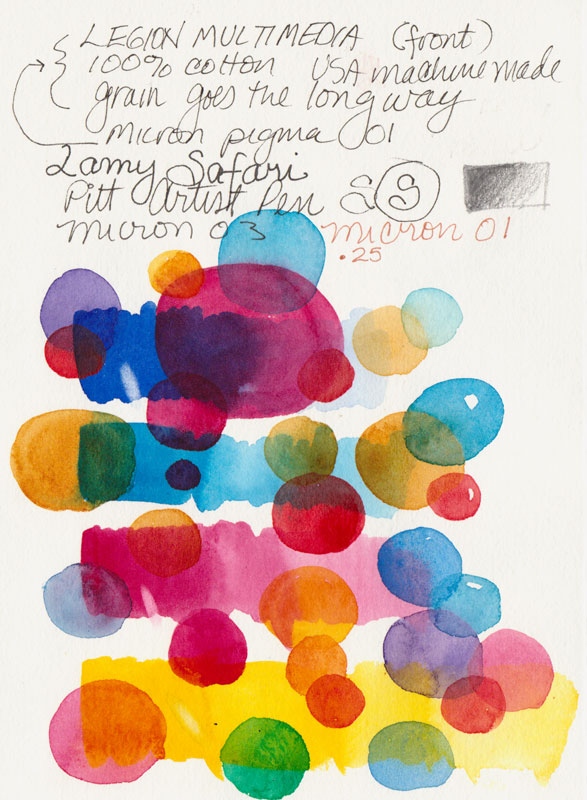
I used random items from my junk drawer as still-life subjects to test paper for binding my next journal.  The paper I’ve chosen is Legion Multimedia Aquarelle 300 gsm (a little thinner than 140 lb). An employee at my local Artists & Craftsman store suggested it when I was unsuccessfully seeking the Fabriano Soft Press 140 lb recommended by Shirley of Paper and Threads.

Legion Test #2
Legion Test #2

Legion Multimedia/Aquarelle

I was delighted to find that the texture of the Multimedia/Aquarelle  paper is perfect for writing on with the finest of pen points (unlike my current journal’s Arches CP paper). It took watercolor washes and multiple layers of glazes beautifully without buckling, pooling, or pilling. Color lifted off easily when rubbed with a damp brush.

The paper is nicely sized to prevent the paper from soaking up the paint, but not so extremely sized as the Arches 90 pound cold press that practically resists the ink.

It has two deckle edges and is relatively inexpensive. The Legion Multimedia/Aquarelle paper cost $2.69 a sheet at my Blick store while the Fabriano Soft Press 140 lb paper was $4.99 a sheet. Unlike the Fabriano, this paper is also available in 90 lb weight which I will try next, but I think that will have to be a special order through Artists & Craftsman since Blick only carries the 300 gsm paper.

Dick Blick’s website says about the Legion Multimedia paper:

“Use any painting and drawing media you choose on this fine quality, crisp white paper! Multimedia/Aquarelle Paper consists of 100% cotton fiber, is acid-free, and has a neutral pH. The paper is 140 lb (300 gsm) weight, and has an uneven textured surface. Available in two different surfaces — Cold Press and Rough. Cold Press is available in sheets and pads, Rough is available in sheets only, and comes in 200 lb (380 gsm) weight.”

I tested the paper for grain direction and it runs the long way, making it possible to tear it down for a journal just the size I like: 5.5″ x 7.5″, with no waste, which is not possible with the Fabriano whose grain runs the short way.

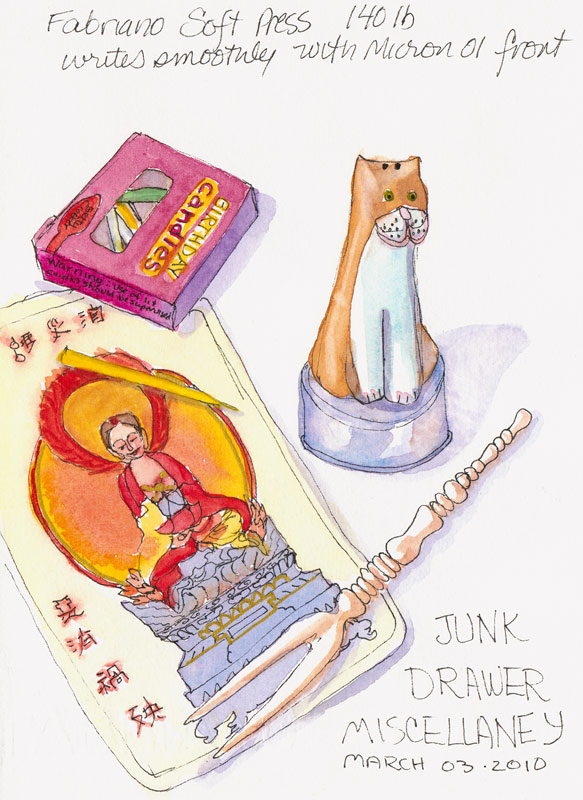
I finally was able to buy a sheet of Fabriano Soft Press (which has a similar surface texture, between hot press and cold press) and tested it too:

Fabriano Soft Press 140 lb: Test #1

Fabriano Soft Press

The Fabriano Soft Press paper had some things in its favor but ultimately the cons outweighed the pros in my mind. It seems like good sturdy paper, and the paint lifted OK without surface damage, but it was slightly less pleasant to write on with a fine-point pen, even though the surfaces of the two papers are very similar.

Since the grain runs the short way (which means the pages will need to fold the short way) you either end up wasting some of the paper or have fewer size options for the book. Also, the paper is thicker and stiffer, which means fewer sheets per book or a thicker, heavier book. And it is more expensive.

But what bothered me the most was the sizing. According to Blick:

“Fabriano papers are synthetically sized both internally and externally so that no animal by-products are used.”

In fact, Fabriano uses an acrylic sizing as opposed to the organic sizing (gelatin) that other companies use. I found that juicy washes on this paper took forever to dry and I assume it has to do with the non-porosity of acrylic sizing.

Fabriano Soft Press Test #2

Despite waiting and waiting and finally using a hair dryer before adding the next layer of glaze, the paint still wasn’t dry and glazes bled into each other.

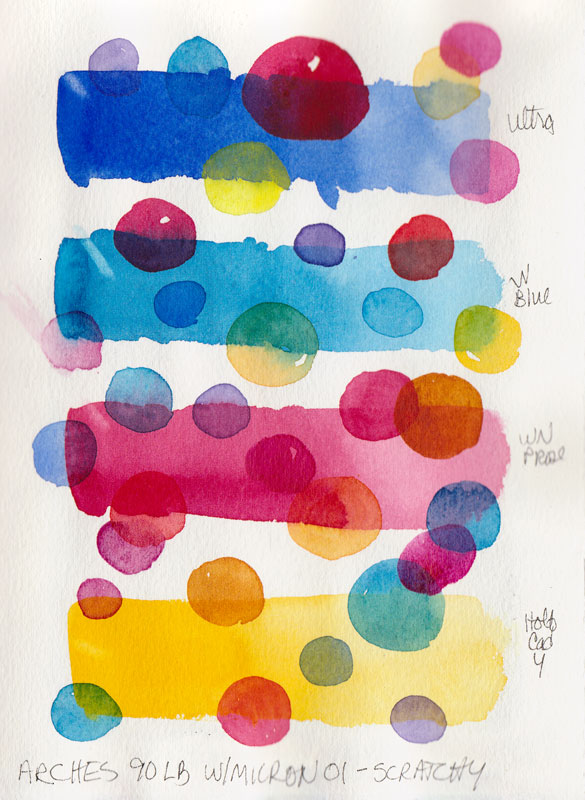
I also tested the Arches 90 lb Cold Press in my journal (below). Washes, glazing, lifting worked fine, but just isn’t pleasant to use with a fine point pen.

90 lb Arches Cold Press test

I’m looking forward to binding my new book and then giving the Legion Multimedia Aquarelle paper a true test of its journal-goodness and whether it really is the “perfect” watercolor journal bookbinding paper for me.

Categories
Art supplies Bookbinding Drawing Ink and watercolor wash Outdoors/Landscape Painting People Pinole Sketchbook Pages Subway drawings

Pinole and Pen, Paper, Ink Tests

Pretty Pinole from Peets, Ink and Watercolor

Warm sun, green hills, blossoming trees and a great Peet’s cappuccino to sip at an outdoor table while sketching was made even better by a pen that actually worked in my sketchbook. After struggling to find a pen that would not skip, scratch, smear, show through or bleed on the Arches 90 lb cold press paper I’d bound in my journal, I discovered that my Lamy Safari fountain pen was just right.

Pens

All of the pens I normally use were giving me problems. The Sakura Pigma Micron skipped, scratched over the textured paper when drawing, and was even worse for writing in the journal, whether I used my favorite .01 or a fatter-tipped .05.

Pitt Artist Pen and Sharpie tests

I tried using an Ultra-Fine Point Sharpie since it would at least produce a strong line (above). But I found that the ink flowed too quickly, bleeding and spreading if held in one spot and worse, showed through to the other side.  I also tried the Pitt Artist Brush Pen on this page, which worked OK but was a thicker line than I like for general sketching. The black ink in the finer-point Pitts seemed paler than the Microns, but it might also be that they resist the sizing on the paper more.

Testing Prismacolor .05 Pen

Prismacolor Illustration pens are similar to the Sakura Pigma Micron and Pitt Artist Pens and are very nice and comfortable to hold. But they too performed poorly on the Arches CP. In the sketch above I was trying to do a contour drawing of what I saw on the BART train but my lines were barely visible until I redrew them with a Sharpie.

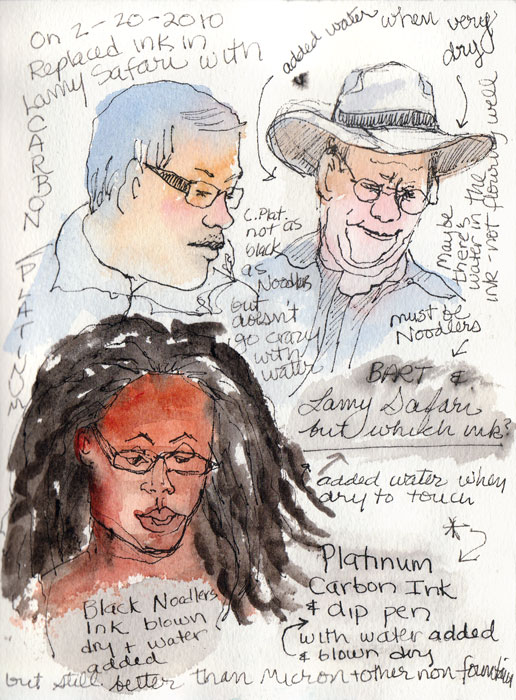
Testing Noodlers & Carbon Platinum Ink

Then I tested my Lamy Safari F-point fountain pen and was delighted to see that it was a pleasure to write and draw with on the Arches CP paper.

Ink

I’d last filled the Safari with Noodlers Black Bulletproof ink, which is supposed to be waterproof but actually bleeds a fair amount when a wash is applied after it’s dry. I used a dip pen to test Platinum Carbon Ink and it held up better, barely bleeding at all.

So I squirted out the remaining Noodlers in my Lamy and refilled it with the Carbon Platinum ink. I’ve been a happy sketcher ever since. The ink is a rich black, doesn’t bleed, is great to write with on this bumpy paper, and is comfy to hold. Yay!

Paper

Now that I’m halfway through my journal it’s time to prepare for binding the next one. I’ve been testing papers and I think I’ve found the one. When I finish my tests I’ll post them. I have a feeling I might have found the perfect paper for ink and watercolor journaling.

Categories
Art supplies Bookbinding

Bookbinding a Watercolor Sketchbook Journal: Learning from My Mistakes

The Mutt: My first casebound sketchbook

The most important thing I learned in binding my first hardbound sketchbook journal is that the process is very forgiving and not rocket science. In fact, despite making every possible mistake along the way, it still turned out as a quite usable little mutt of a book.

Inside the Mutt
Inside the Mutt

I took notes as I worked: reminders what NOT to do next time, which parts to skip, what really matters and what doesn’t. And now, using the medical school approach for teaching surgery (“See one, do one, teach one”) I’ll share what I’ve learned. Fortunately this isn’t brain surgery, since I’ve literally only seen one and done one.

UPDATE: I have refined the process described below; the most up-to-date version is always available as a download on the Resources page here. You may also find my more recent bookbinding posts by selecting “Bookbinding” from the Categories pull down menu on the right. Now, to continue on with the original post…

Side view
Side view

I will simply refer you to the resources I used and try to serve as a sort of docent on the journey through the process. If you are an experienced bookbinder PLEASE share any suggestions, advice or corrections and I will update this post with them.

Open and ready to play
Open, not perfect, but ready to play

I’ve divided the post here to hide the details since it’s long…