Categories
Drawing Faces Other Art Blogs I Read People Sketchbook Pages Subway drawings

Subway Drawings & Mom Visit

Subway Drawing -bart41

Chubby cyclist. He was so stuffed into his clothes it must have been uncomfortable — but I give him lots of credit for riding his bike to and from the BART station instead of driving there like I do.
All drawings Micron Pigma pen in small Moleskine notebook

Subway Drawing -bart39

Sound asleep and resting comfortably after a long day.

Subway Drawing - bart40

She figured out I was drawing her and gave me a big smile as she got off. I didn’t have time to finish her bearded partner though I wished I did. He had a lovely gentle face.

It’s been a crazy week at work leaving me no energy to draw or paint in the evening. My mother ( see her artwork from the 50s here) arrives tonight for a nearly weeklong visit. I’m hoping to do some drawing while she’s here and I start a plein air painting workshop on Sunday with Elio Camacho.

Categories
Faces Other Art Blogs I Read Painting People Portrait Sketchbook Pages Watercolor

Portrait Swap – Ujwala in Watercolor

Ujwala, Watercolor

Watercolor in large Moleskine watercolor sketchbook from color photo
Larger

Ujwala, Monochrome

Watercolor (Ultramarine Blue & Indigo) in large Moleskine watercolor sketchbook from black & white photo
Larger

Forgive me Ujwala; I fear I haven’t done you justice but I thoroughly enjoyed painting your beautiful and expressive face. Thank you for allowing me to draw and paint you.

Update: Casey just posted her drawing of Ujwala too. Check it out here.

Quite awhile ago my friend and fellow art blogger Ujwala in Bangladesh invited me to do a portrait swap with her to be posted on Illustrator Rama Hughes‘ Portrait Party blog but I got sidetracked. She reminded me again recently when I was commenting on the wonderful series of portraits she’s been working on. The Portrait Party blog is really fun. It’s all drawings, paintings, and cartoons done by pairs of artists of each other. Rama recently posted pictures my friend Judith and I did of each other and when Ujwala finishes mine we’ll send them to him. If you want join the portrait party, just follow the instructions on his blog.

When I agreed (again) to do the portrait swap (which just means I paint you and you paint me), she promptly emailed me two great photos. It took me another few weeks to get around to sending her photos. I took pictures of myself at midnight in my old plaid flannel pajamas, holding the camera at arms length under bright light in the studio. The resulting photos showed every wrinkle and magnified my nose since I was holding the camera so close. I decided to forget about vanity and just send her the photos so we could get started.

Categories
Drawing Faces People Sketchbook Pages Subway drawings

“Pitty” Tail – Tuesday Subway Drawings

bart37

Ink in Moleskine notebook.
On my ride to work this morning, he looked so jaunty, with his perky cap, sunglasses, outdoorsy jacket and wearing what my sister calls a “pitty” tail — those skimpy little gray ponytails that balding men trying to hang onto the last bits of their wilder youth wear.

bart35

The morning light was shining in from the window onto his face. He was only there for a minute and then he got off.

bart36

On my ride home the train was very crowded and he was sitting on the floor cross-legged reading. I gave myself room in my sketchbook to draw all of him but he got off before I could.

bart38

He was sound asleep on the seat in front of me, less than two feet away when I got on at 6:45 p.m. He was still asleep when I got off. I hope he didn’t miss his stop. I had a feeling that the woman on the seat beside me was watching me draw. I was imagining what she might be about to say to me (“you better not draw me” or “nice drawing–it looks just like him” or “do you think that’s right drawing somebody who’s sleeping?”) but when I stole a glance in her direction, she was also sound asleep.

Categories
Faces Oil Painting Other Art Blogs I Read Painting People Portrait

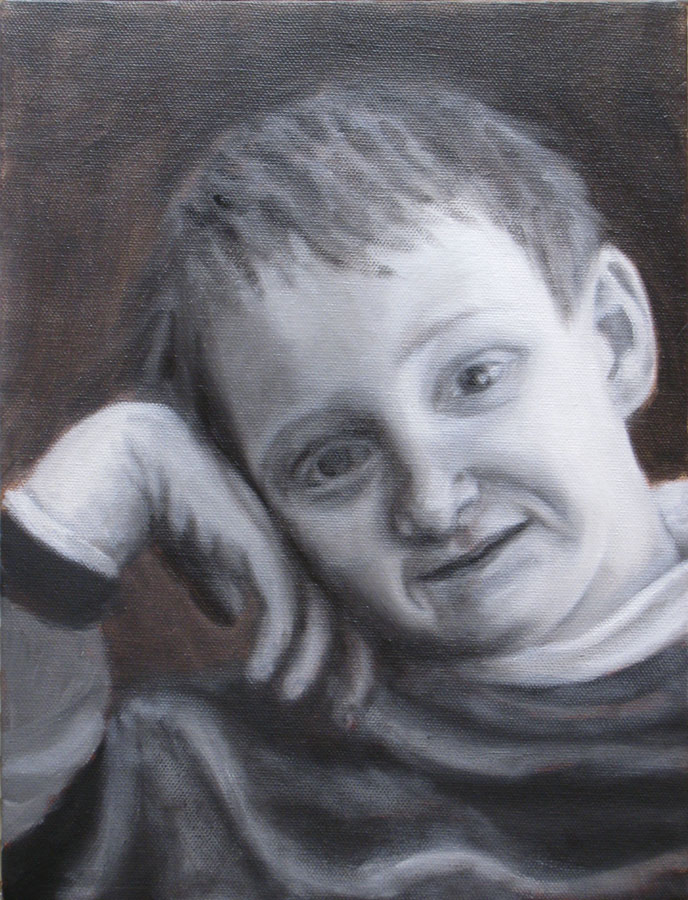
Francis: Work in progress, oils

Francis-Grisaille underpainting done

Grisaille underpainting, oil on canvas, 9×12 (larger)

Francis is a little boy I photographed (with his mom’s permission) in the cafe at the Museum of Modern Art in San Francisco. Something about his red hair and sweet, wise nature made me want to paint him. This is a second attempt–the first got tossed. I’m trying a technique I recently saw demonstrated at the California Watercolor Association meeting. The goal is to end up with strong darks, high contrast and glowing skin. The artist who demonstrated the technique started her demo by showing slides of Caravaggio‘s paintings. He is known for strong contrast of glowing light in an otherwise dark scene, known as Chiaroscuro.

Once this layer dries I will be painting over the underpainting with a thin layer of color, trying to allow the darks and lights to remain and show through.

Francis-sketch on toned canvas
(above) First I started by toning the canvas with a thin wash of acrylic burnt umber paint. Burnt sienna would have been better though–this color is too dark and not warm enough. Then I used Saral transfer paper to trace the enlarged photo onto the canvas. Portraits are the one subject that I still do that kind of transfer instead of drawing freehand when I want to be sure to get a resemblance with all the features the right size in the right place.

Francis-Getting started

(Above) Next I started blocking in the dark shapes and lines I saw using burnt sienna oil paint thinned with Gamsol Odorless Mineral Spirits.

Francis-blocking in

(Above) Once I had the shapes blocked in I was ready to start adding the black paint, trying to keep it thin so some of the burnt sienna would show through.

Francis-Grisaille underpainting started

(Above) Then I started adding white paint, trying to make smooth transitions between dark and light. And this brought me to the finished grisaille underpainting at the top. Now I just need to let it dry and then start adding the thin layer of color and see what happens.

Categories
Art theory Faces Gouache Painting People Portrait

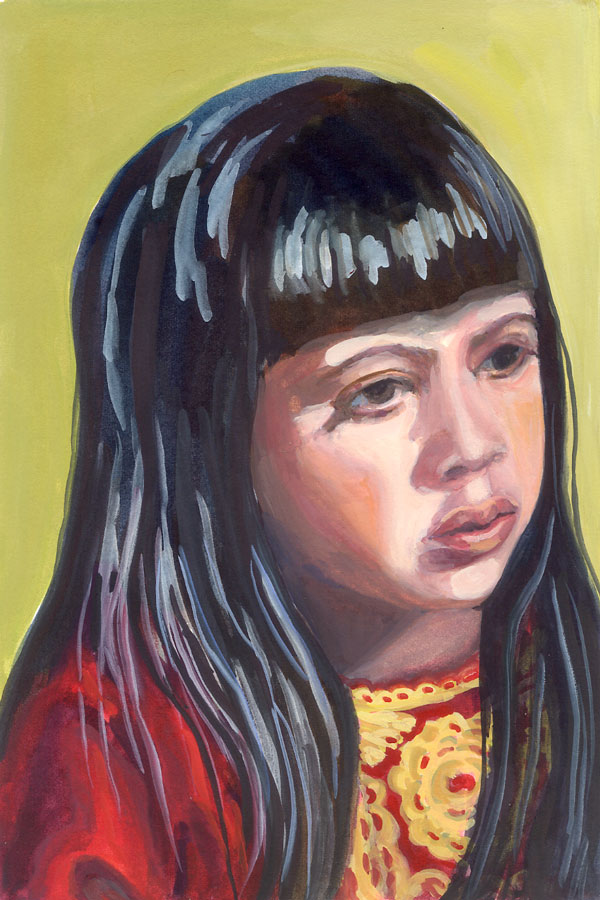
Girl in Gouache

Girl in gouache

Gouache on hot press watercolor paper, 7×10″
Click here to see large (then click again)

I painted this from a photo I took of a little girl at my niece’s high school graduation. I’m learning a lot from working with gouache–it’s a great way to experiment with seeing values and color temperature which is so important, especially for working with oil paint. I’m also learning that while you can repaint layers with gouache you do eventually get unpleasant paint build-up and it becomes more difficult to blend, as layers beneath get reactivated (unlike acrylics).

One note for anyone who’s interested in working with gouache: Many of the colors are not at all permanent since many artists who use gouache are painting for publication and the work only needs to look good until it’s photographed. When shopping for gouache, make sure the tube of paint has an A or AA permanence rating. Anything below that (B or C) and the paint may fade or change color rapidly (just in case you paint a “keeper”).

Categories
Drawing Faces People Portrait Sketchbook Pages Watercolor

Drawing Faces

Faces-2-JMc

Graphite and watercolor in Aquabee 6×9 sketchbook
To enlarge, click images, select All Sizes

Faces3-JMcG

These are two more faces from my project of drawing faces from a book of character actors acting that I  explained in a previous post here. This actor was supposed to be a soccer dad whose daughter just scored a winning goal in the first picture and a Hells Angel preparing for a confrontation in the bottom picture. Drawing the top picture I could really see what all the muscles in face were doing to pull his skin here and there.

I had to draw the first one twice–the first time I didn’t get things lined up at all. I seem to always want to make faces and their features symmetrical whether they are or not. I try to straighten tilted heads, make mouths the same size on both sides of the face even when the head is turned so that it’s shorter on one side. The second time I looked more carefully at angles and where features lined up with each other and their sizes in relation to each other and I got closer to reality.

Categories
Art theory Faces Other Art Blogs I Read People Portrait Sketchbook Pages

Drawing Famous Faces & Copyright Info for Artists

Faces-1-LM

Ink (Pentel brush pens) in Aquabee Deluxe 6×9 sketchbook
To enlarge, click image, select All Sizes

My painting group buddies Lea and Susie are taking a monthly portraiture class from local artist Myrna Wacknov. One of the homework assignments they’ve worked on during our painting group sessions is to take two sheets of watercolor paper and divide each into 8 sections using strips of tape. Then on one they draw the same person 8 times using different colors, techniques, lighting, etc. on each image. On the other they do eight different people but unify them in some way. Judith isn’t taking the class but jumped in anyway and is painting a sheet of 8 angelic portraits of George Harrison from an old Rolling Stone cover.

Then I found the book “In Character: Actors Acting” at the library, with 250 pages of photos of character actors’ faces showing every kind of expression and feeling. I couldn’t resist joining in. I bought a used copy of the book and plan to go through it, flipping it open to a page and making drawings or paintings in my sketchbook. This is the first one. There were two photos of this guy on the same page and I got distracted and accidentally drew his left eye from one photo and the right eye from the other photo. He was looking in different directions in the two photos–he’s not really wall-eyed, poor guy.

Copyright issues:
I did some research about whether I need copyright permission to use these photos in drawings. The answer is yes and no… BUT since I doubt anything I draw will look “substantially similar” to the original photo (or the person I’m drawing!), I’m probably OK.

Here’s what I learned on a page about copyright rules for illustrators:
Q: What are the rules when it comes to illustrating celebrities?
First of all, if you’re not working from your own photographs or memory, you need to obtain permission from the photographer who created the photo you will be using as reference material. (You do not need to get permission from photographers if you create portraits or caricatures based on dozens of photographs from different sources and you are careful to not to include elements that would make it obvious you copied from a particular photograph.)

Q: Can I use someone else’s photograph as reference material for a painting I’m creating?
If you’re copying a photograph, you must get the photographer’s permission…Even though it’s in a different medium, you’re violating the photographer’s copyright if you copy a photograph in your painting.
BUT….
To constitute a copyright infringement, a “copy” must be “substantially similar” to the original work. If your finished illustration looks different from any of the originals you used as a reference material, you shouldn’t need to obtain permission.

Categories
Art theory Drawing Faces Other Art Blogs I Read People Photos Portrait Sketchbook Pages Watercolor

Painting vs Preparing to Paint (& Portrait Request)

Fake Dane's Portrait

Brown Micron Pigma ink and watercolor in large Moleskine Watercolor notebook
To enlarge, click images, select All Sizes

The other day I got a mysterious email from someone calling himself “Fake Dane.” He wrote, “Hey, I think your art is great. I was wondering if you’d be willing to sketch me from a picture. I’m assembling a collection that I’d post. Dane”

And he sent me his photo. If you want to draw him too, just click the photo below and select All Sizes when you get to Flickr and then you can print it out:

Fake Dane's Photo

I wrote back, “Sure, why not?” and did the sketch above. I was going for caricature so I hope he’s not offended. (UPDATE: He replied and said he really liked it and put it on his blog. There’s some funny drawings of him as a vampire there too.) If you want to do a drawing of him and send it to him too, there’s instructions in the “Please Read” sidebar on his blog.

It was a fun, quick painting project on a day in the studio that was mostly spent at the computer, trying to sort out photos and compositions for upcoming paintings, something I don’t particularly enjoy doing. And that made me think about the differences between…

Alla Prima/Plein Air vs carefully planned painting

When I’m planning a painting I consider focus, value, composition, color scheme, etc. I do thumbnails and value sketches. If it’s something requiring exact proportions, such as a portrait of someone’s child, pet or home, I’ll start with a drawing and then work from a photo, tracing it onto the watercolor paper. But even with more carefree subjects like flowers and still life or landscapes, that prep work saves a lot of frustration once painting is underway. I’ve learned that lesson the hard way.

On the other hand, my understanding is that people who regularly paint alla prima (in one setting) or plein air make the prep work quick and intuitive and let go of exactitude, painting their impression of the subject rather than a careful rendering. I’ve done some and it’s a lot harder than people like Kris Shanks, Nel Jansen, Ed Terpening, and others whose blogs I enjoy visiting, make it look.

What I’m trying to figure out is how to combine the two approaches, or how to avoid all the labored pre-planning. Judy Morris, the teacher of the workshop I took in February, said that her favorite part is planning and composing from photos, not the actual painting. For me it’s the opposite — while I enjoy drawing, I love painting more and don’t really enjoy spending a lot of time photoshopping compositions and sorting through photos at the computer. (She does the prep work manually, working with black and white photocopies and enlargements of the subject and background, which she cuts out and assembles.
On the other hand, if I don’t do the pre-planning (especially with watercolor) the whole painting ends up being a study that has to be done over. I guess with acrylics and to some extent oils, one can just keep working on and changing a piece until it’s right, but I’m not sure if that’s a great way to go either.

I’m hoping to find my own way of working that incorporates the best of both worlds.