Categories
Art theory Oil Painting Painting Still Life Studio

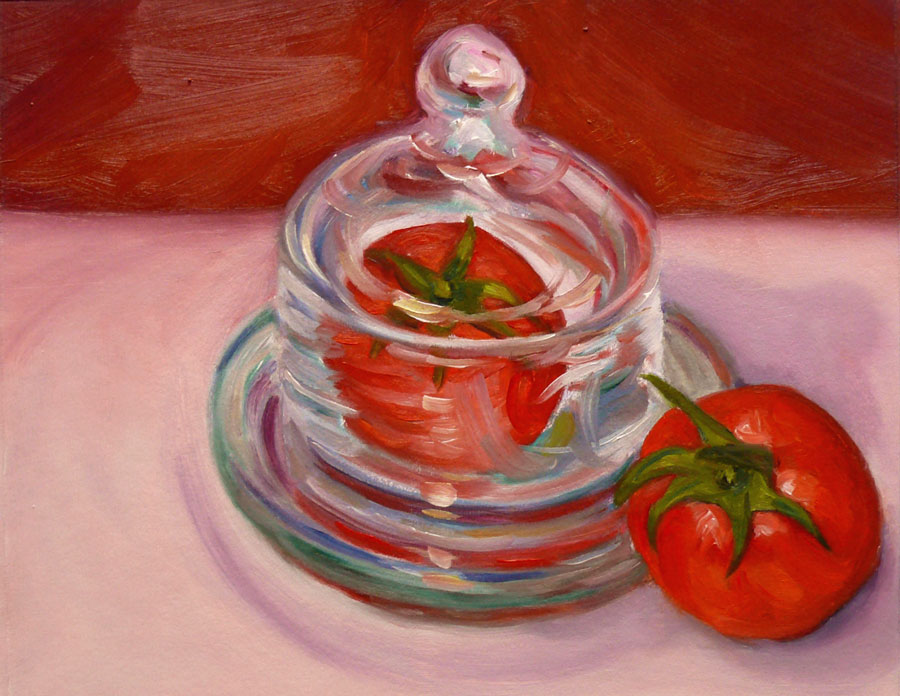
Tomato Under Glass

Tomato Under Glass

Oil on gessoed Museum Board, 7.5″ x 9.25″
Larger

I did this oil sketch from life in the studio yesterday evening. One of the “rules” of oil painting is to keep your darks thin, with no texture and you can see why on the background here. Those brushstrokes catch the light and draw attention to it. Here’s the preliminary sketch with the darks blocked in first:

Categories
Art theory Landscape Oil Painting Other Art Blogs I Read Outdoors/Landscape Painting Plein Air

Sharing my learning process

Tilden Park Plein Air & Studio 3

Oils on 9×12″ canvas panel
Larger view

In the interest of sharing my learning process in oils, I’ve posted this painting and some of my teacher’s critique. There are so many problems with this plein air plus studio painting that it seems to prove Dee Farnsworth’s saying, “Plein air is French for ‘bad landscape painting.'” I like to think of plein air painting as being the outdoor version of figure/life drawing — you’re trying to capture a 3-D live subject in real time, but with changing light.

The biggest problem is that it’s a painting of nothing…that is, there’s no focal point. In fact, the thing that interested me the most about the scene (some interesting branches) didn’t even make it into the painting. The composition basically sucks: there should be a path of dark values for the eye to follow but instead there’s a bright path leading nowhere: your eyes go up the path where you can turn left or right but there’s nothing there to see.

The shadows on the road don’t work because they’re too lumpy — shadows should be flat with softer edges. The daubing paint application is basically the same everywhere (I was trying to make myself use more paint–I tend to be too stingy with oil paint and was trying to work thicker). The foliage should be painted as masses–clumps of different sizes and shapes that go from dark underneath to light on top–just as you’d paint an apple–to give them dimension and form.

My teacher thought the painting was better before I messed around with it in the studio. Here’s the original done at the park (below):

Tilden Park Plein Air 1st

I’d gone out painting with my friend Susie who is much more experienced at plein air than I. When we packed up she pointed out that when we set up to paint, the Eucalyptus trees were light against a dark background, but as the sun had moved, the scene had reversed and the foreground trees were now dark against light background trees. I hadn’t even realized that but had unconsciously kept “correcting” my painting as the afternoon progressed which was not a good thing for the painting. It was best at about one hour. After that it just got more and more mucked up. When I brought it home I decided to work on it some more in the studio and lost a lot of what I’d originally liked about the painting which I didn’t realize until I posted both of them.

About knowing when to stop…I’ve always loved this story by Danny Gregory:

“When Jack was in preschool, there was one teacher whose class always did the most amazing paintings. Each one was clear and sharp and intelligent, Picassos in a sea of muddy fingerpaints. I asked her what she taught her kids, what she said to keep their visions so pure. She replied, “I don’t tell them anything, really. I just know when to take their paper away.”

Categories
Art theory Landscape Oil Painting Outdoors/Landscape Painting Plein Air

Sunset View Cemetery- Oil sketch

Sunset View Cemetery Sketch

Click here to see larger
Oil on Raymar Panel 9×12″

Sadly I wasn’t feeling well enough to join the Benicia Plain Air Painters at Mare Island Friday and Saturday. I was fighting a cold (I won…after 12 hours sleep last night!). On Saturday it took me until 2:00 in the afternoon to get out of my jammies and into the shower, about the time the event was ending. Even though I still felt crummy the weather was beautiful (though windy) so I decided to try painting someplace closer.

The Sunset View Cemetery is quite nearby and has some lovely views so I headed up there. I drove around and around trying to find a spot to paint. Then I walked around, dragging all my gear, finally settling on this view. Unfortunately it was on top of the hill in the bright sun and very windy so I couldn’t use my umbrella to shade the palette and canvas, making color mixing tricky.

Even though I felt funky and tired, once I started painting all I felt was joy and pleasure. Then I ran out of steam after about 90 minutes, just managing to block in the lights and darks. I fiddled with it a bit today but wiped off all my fiddles. I decided I liked it just the way it is so I’m calling it a finished “sketch.” I may try making a larger painting from the sketch.

Value studies

Here are the compositional value studies I did first with Copic Markers (more about the markers). I meant for the tree to be further to the right like the bottom sketch but it ended up being closer to the middle in the painting.

Cemetery-value-comp

Alla prima in oils vs. watercolor

Two things that are important in working alla prima (all at once instead of in many layers) in oils and very different from my approach to watercolors are:

1) The importance of planning the composition (of course it’s important with watercolor too, but with watercolor you can crop off the bottom or side of a painting if you need to do improve the composition) . With stretched canvas or canvas panels it’s not nearly as easy as just snipping off the offending section or hiding it under a mat.

2) Getting the values (darks and lights) and the color right the first time. In watercolor I’m used to going for an approximation of the right color and then adding washes to make it darker, cooler, warmer, etc. In alla prima painting in oils I’ve learned I need to figure out the values first, then put down the darkest darks, and then the light areas for each main shape. Unlike watercolor, there’s no corrective glazing or washes when you’re working with wet gooshy paint.

Categories
Art theory Life in general People Sketchbook Pages Subway drawings

Art Shows on TV & Subway Drawings

BART26

Above, on the train to work in the morning, 5 minute drawing.
Click here for larger image

All are ink in Moleskine sketchbook

BART27-El Cerrito Plaza Station

Above, waiting for the train on the platform, 3 minute drawing

Bart25

Click here for larger image
Above, people on the train to work, probably 3 minutes each (my trip is only 13 minutes)

I’m sooooo tired tonight. I think I used up all my brain juice at work today which seemed more intense than usual, multi-tasking, solving problems, meeting needs, responding to questions, ticking one thing after another off the bottom of my to-do list as more things piled on top of it. At the end of the day I had 48 work email messages I still hadn’t dealt with yet, some left over from Monday. I get about a hundred a day, most needing me to do something. Thank goodness tomorrow is Thursday and Friday starts my weekend. How did I ever manage a 5-day work week? It’s only 8:15 and it feels like 10 p.m. so I’m going to go watch some mindless TV and then go to bed.

Art History Shows
I’ve TiVo’d and have been gradually watching the Simon Schama series, The Power of Art, on PBS. It’s really weird. Each week a different seedy-looking British actor portrays another famous artist (most of whom weren’t British) while Schama narrates bits of history, trying to make everything sound as lurid as possible. The actors dramatize the artists’ darkest, most desparate moments of depravity, criminality, mental illness, illicit affairs, and bizarre behavior, focusing not on their most famous work, but the work they were most infamous for. It’s kind of like the Jerry Springer/National Enquirer/tabloid TV show version of the world of art. Some of the scenes are really disturbing such as Van Gogh squeezing tube after tube of brilliant oil paint into his mouth and swallowing it. Yechh!

I’ve also TiVo’d a CPB show, “Art of the Western World” with another British guy narrating the history of art, period by period, with just the opposite approach–a bit on the “good for you” but boring side. It was originally made as a college course, I think. I love my TiVo, by the way. It’s easy to use and I can set it to record every episode of a show with one click of the remote, and search for shows about art and painting and click to record them (which is how I found these programs). One more excellent program is American Masters on PBS. Recent episodes have featured David Hockney: “The Color of Music” and John James Audubon: “Drawn from Nature.”

Painting How-To Shows
Another show I’ve been enjoying is Your Brush with Nature. Each week the host, Heiner Hertling, paints a plein air oil painting on site in different locations. It’s not corny like some painting shows and he’s a good teacher, thinking out loud as he tackles the challenges of painting outdoors. There are two watercolor painting shows I record: Terry Madden’s Watercolor Workshop and Gary Spetz’s Painting Wild Places. I’ve gotten a little tired of Spetz because he does SO MUCH detailed masking with masking fluid, but both Madden and Spetz make attractive paintings and demonstrate techniques worth knowing about. For acrylics, Jerry Yarnell demonstrates how to paint what look like traditional oil paintings but using acrylics. I was having a really hard time figuring out acrylics and watching his show really helped to understand. I tried watching the ubiquitous Bob Ross oil painting shows on PBS but just couldn’t stomach them because they were way too gimicky and not at all about painting what you see (“here’s how to paint happy little trees”). I do love his voice though.

I’ve recently discovered an art video rental company like Netflix only for art videos called Smartflix. I haven’t rented from them yet (it’s a little expensive–$10 a video rental) but it seems like it might be worth it–cheaper than taking classes (though without the teacher feedback on your own work) –to see masters at work whose books I’ve read but seeing them work adds another whole dimension.

Categories
Art theory Landscape Life in general Other Art Blogs I Read Outdoors/Landscape Sketchbook Pages

Snow Park, Oakland

Snow Park,  Oakland

Ink & colored pencil in small Moleskine notebook
Click here for larger view

I drew this sitting on a wall in front of the building where I work, waiting for a ride after I witnessed something disturbing and weird this evening that changed my plans for the evening. I left work and headed to BART to get home and meet Lea to go to the California Watercolor Association meeting where Jody Mattison was going to be demonstrating painting using a grisaille technique in black and white oil painting over an acrylic underpainting in burnt umber, and then glazing in color in oils (odd for CWA which is usually all about transparent watercolors, but serendipitous for me since I wanted to learn that technique).

I saw a boy in a small group of middle-school age skateboarders being attacked by a huge security guard half a block from my building. The security guard looked and acted just like Forrest Whitaker as Idi Amin in the Last King of Scottland. The boy couldn’t have weighed 100 pounds and the enormous guard must have been 6’4″ and 280 pounds. They were fighting like kids in a school yard shoving each other and yelling. The guard shoved the boy hard who threw his skateboard at the guard, who then pushed the kid down in a raised planting bed and began choking him. He finally let the kid up with a viscious crazy laugh and the two began yelling at each other again. People on both sides of the street and driving by in cars looked stunned. The guard kept roughing up the kid, pushing him down, strong-arming him and yelling madly. Two cars pulled over and tried to intervene but the guy ignored them, and I could see people calling 911 on their phones. Occasionally the guard would talk into a radio and then go back to acting crazy and aggressive with the kid.

I started to leave and then just couldn’t. I walked over to them and said, “Excuse me sir, do you work here? This is totally inappropriate and unprofessional behavior.” He said he worked for the security firm hired by the building. The kid was saying, “Did you see him attack me? He was harassing me…” and his buddy said “I have it all on my camera!” He showed me the film on his little digital camera and it clearly showed the guard’s aggressive behavior and the kid defending himself. I asked them if they would all follow me back to the building where I knew the building security guards who staffed the front desk would be more reasonable. Surprisingly they all agreed to follow me as did several witnesses. Inside the building the guard said the police had already been called and everyone agreed to wait for them or left their names and numbers for the police.

Meanwhile I realized I’d never get home in time to meet Lea so I phoned her. She offered to bring me dinner so that we could go directly from my office to the meeting. Finally the police came, interviewed everyone separately. From what I heard while waiting, apparently these kids regularly skateboard by the building because the boy who got attacked’s mom owns the Togos Deli in the building and the guard regularly harasses them about skateboarding, even though they stay on public property, not on the building’s grounds. And the guard claimed the kids harass him. I told him that he still had no business behaving that way and I told the boys that they were asking for trouble, knowing that this guy was wacked but still tempting him by skating nearby but that still didn’t give him the right to harm them.

Finally I left everyone in the building with the police and went out in front and did this drawing of the sunset view of the park across the street with the huge herd of geese (it’s too big to call it a flock) that hang out there, Lake Merritt in the back to the left, and a tall, glorious Art Deco apartment building behind the trees. Lea arrived with a wonderful dinner for me, and drove us to the meeting for the demonstration which was terrific!

Tomorrow when I go to work I’m going to talk to the building management to tell them that guy should NOT be working there.

Categories
Art theory Oil Painting Painting People Photos Portrait Puerto Vallarta

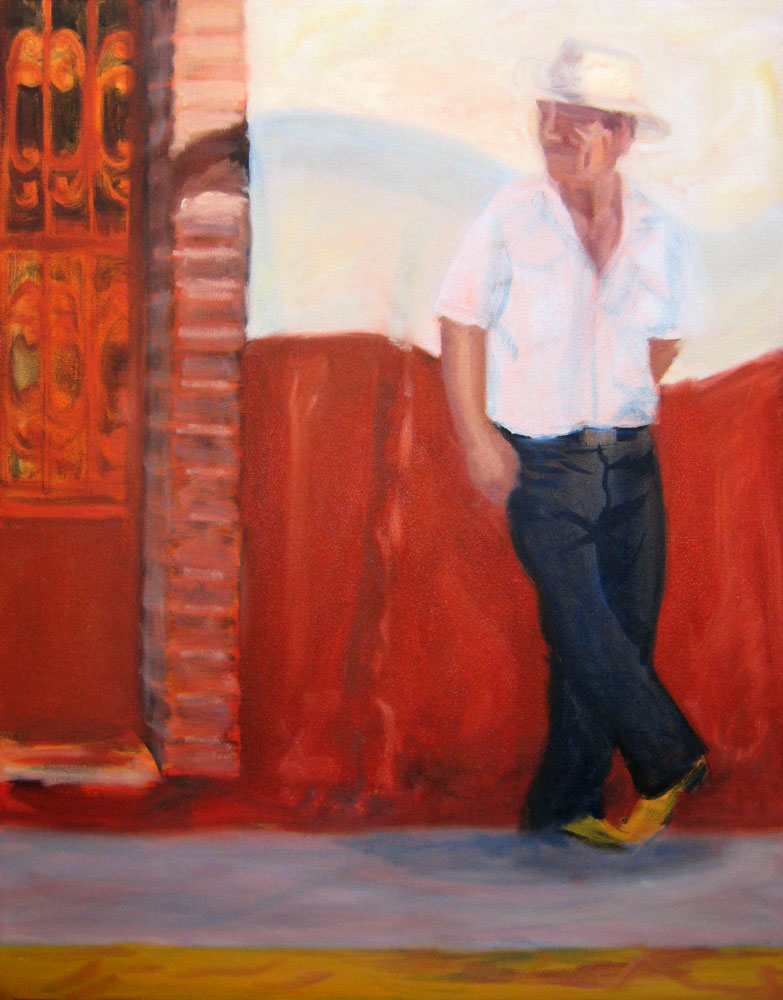
Work in Progress: Puerto Vallarta Cowboy in oil

PV Cowboy - Oil painting layer 2

Oil painting IN PROGRESS – 22 x 28 inches
Click here to see larger

I started this oil painting today from a photo I took in Puerto Vallarta a few months ago (see bottom of this post for the original photo). I thought I’d track my process and progress and post the results as I go.

(Clicking on any of the pictures below will take you to Flickr where you can click All Sizes to see larger)

Original thumbnail sketches

Above are the thumbnail sketches (each about 2″ x 3″) that I did first, trying to work out the composition and colors. I needed to make the sketch match the dimensions of the canvas. Unlike watercolor paper that you can cut to any size, with canvas you either have to stretch it yourself (been there, done that) or use standard sizes.

Above top right: I used grey markers to work out the values but I didn’t change the composition from the photo. Above bottom left: In this grey marker sketch I moved the cowboy to the right, adding more wall between him and the door and added some white gel pen to put back light I lost. Above bottom right: I used gouache to work out the colors.

Enlarged photo with cowboy moved Drawing on colored acrylic ground

(Above left) I placed the original photo in InDesign so I could print it out in grey scale in”tiled” pieces and then I taped the printed sections together so that it would be the same size as my 22×228 canvas. Then I printed just the cowboy in color and stuck him where I wanted him on the large printout. I could have done this in Photoshop but decided it was quicker to do manually. It’s placed over the canvas in this photo.

(Above right) I toned the canvas with acrylic paint mixed to a sort of orangey-brown. I used a sponge brush and kind of messed it up, going over an area that was partially dry, which took off paint instead of putting it on. Fortunately it was in an area where there’s a textured wall so it didn’t matter. Then I put a sheet of Saral graphite “carbon paper” between my enlarged printout and the canvas and using a stylus originally designed for using on a Palm Pilot PDA, drew (invisibly) along the outline of the shapes on the enlarged photo. The Saral paper transfered those lines to the canvas. Unfortunately I didn’t notice the enlargement slipped so I had to retrace the guy again, half an inch to the left which left a lot of confusing double lines. The main reason I wanted to trace was to get the shapes on his face right and they were totally messed up. So I redrew him over the graphite lines with a fine point Sharpie instead of tracing, which worked OK.

Working from enlarged thumbnail sketch & photo

Above: I scanned my thumbnail value sketch, enlarged it to 8×10 and printed it out and stuck it on my easel along with the reference photo and then….

5-Monochrome acrylic underpainting

Above: Using black acrylic gesso I referred to my value sketch to make a grisaille or monochrome underpainting over the orange. Now that I’m looking at this I realized I forgot to put the grey rectangle behind his head that will have the text on it and the orange is looking paler than it really was.

6-Painting the face upside down

Above: I was having trouble with the face so I enlarged his face and printed it, then turned the canvas and the printout upside down and tried to get the shadows and value patterns right on his face.

Then I blocked in the first layer of color with oil paints over the underpainting (picture at top of post). Once it dries I’ll paint another layer. I plan to work loosely, avoiding overworking, especially the door on the left which I like just the way it is.

Below, the original photo. Isn’t he wonderfully macho?

Original photo

Categories
Art theory Faces Gouache Painting People Portrait

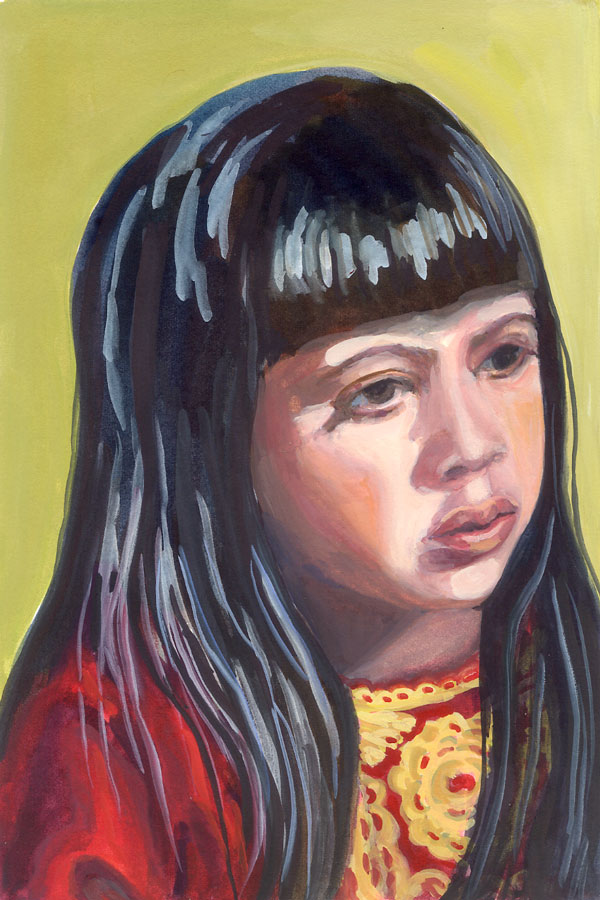
Girl in Gouache

Girl in gouache

Gouache on hot press watercolor paper, 7×10″
Click here to see large (then click again)

I painted this from a photo I took of a little girl at my niece’s high school graduation. I’m learning a lot from working with gouache–it’s a great way to experiment with seeing values and color temperature which is so important, especially for working with oil paint. I’m also learning that while you can repaint layers with gouache you do eventually get unpleasant paint build-up and it becomes more difficult to blend, as layers beneath get reactivated (unlike acrylics).

One note for anyone who’s interested in working with gouache: Many of the colors are not at all permanent since many artists who use gouache are painting for publication and the work only needs to look good until it’s photographed. When shopping for gouache, make sure the tube of paint has an A or AA permanence rating. Anything below that (B or C) and the paint may fade or change color rapidly (just in case you paint a “keeper”).

Categories
Art theory Dreams Gouache Other Art Blogs I Read Painting People

Painting with Gouache

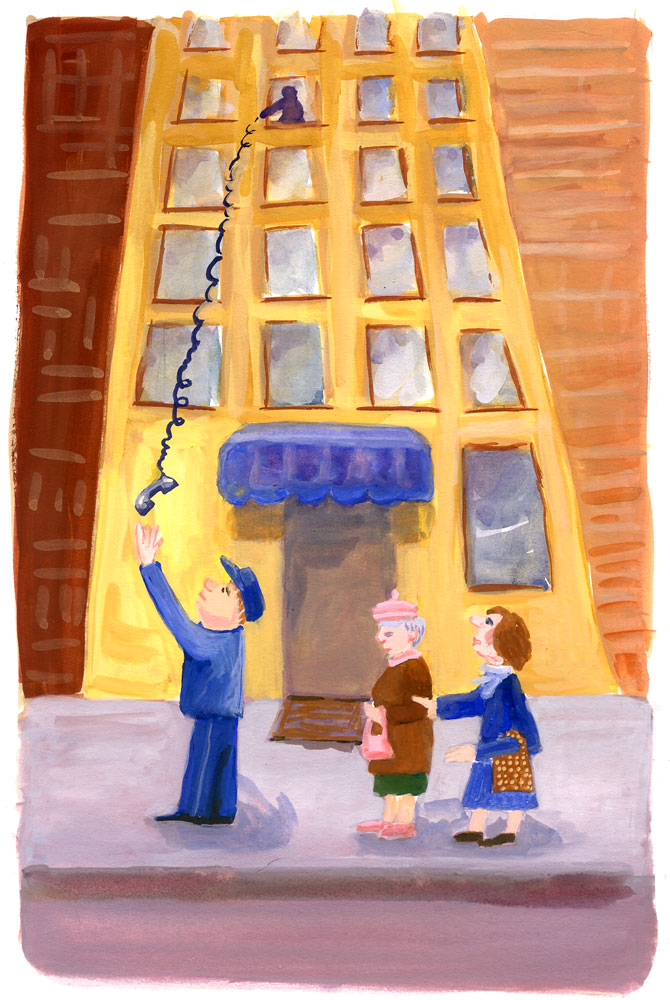
Phone dream

Gouache on hot-pressed watercolor paper, 7″x11″
Click here to enlarge

I’ve been wanting to experiment with painting in gouache (opaque watercolor) and today finally got the chance. I so adore the artwork of Maira Kalman and the painterly, juicy way she uses gouache….which reminds me a lot of the kind of oil painting I want to do–John Sonsini is one of my current favorites…and his work reminds me a lot of Alice Neel, one of my major art heroes, who, at the age of 80, did a wonderful nude self portrait of herself painting herself.

It turns out gouache, at least on the two relatively small pieces I’ve tried so far, actually combines the best of watercolor, acrylics and oils. You can blend easily, paint with bright juicy colors, it dries quickly but not too quickly, you can paint over areas, and it cleans up with water. I had some ancient tubes of Winsor Newton Designer’s Gouache and bought a few new tubes since some of mine had turned to cement. I love it!

I’ve been trying to paint in that juicy, painterly way with acrylics and oils but haven’t succeeded so far. I haven’t worked out the balance between working quickly, free and loose, and still trying to capture a likeness of my subject and getting to detailed and tight. Then there’s the problems associated with the actual media–acrylic dries too fast too do much blending and oil dries so slowly that I keep having to stop and let it dry for a week before continuing.

I’m excited about the possibilities with gouache and enjoyed this first experiment, which was inspired by a dream. I posted the original sketchbook image here.

If you want to see more of Maira Kalman’s art, she’s had a monthly art blog on the New York Times website and the work is stunning. It will be published in a book in October. The NY Times offers a free 2-week subscription, which I took in order to look at the whole year of her art blogs.

Categories
Acrylic Painting Art theory Other Art Blogs I Read Painting

Practice with Acrylics: Blending and soft edges

Acrylic-blending Acrylic-watercolor

Acrylic on gessoed canvas and watercolor paper (R)
To enlarge, click image, select All Sizes

(I know this isn’t much to look at, but it’s what I did with my art time today — practiced making soft edges using dry brush, blending with wet-in-wet and other techniques, and painting watercolor-style washes using acrylics thinned down with water and “Acrylic Flow Release.” It’s harder (but not impossible) to make the kinds of beautiful soft edges and blends that can be done easily in oil paints (these samples are neither beautiful nor soft as I’d like, but that’s what practice is for). I was surprised how easy it was to make clean flat washes using acrylics as watercolors.

I’ve just started reading “Carlson’s Guide to Landscape Painting,” originally published in 1929. Even though he’s incredibly opinionated and assumes all artists are men, I’m finding his observations to be really interesting and often astute and applicable today. Here’s a few tidbits from the first chapter, “How to Approach Painting:”

“The art of painting, properly speaking, cannot be taught, and therefore cannot be learned. I believe about art, as I believe about music or architecture, that the only way to study is to practice; and that any good teacher can point out certain intellectual or technical “makings,” certain helps that will give a fulcrum to the lever of practice.”

“No one can teach ‘art.’ No one can give a singer a glorious voice, but granting the voice, and emotional sensibility, a teacher can teach a man to sing…”

“A snapshot is a correct rendition of physical fact…but the camera does not have an idea about the objects reflected upon its lens. It does not ‘feel’ anything, and will render one thing as well as another. This ‘idea,’ or thrill is the unteachable part of all art.”

“The beginner in painting begins by copying nature in all literalness, leaving nothing out and putting nothing in; he makes it look like the place or person or thing. By and by he will learn to omit the superfluous and to grasp the essentials and arrange them into a more power and significant whole. And it is wonderful to know that these ‘essentials’ will be essentials to him only (and herein lies the secret of orginality). Another man will choose another group of essentials out of the same fountain of inspiration.”

These hit home for me, especially the last one. Do you find them interesting? annoying? inspiring? helpful?

Categories
Art theory Painting Still Life

Acrylic glazing practice: Pear

Acrylic Glazing exercise

Acrylic on gessoed mat board, 8″ x 10″
To enlarge, click image, select All Sizes

Today I practiced acrylic painting techniques in my new book, “Acrylic Revolution.” This exercise started with a painting done in black, white and grey (known as a grisaille) to establish the form and shadows. I meant to photograph that stage but got too involved and forgot. When it dried I painted over it with transparent layers of paint thinned with glazing liquid). I had to do a bunch of layers to compensate for having made the initial grisaille too dark. Unlike watercolor which dries lighter, acrylic dries darker than it looks when you mix colors. This is because acrylic medium is white when wet and clear when dry. I haven’t gotten used to accomodating that change yet.

I also experimented with using acrylic like watercolor, trying various types of washes which all worked perfectly. I was less successful with oil-style blending techniques and will work on those some more tomorrow.