Categories
Drawing Life in general Painting Plein Air Sketchbook Pages Watercolor

Ladies, Stand Up for Your Right to Pee Standing Up!

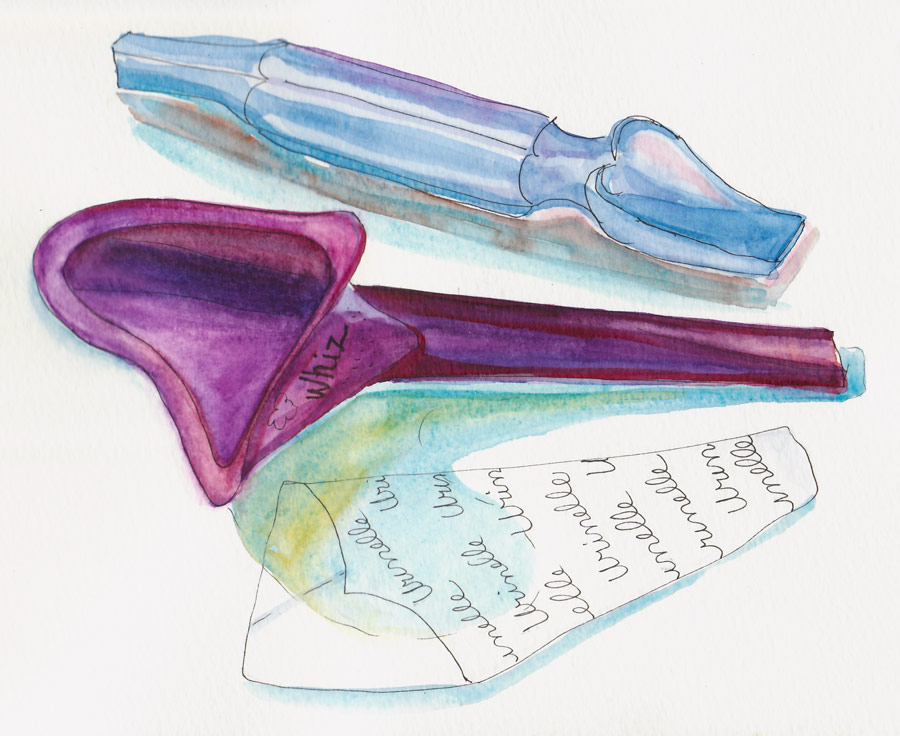
Pee Standing Up Tools

Ink & watercolor, 7×10″ (Larger)

Plein air painting means spending the day out in nature … but what to do when nature calls and there’s no restroom? The guys can just face away, pee on a tree, and preserve their modesty. But we women have to find somewhere to squat with knickers around our ankles, fannies exposed.

After my first painful experience in this situation (too much coffee, no place to hide) I wondered what more experienced plein air painting women did. My research led me to the devices pictured above that allow women to pee standing up, without having to drop their drawers. All you have to do is unbutton and unzip your jeans enough to slip one of these nifty devices into position and you’re ready to “go” with no body parts exposed.

I practiced first at home, trying out all three of items illustrated above. My favorite is the purple one, called the Whiz. It’s reusable, works perfectly and lets women wee anywhere that men can (just remember not to pee into the wind). WhizBiz’s website recommends it for active women for hiking, snow activities, climbing. It is flexible and can be squished small for carrying. WhizBiz is in Australia but ships internationally. I received my order in about a week.

I also liked the Urinelle, which I ordered from Magellan’s travel supplies. They recommend it for foreign travel when bathrooms are unavailable or too nasty to use. The Urinelle is made from stiff paper and resembles a snow cone cup. They are disposable and can only be used once, which could get expensive since they cost a little over a dollar each (sold in packs of 6). They are very easy to pack or carry since they are flat until you open them for use.

Of the three I tried, the only one I did not like was the Caring Hands TravelMate (the blue one above). It is too small and not at enough of an angle and…well, I’ll spare the details except to say I’m glad I was testing it in the shower. I wrote to the company and asked for a refund but they didn’t respond.

Peeing standing up is so much fun! I keep a Urinelle in my purse and another in my car, just in case. When I go out painting I carry the Whiz in my backpack. It’s saved my fanny several times now.

Categories
Landscape Oil Painting Outdoors/Landscape Painting Plein Air

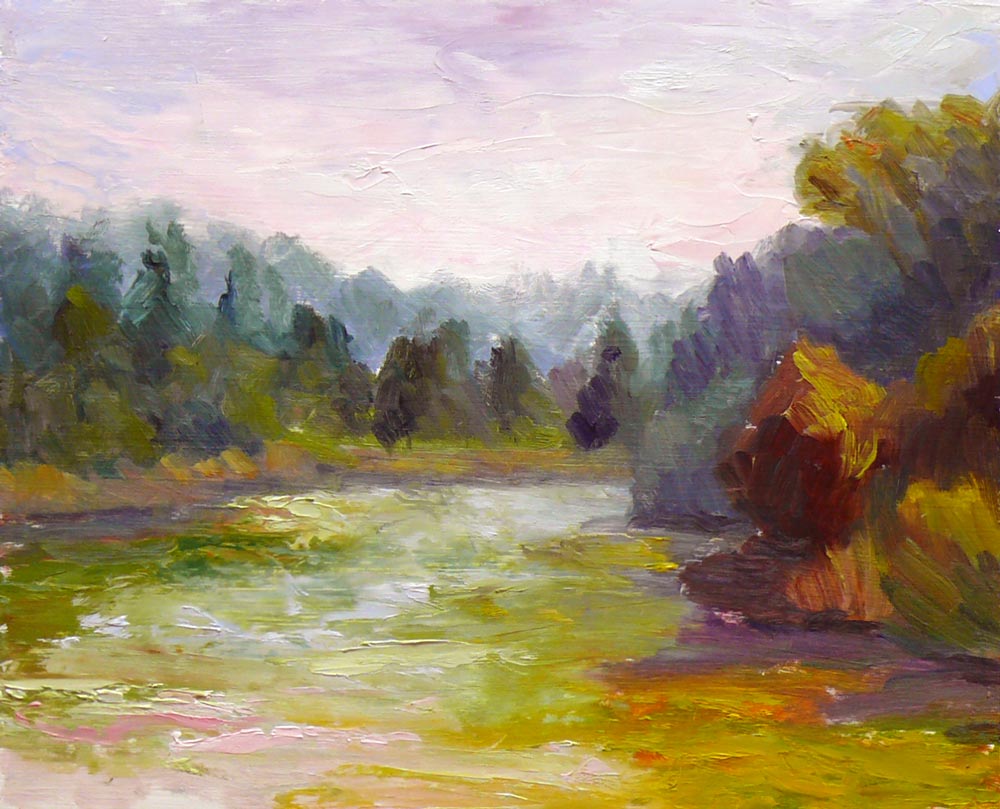
Lake Temescal in oils, plein air

Lake Temescal, Oakland, CA

Oil on masonite panel, 8×10″ (Larger)

Sunday my painting class with Elio painted at a beautiful spot in the Oakland hills. Lake Temescal is actually a reservoir surrounded by trees, hills and park, just off Highway 24 and perched right on the Hayward earthquake fault. It was a lovely foggy morning when we arrived, and as the day progressed, the sun peeked out from behind clouds. Joggers, families, dogs and fisherman wandered by, also enjoying the springlike weather.

I’m happy that much of what I’ve been studying and learning about oil painting, perspective, color, landscape, composition, etc. is starting to make sense and I’m finding ways of working that feel good to me. I got a lot bolder with color in this painting, starting off painting freely with really strong colors, knowing that I could adjust and tone them down once I got everything blocked in.

I tried to make myself finish the painting within a 2-3 hour window so that I wouldn’t be painting a scene that had completely changed as the time passed and sun moved overhead.

Then Elio did a demonstration and explained how he using color temperature (going from a warm yellow green to a medium green to a cool blue green) to create the illusion of form and depth on a tree. The greens were pretty close in value but their color temperature changes really moved the warm part of the tree forward and the cool part back, making it look very round and full. The really cool part was that I understood what he doing and saying; previously it just seemed like magic.

Categories
Art theory Drawing Landscape Plein Air Sketchbook Pages

Back to Basics: Perspective

20080212-perspective1

Pencil sketch, 9×12 (larger)

I studied perspective in college drawing class but didn’t completely understand it, didn’t like it, and thought I had little use for it. Years later my friend Barbara gave me a copy of Drawing on the Right Side of the Brain. In that wonderful book, the author offers a more “right-brained” way to work with perspective, using a variety of strategies that allow one to see angles and shapes without having to use more “left-brained” techniques like 2-point perspective.

It gave me what I needed to draw well enough to get by, and I came to appreciate my slightly wonky style of drawing. It worked just fine for free-spirited sketches or paintings. When I needed something to be drawn accurately (as the basis for a realistic watercolor, for example), I would either grid it up, trace the enlarged photo onto watercolor paper, or draw/erase/draw/erase first on tracing paper until I got it right and then trace that onto watercolor paper.
20080212-perspective6

I got confused in this one…it has several problems

But plein air painting, which I’ve become passionate about, requires a quick accurate drawing in order to start and finish a painting within 2-3 hours max. After that time the light changes so much that colors, shadows, and anything moving (clouds, creatures, water) are completely different. Starting with a bad drawing dooms the painting right from the start. I needed to go back to basics and get a grip on perspective.

I grabbed Keys to Drawing by Bert Dodson, read the section on perspective and started sketching stacked up childrens blocks, stuff in my house, and from my imagination, trying to understand perspective.

20080212-perspective3

Here’s something I didn’t know before: The horizon is always at your eye level. The horizon line (e.g. where the sky meets the land or the sea) is actually what you see when looking straight ahead at your eye level, whether you’re sitting, standing, or lying on the ground. I find that really amazing — it just seems so self-centered, somehow.

20080212-perspective5

(I drew eyeballs on this one to remind me of my point of view/horizon)

A few things still confused me so I did some more research on the web and found two helpful sites with good information. How to Draw and Paint, offers a couple of basic, easy to understand articles about perspective. Ralph Larmann’s Art Studio Chalkboard from the University of Evansville goes into more technical detail and provided answers to the things that were confusing me (like what happens when the object straddles the horizon, or the object is at an angle, like peaked roofs, or the ground is hilly).
20080212-perspective2 20080212-perspective4

I’m going to do some more practicing using what I’ve printed out from those two sites. I also picked up an excellent book from the library: Perspective Drawing by Kenneth Auvil, which is actually fun and interesting reading. Any other suggestions for improving linear perspective drawing would be gratefully accepted.

Categories
Art theory Oil Painting Other Art Blogs I Read Painting Photos Plein Air

Learning to See Color

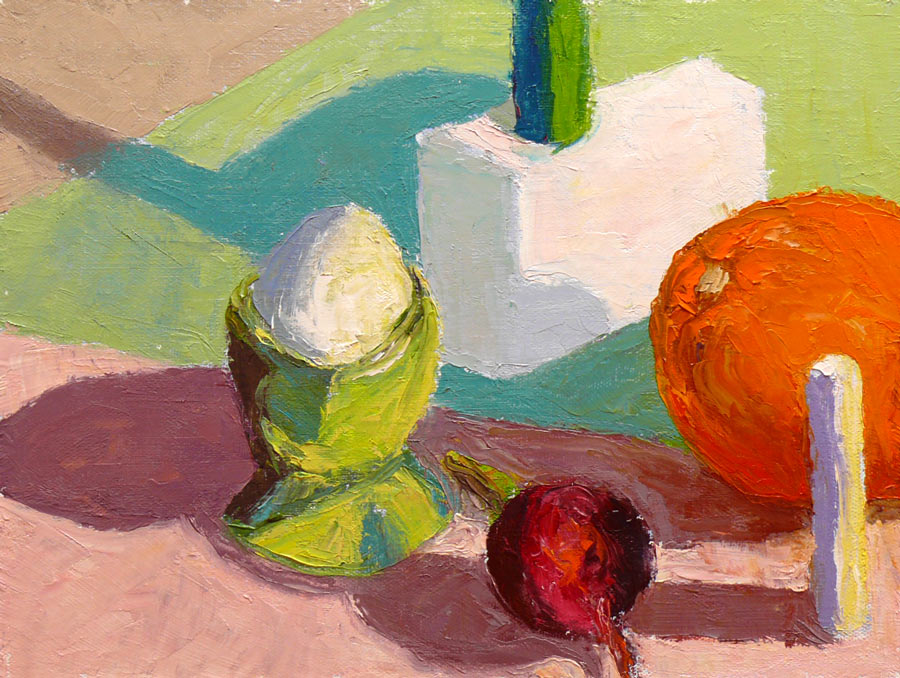
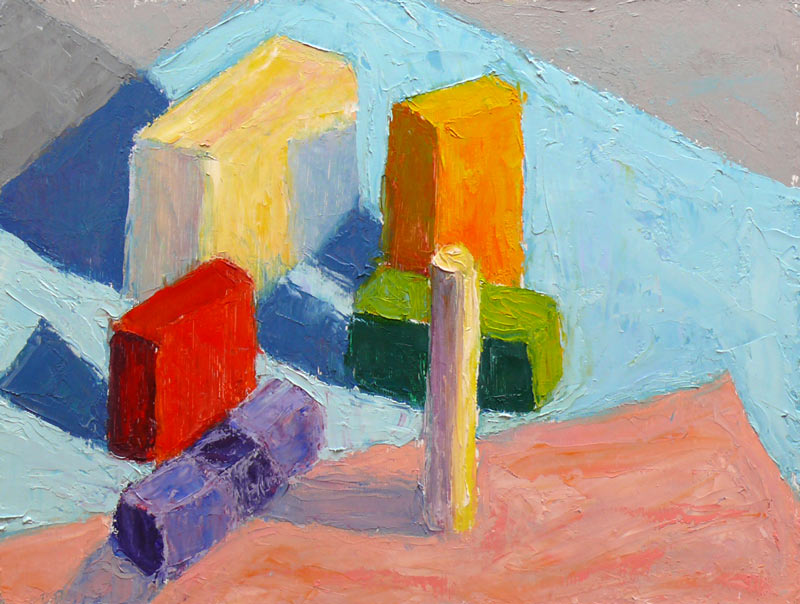
Color study with blocks and food

Oil on panel, 9×12″ (Larger)

On Monday mornings I’m taking a painting class from Camille Przewodek in Petaluma. I first read about her on Ed Terpening’s blog and when I saw her absolutely stunning work I was thrilled to be able to study with her.

As I understand it, the focus of her class is learning to develop one’s ability to see light, atmosphere, and their effects on the subject one is painting and to develop the ability to interpret that in paint. Camille bases her teaching on Henry Hensche‘s, with whom she studied and then spent many years further expanding upon his work. Hensche was a student of Charles Hawthorne who was a student of William Merrit Chase, an American Impressionist who developed his color theories via his study of Monet‘s groundbreaking work.

Camille’s paintings are simply stunning. A slide show of her paintings brought tears to my eyes with their beauty…something that has only happened to me once before when I saw Renoir’s Luncheon of the Boating Party in person.

Newcomers to the class begin by doing plein air still life color studies of colored blocks. Using blocks simplifies the subject matter in order to focus on using changes in color hue and temperature to create the illusion of form and depth. There’s an explanation of this process in the book, Painting the Impressionist Landscape: Lessons in Interpreting Light and Color by Lois Griffel, who took over Hensche’s art school after he died.

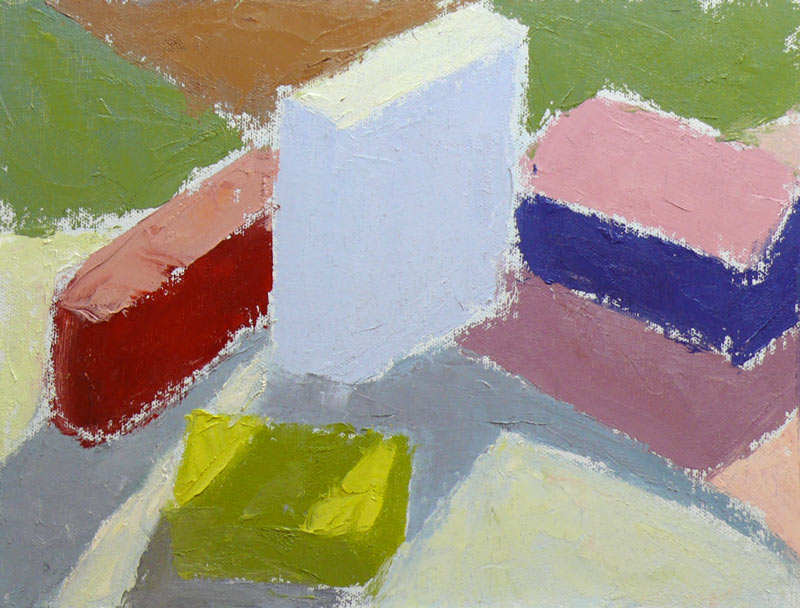
Color Study plein air with blocks

Oil on panel, 9×12″ (larger)

Above is the first block study I did in class while everyone else was painting beautiful marshland. The process for doing the studies is to block in the masses with a palette knife, leaving white space between color areas, breaking each shape into two values: shade and light. You start with one color and move to the next, focusing on the relationship between each color and the next.

Elio Camacho, my other wonderful painting teacher, also strongly emphasizes the importance of the relationship between contiguous colors. They both explain that there’s no such thing as a “muddy” color—that the appearance of muddiness results from the relationship not being right between a color and it’s neighbor.

Color Study, cloth lightened

Oil on panel, 9×12″ (Larger)

The one above was done at home under a bright light, trying to simulate sunlight on a dark and rainy day. When I brought the original version of this painting to class for critique, Camille pointed out that blue cloth was too dark because in the bright light it shouldn’t be darker than the shadow on the white block so I worked on it some more, lightening the cloth. If you want to see how it looked before, and the steps in getting there, including the photo of the blocks, just click “continue reading” below.

Categories
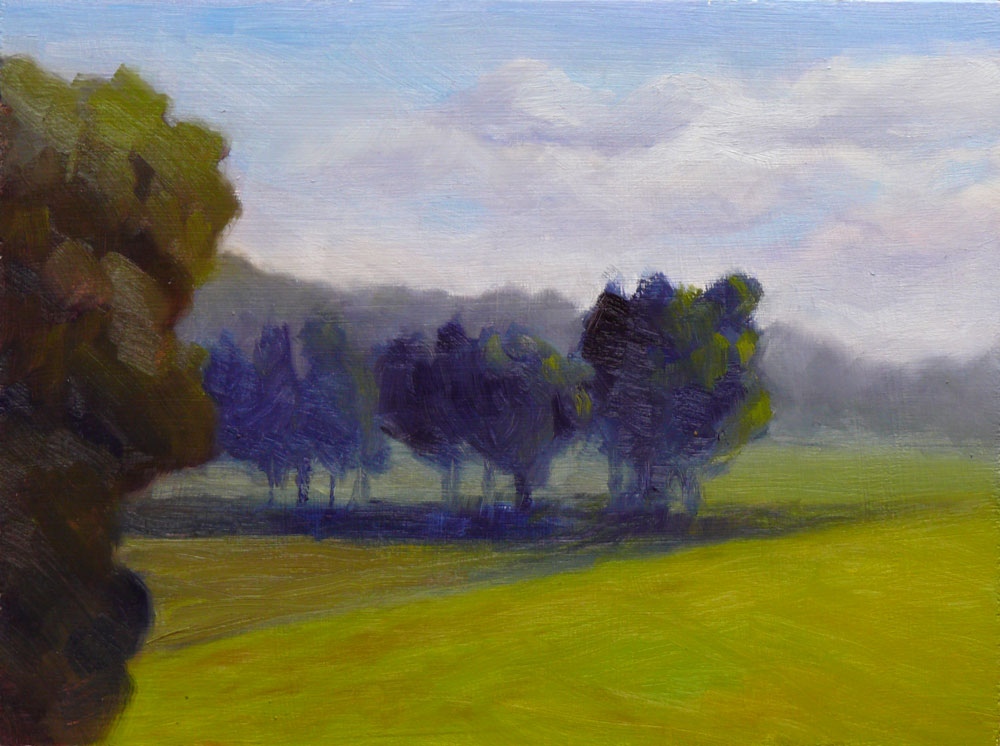
Landscape Oil Painting Outdoors/Landscape Painting Plein Air

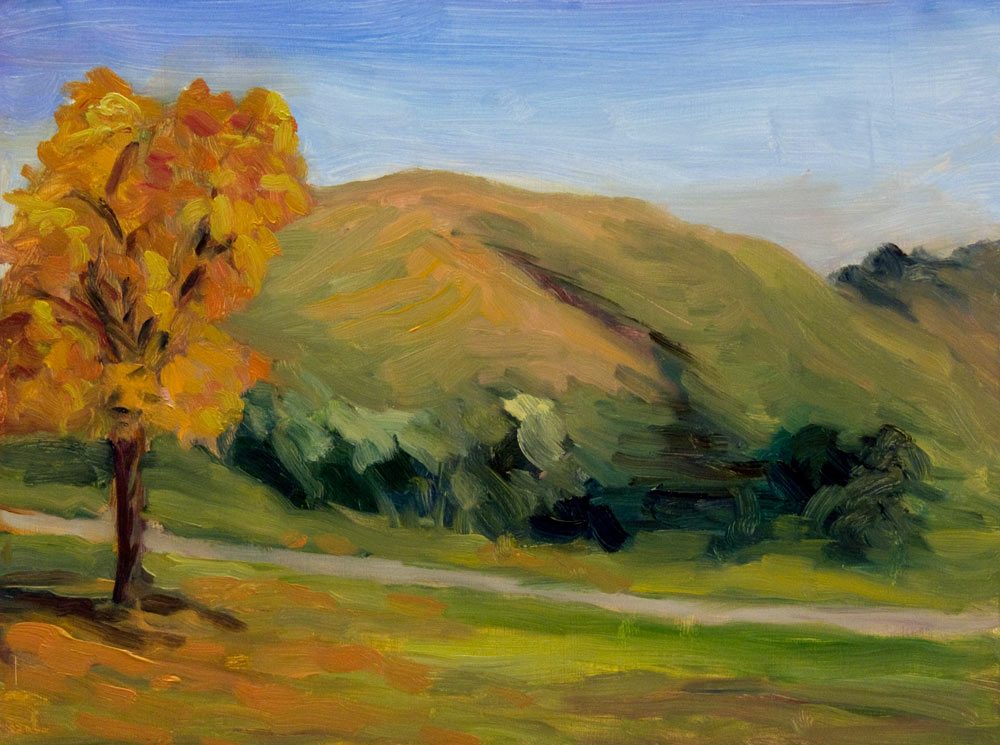
Viano Vineyards in Martinez

Viano Vineyards, Martinez

Oil on masonite, 9×12″ (larger)

Disclaimer: Elio made those lovely brushstrokes on the big tree on the left when he was showing me how to rescue its dorky shape that I was complaining about.

We were grateful to have been given permission to paint in this lovely private vineyard in Martinez. The fields were covered in bright yellow-green mustard grass and the constantly changing and moving clouds made the light very dramatic (and chilly, even in the weak winter sun).

I had a few celebratory moments when an area of this painting worked right and I felt like I was really getting it. And then of course there were the sad moments when I ruined a perfectly good passage, and the hilarious moments when I tried to make marks indicating the rows of vines which were just plain laughable (gone now).

For now I’ll take the improvement of the painting above over the two lame plein air paintings below that I did the previous few weeks:

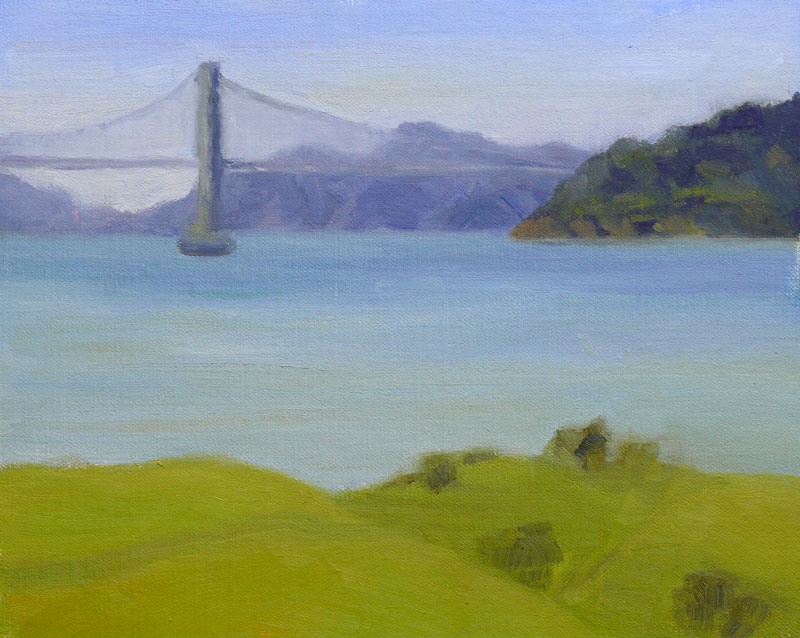
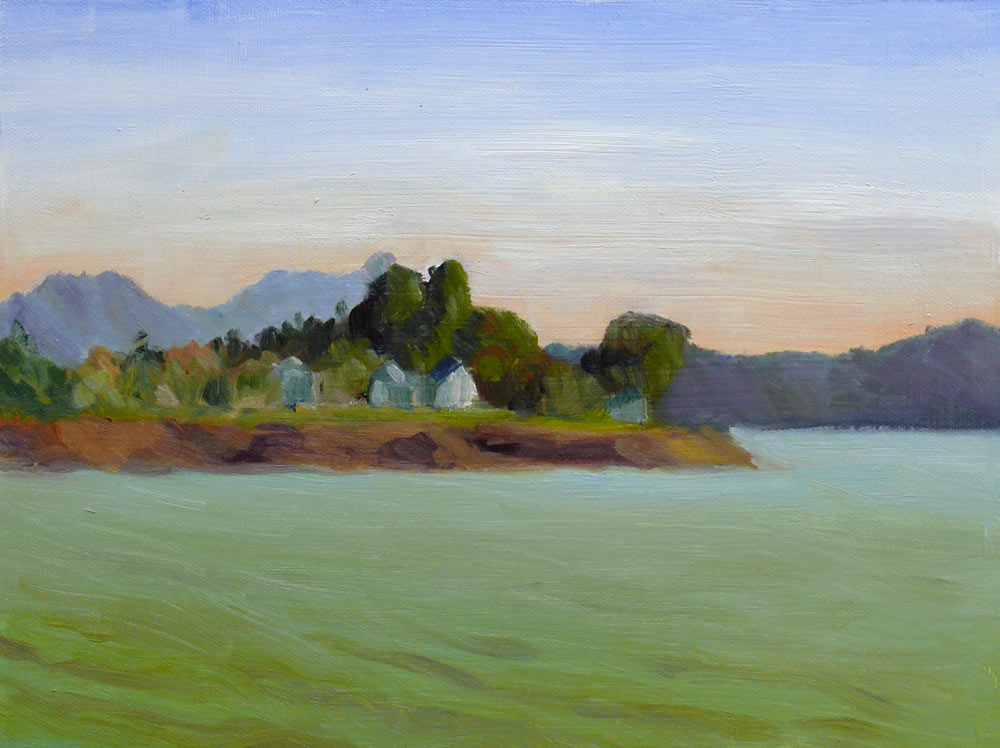
Oakland Inner Harbor Park

Oil on canvas panel, 9×12″ (larger…but why?)

I painted the one above from Chappel Hayes observation tower in the Western Pacific Mole area of Oakland Middle Harbor Park at the Port of Oakland, right beside the docks where huge container ships are loaded by giant cranes that look like creatures from Star Wars. It’s a great new park with wonderful views, walking trails, and a perfect place to bring active kids to watch all the activity. An old Railroad man stopped by to chat and explained that the area where we were painting used to be where the railroads went all the way up to the ships to load the freight. We could see the rails now embedded in the grass and paved trails.

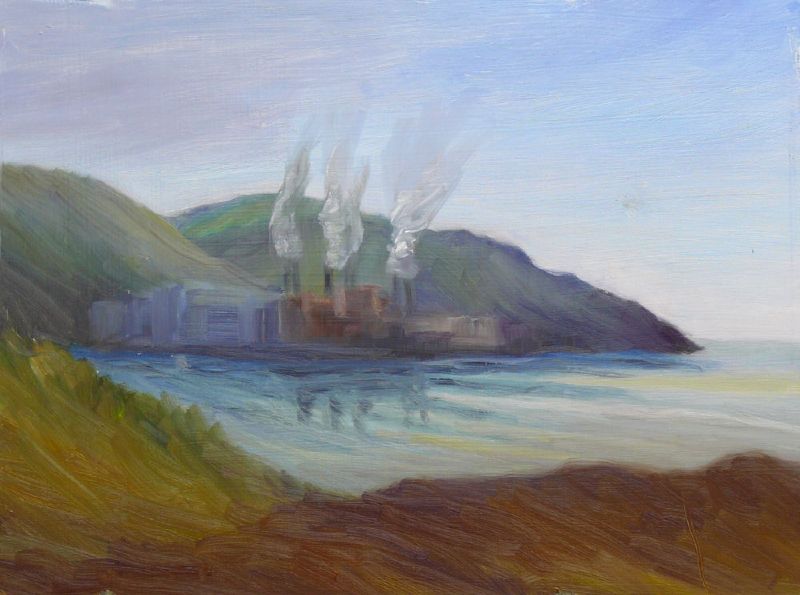
Crocket from Benicia State Park

Oil on masonite, 9×12″ (larger)

This one was painted on a hill in the cold fog at Benicia State Park’s Glen Cove. I’m pretty sure that’s the C&H Sugar Factory across the Carquinez Straights in the little town of Crockett but I’m not positive. It was a fun couple of hours on December 30 when Elio and I joined the Benicia Plein Air Painters for this paint out. It was a small gathering due to the cold, mud and fog and I didn’t last too long.

Categories
Animals Art theory Landscape Oil Painting Outdoors/Landscape Painting Plein Air

Point Isabel Dog Park & a painting breakthrough

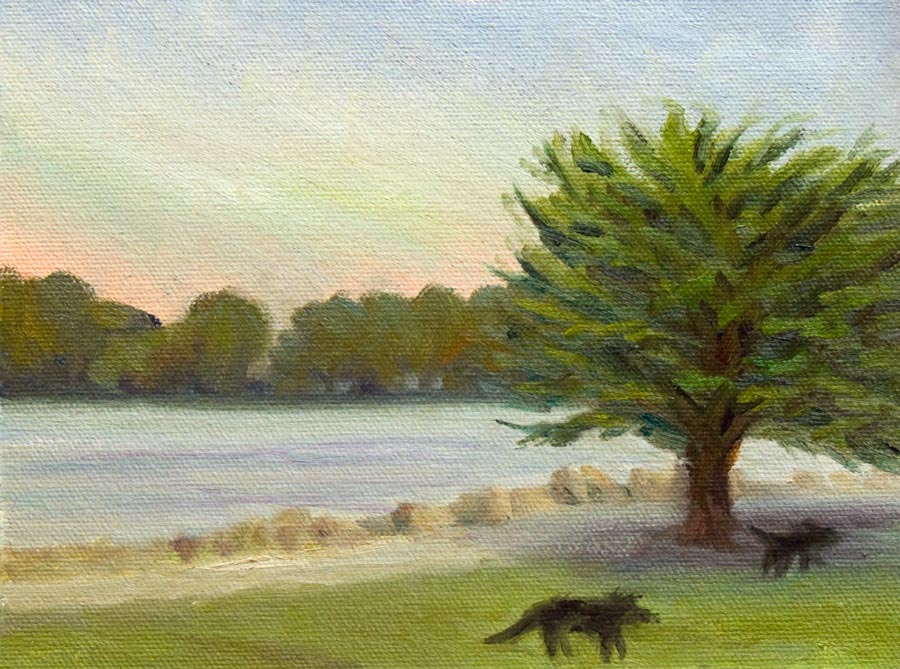
Point Isabel Dog Park Plein Air

Oil on canvas panel, 6″x8″ (Larger)

We’re expecting a series of big storms for the next week but the weather today was comfortable, no wind and in the 50s. Although I’ve been working on another painting and wanted to keep going on it, I couldn’t resist the opportunity to get outside and paint before the storm hits.

I headed down to nearby Pt. Isabel, an enormous park along the bay that is designated as an off-leash dog park. It has spectacular views of the Golden Gate Bridge but smog, fog and clouds made the visibility so bad that I picked a closer view.

I’m really excited about the breakthrough I had yesterday with oil painting, and how I was able to apply it to this little painting. Up until yesterday I’d been using various oil painting mediums to thin the paint and what I kept ending up with was thin, washed out, chalky, greyed, paint; stickiness and smell from alkyd mediums and smell (and toxins) from turpentine. I’d heard people say they used little to no medium and I couldn’t understand how that was possible. It seemed like the paint would be too thick and hard to manipulate without first thinning it down.

I finally tried it and was shocked to discover it works! Of course it means using a lot more paint, especially on this coarser canvas, but I was able to put down one layer of paint, and leave it. If I made a mistake I could scrape the paint off of that section and repaint it, no problem. Before when I tried to do that, there wasn’t really anything to scrape off because my paint was sooooo thin.

I did this painting in about an hour. I know the dogs look a little dorky, but it’s just a little oil sketch, so who cares. Then I was able to go home and continue working on the painting in progress in my studio. That painting is almost finished and I’m just so excited that after all the work and study I’ve put into oil painting it at last feels as if I’m getting somewhere. And I still have 5 more days of vacation!

Categories
Art theory Landscape Oil Painting Outdoors/Landscape Painting Plein Air Sketchbook Pages

Learning to Stop (making ugly paintings)

Plein Air - untouched in studio

Oil on canvas panel, 9×12″ (Larger)

The painting above is not great, but it’s loose and free and painted plein air with no touching up in the studio.

I’ve been painting and repainting the formerly plein air painting below over the past few days and it’s been both a good learning experience and discouraging. Mostly what I’ve learned is NOT to (re)do it. When I try to “just fix one little thing” I end up working for hours (days in this case), completely losing the freshness of the original plein air painting and, at the end of the day, finding myself right back where I started from, with dull, overworked paint.

This is the final version and I hereby VOW to not touch it again (other than to throw it in the trash!) I thought I vowed that yesterday and yet today I found myself trying one more time:

Briones again...the end

At several points in the process I had a good painting but just kept on fixing one more little thing until…well…it’s like scratching mosquito bites…I just keep scratching at until it bleeds and then I’m sorry. The original before messing with it appeared on my easel in my post about my studio here (first photo).

This was yesterday’s version:

Plein  Air - finished in studio

Part of the problem with retouching in the studio is that the reference photos rarely capture the colors and memories of the scene. This one sure didn’t and yet I continued to work from it and wondered why everything looked so dull!
Briones photo ref

(above: the bad reference photo)

Photoshopped photo reference

(Above) I even tried painting over the reference photo in Photoshop to try to use that as reference instead but I still ended up with mud.

So here’s what I’ve learned (AGAIN!):

  1. Stop! Don’t waste time. Make progress by painting more paintings not the same one over and over
  2. Use more paint and less medium.
  3. Mix the right color, put it down and leave it alone.
  4. Messing with a hopeless painting forever is not art, it’s OCD (obsessive-compulsive disorder). I need a painting alarm like those car alarms that say, “Step away from the painting…” or a Sister Mary Catherine to smack my knuckles with a ruler and snatch the canvas away from me…
Categories
Landscape Oil Painting Outdoors/Landscape Painting Plein Air

Benicia Plein Air Sketch and the Goose Lady

Benicia Plein Air

Oil on canvas panel, 9×12″ (Larger)
Painted plein air

Last weekend the two plein air groups I belong to combined and met at Matthew Turner Park in Benicia on San Pablo Bay. It was a gorgeous, sunny crisp day and a nice switch to be meeting in the afternoon instead of first thing in the morning.

There were a number of odd characters around entertaining us. A middle-aged woman sat in her car nearby us calling her dog (“Dog…dog…come here dog!”). Except there were no dogs anywhere in sight. There were lots of geese though, including one that seemed to be wearing a white, ruffled feather tu-tu.

She kept up her patter and eventually the geese wandered over to her car. For the next couple hours she barked commands at the geese, still calling them “Dog.” She lectured them about being too greedy, warned them they better start sharing nicely, and threatened to leave if they didn’t behave. It reminded me of when my parents used to threaten my sister and I when they were driving and we were misbehaving in the back seat, “If you don’t stop it I’ll pull over and give you both a spanking!”)

Then a man with a grey ponytail arrived and started talking to the geese and feeding them too. He claimed to know each of their names and their histories. The geese were apparently used to this treatment and were quite demanding, pecking at the feet of some of the artists when we first arrived before their benefactors got there.

I’d planned to finish and touch up this painting in the studio, but I’ve learned my lesson. After wasting the past few days trying to “finish” another plein air painting, I’ve decided to leave plein air sketches alone. I’ll make another post about that tomorrow with before and after pics.

Categories
Landscape Oil Painting Outdoors/Landscape Painting Plein Air

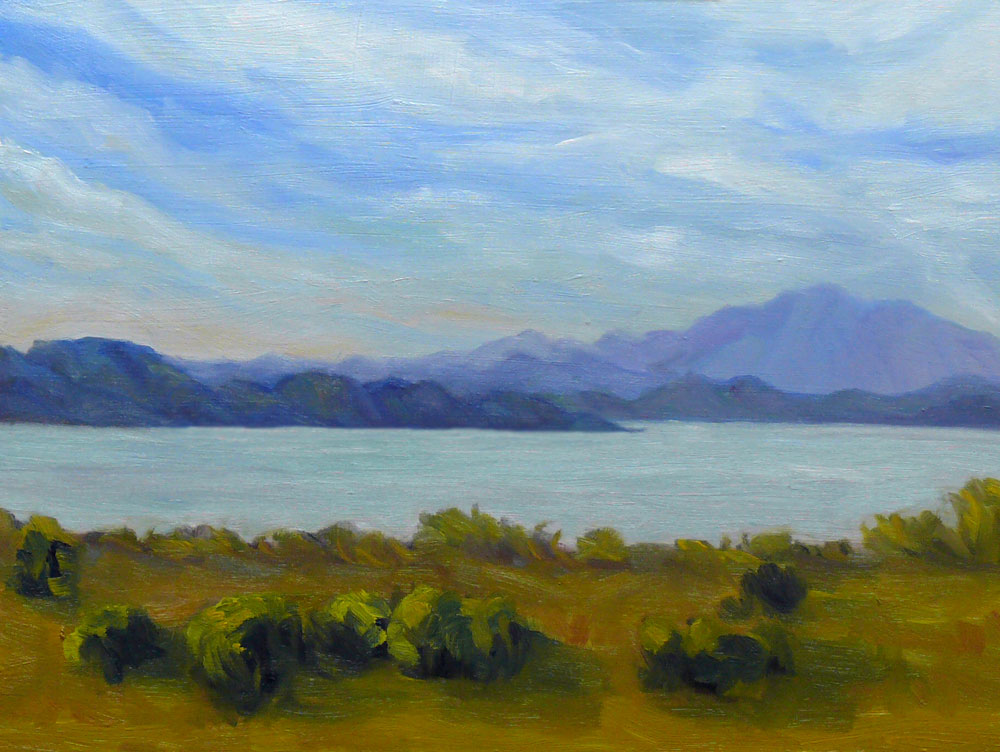
View of Mt. Tamalpais from Pt. Pinole


Oil on canvas panel, 9″x12″
(Larger)

I started this painting at Point Pinole last month but it had so many problems that I put it aside and never posted it. Today I decided to give it a do-over. It was either that or reclaim the panel by covering it in gray paint and using it for another painting.

When I compared my photo of the scene to my painting I could see how far off I really was — I’d both enlarged and shrunk the scene and painted distant details I couldn’t really see. So I did some redrawing, repainting, and I’m happy with the progress I’ve made and the understanding I’ve gained since the first version.

Of course there’s a huge difference in the level of difficulty between painting in the studio vs. painting plein air where the day’s changing light makes the scene change constantly. Even so, I’m missing painting outdoors and have vowed to get out there again next weekend, no matter what the weather. I wimped out this weekend while we were having a cold snap (for the SF Bay Area — frost in the morning and then temps in the low 50s during the day).

Categories
Art theory Landscape Oil Painting Other Art Blogs I Read Outdoors/Landscape Painting Photos Plein Air

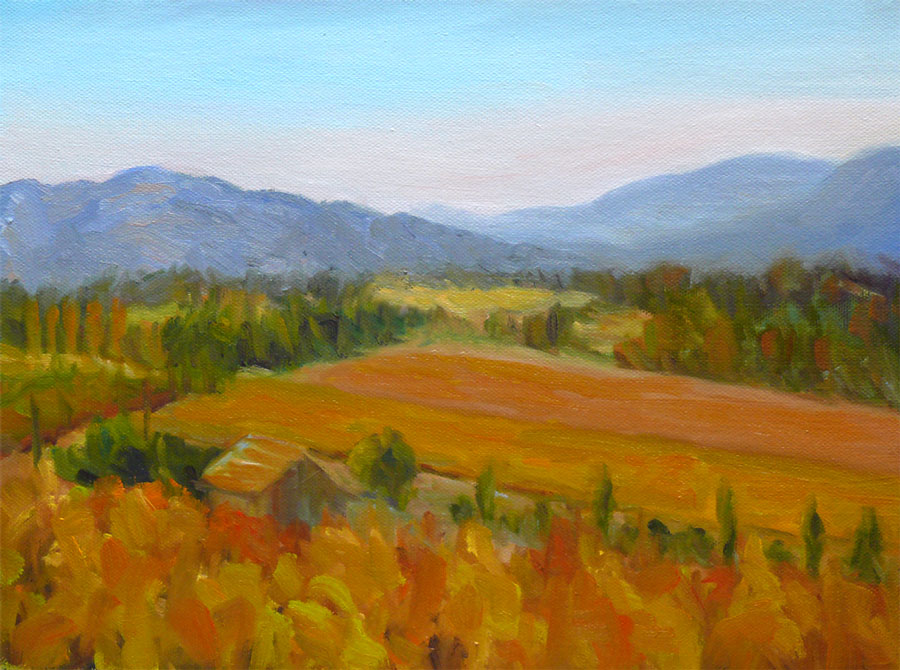
View from Viansa Winery

Oil on Canvas Panel, 12″x9″ (Larger)

On November 3 I went to Viansa Winery in Sonoma County with my plein air painting group. It’s a beautiful estate in the wine country with wonderful views in every direction. I painted the first layer of this painting on site and then today at home I painted another layer, correcting the original plein air sketch. I set my timer for one hour and completely redid the whole painting in about 45 minutes. Then I had dinner and when I came back I forgot my plan to do a one-hour painting and spent another two hours fiddling around with stuff I could have left alone.

As Karen suggested in her comment here a couple days ago, it’s good to focus on one goal per painting. I did that with this painting. My goal was to create a sense of distance, and I think I accomplished that. (Yay!) What’s interesting is that even though it’s only been three weeks since I started this painting, I see how much I’ve learned just in that short time…or maybe how much of what I’ve learned in the past year is starting to sink in and take hold. The on-site painting was out of proportion and very flat–no sense of depth or distance. But it was colorful which was my focus on that day — getting some color into my painting.

As I worked on this tonight I was thinking about two things my teacher recently pointed out to me that applied to the problems I’d had with this painting:

  1. Paint the dog before the fleas (in other words, get the big shapes in before starting on the little details)
  2. When you have man-made objects in a painting, such as buildings or fences, they have to be the right size or the whole painting will look wrong because we know what the object is and what it’s size is.

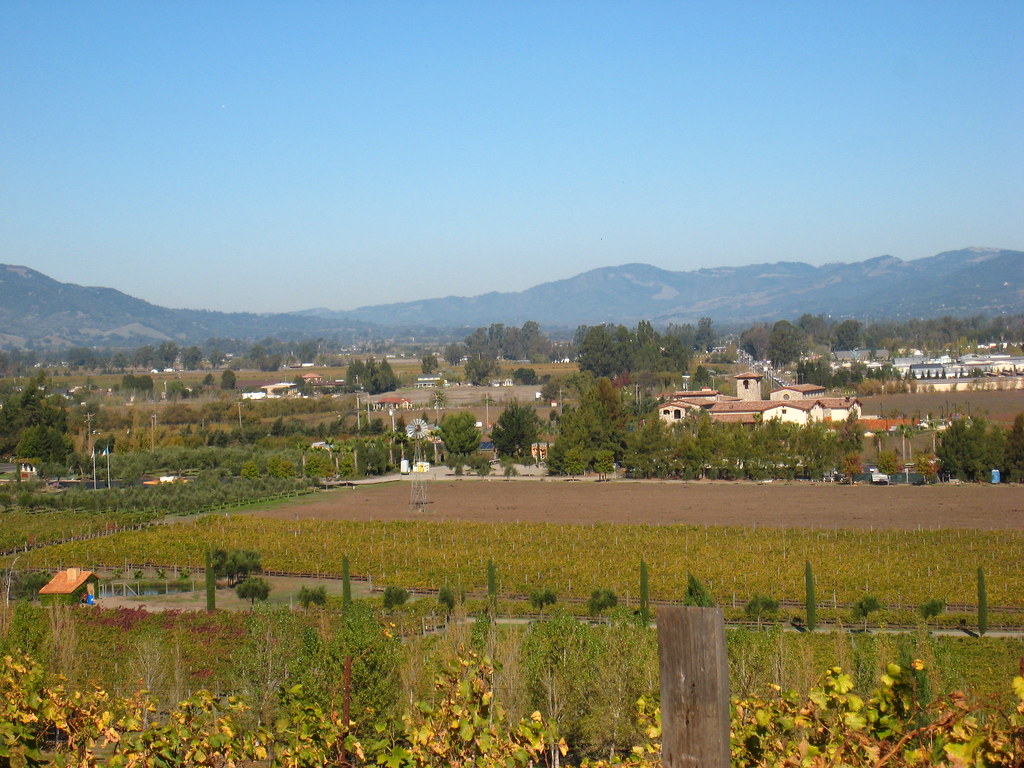
Here’s the photo I took of the scene:
View from Viansa Winery Photo
Larger

In the original version I got really involved in painting the little building in the front left and the bigger one halfway back on the right. But I’d made them bigger than they should have been so I could paint the details. And they were definitely the fleas, not the dog!