Categories
Berkeley Landscape Life in general Oil Painting Outdoors/Landscape Painting Plein Air

Wrong side of the tracks in Rodeo & Trash and Art

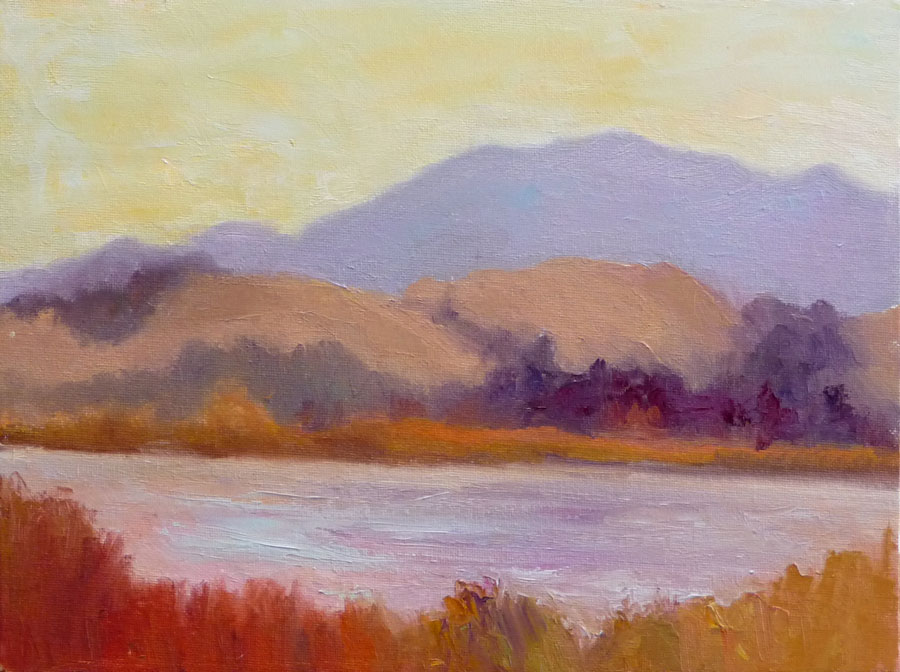
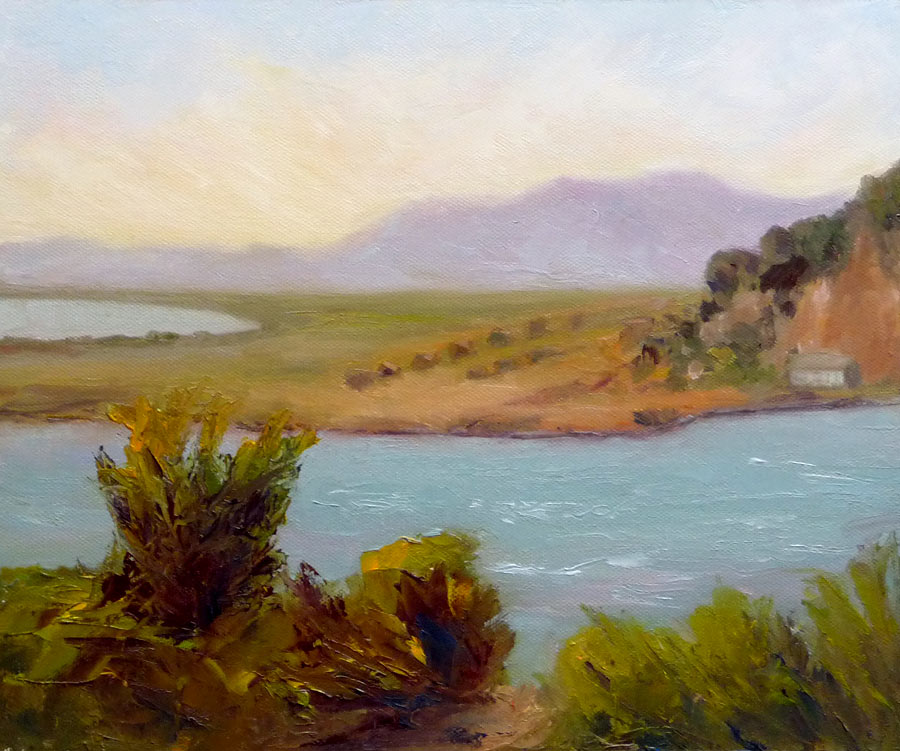
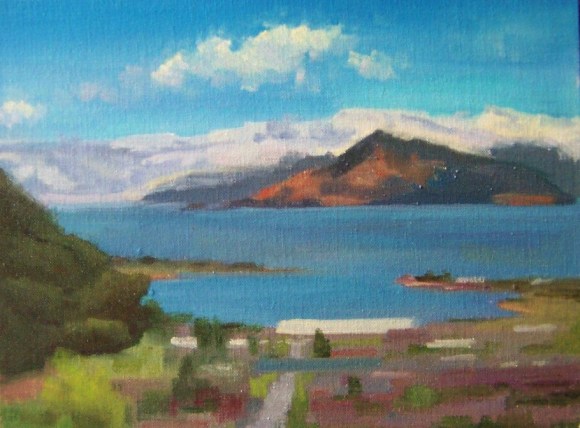
Rodeo Shore, plein air oil on panel, 9x12 in. (click image to enlarge)

The little shoreline park in Rodeo where we painted Sunday is funky like the town itself, but a fun place to paint.  Click here to see some of Sue Wilson’s cool photos of the area or her little video of some of us in Da Group painting there. This beach is about 40 feet from the railroad tracks where freight trains and Amtrak trains rumble by, whistles blowing, every 20 minutes or so.  One train made me laugh: an engine pulling another two dozen engines which were all riding backwards. It looked so silly.

On the north end of the little beach there’s a broken down old pier and a couple of tin shacks. The shacks and pier are all that remains of the “resort” that a man with big dreams (but apparently little common sense) built there on a former industrial dump. In his later years he allowed a homeless encampment to flourish on his property. When he died his heirs had the vagrants evicted. To get even, they burned the resort down to the ground. The property is worth less than nothing because of the clean up needed due to the toxins under the ground.

Dumps to Cities

Most of the bayfront land in the San Francisco Bay Area is built on former dumps. A combination of ignorance, greed, and “out of sight, out of mind” thinking, led cities and businesses to dump everything from tires and batteries to whole cars; from industrial waste to ordinary garbage into the beautiful bay, eventually creating “landfill” upon which homes, hotels, parks and major freeways were built.

I remember going to the dump at the Berkeley waterfront where you drove up  (holding your nose) and dumped your trash in a pile on the ground, seagulls flying overhead. Then the bulldozers would push it into big hills. Now that dump is hidden under  Cesar Chavez Park, home of the Berkeley Kite Festival. The park has air vents to allow the methane gas to escape from the garbage dump buried underneath the grassy hills and waterfront trails. Vents won’t help buildings on landfill if there’s a big earthquake and the landfill undergoes liquefaction.

Now trash goes first to a warehouse “transfer station” where it is sorted and then piled onto trucks and hauled to a dump/landfill in another town. (And in my own bit of “out of sight, out of mind” I realized I didn’t know where it went and had to look it up). It’s trucked to Livermore, land of rolling hills and wind farms.

Dump amidst the lovely Livermore rolling hills

I’ve heard that all the Bay Area dump/landfills are all going to be full within the near future. I hope we learn to do a better job of recycling and precycling before that happens.

Trash and Art

And now to tie this digression about dumps back to art, San Francisco offers an artist in residence program at the Solid Waste Transfer and Recycling Center where San Francisco’s garbage goes before being trucked away. Artists get 24-hour access to a well-equipped studio, a monthly stipend, and an exhibit at the end of their residency.

Categories
Oil Painting Painting Sketchbook Pages Still Life Watercolor

Persistently Painting Potatoes

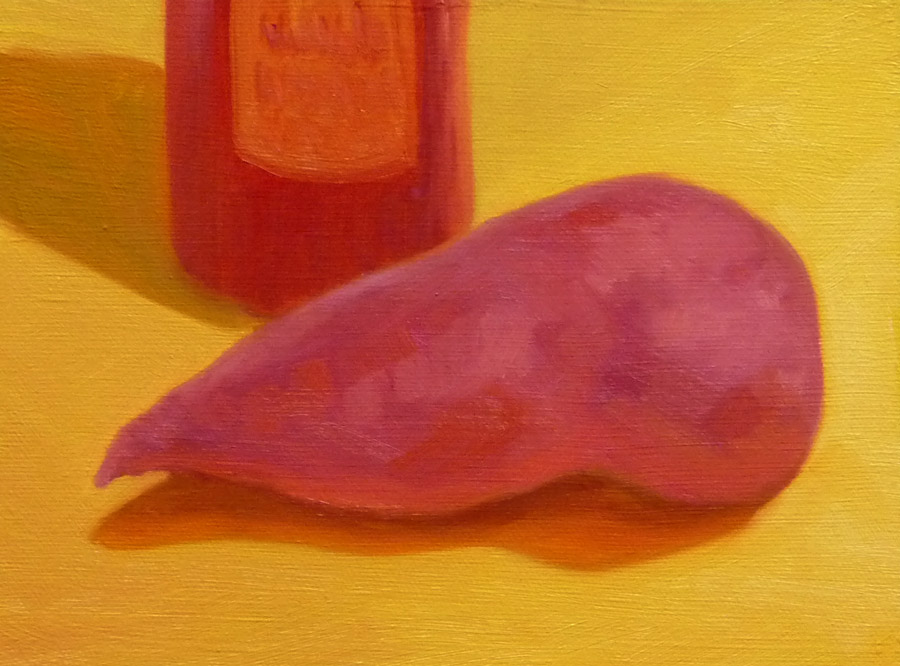
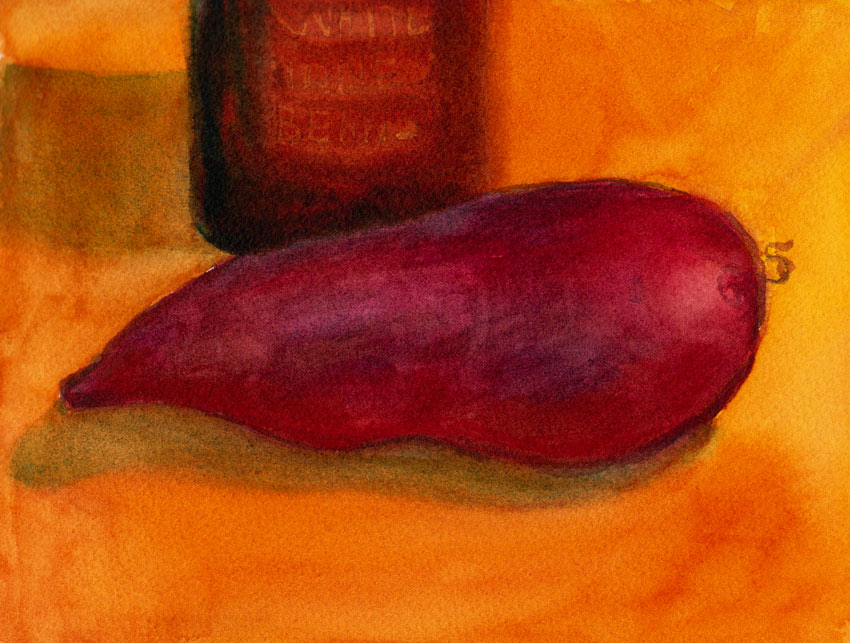
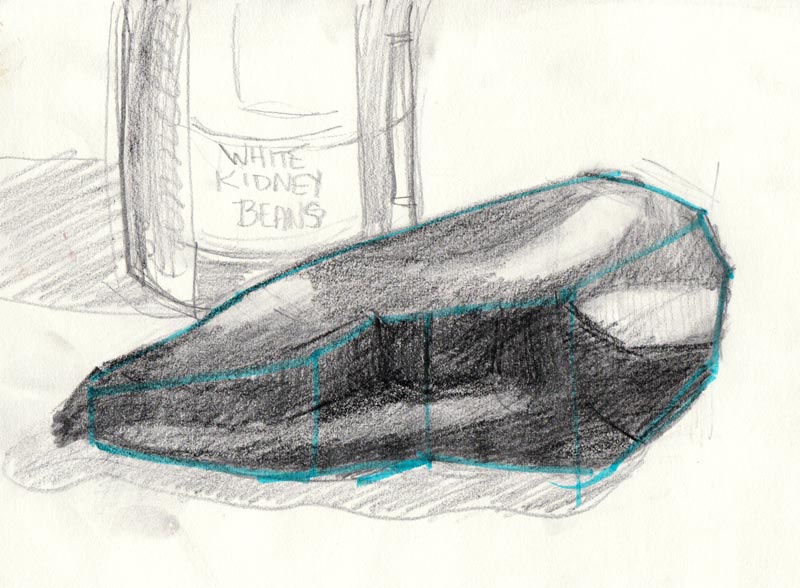
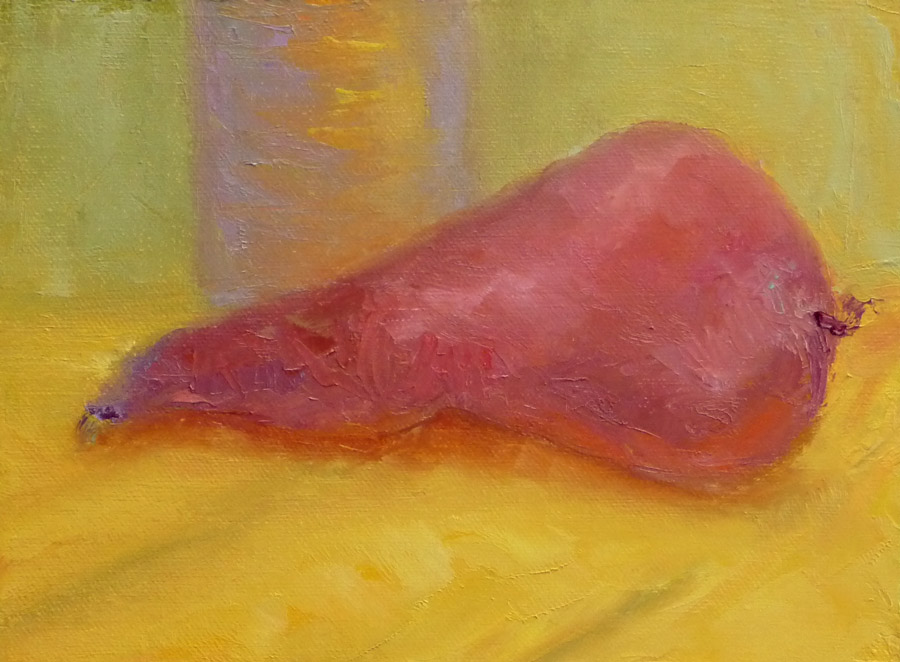
Feeling frustrated from failing to form a faithful facsimile of a silly spud I sought some solutions. (I’ve always loved alliteration.) Displayed below in reverse order (last version first) are my efforts in trying to understand the shape of one homely sweet potato (and a can of beans).

Oil painting #2, after sketch and watercolor study, 6x8", on panel
Sweet Spud #4 , Oil on panel, 6x8" (after watercolor study and sketch below)
Sweet Potato watercolor study, 6x8" on Arches wc paper
Sweet Spud #3, watercolor on Arches cold pressed paper, 6x8"
Pencil sketch to try to understand planes and volume, 6x8"
Sweet potato #2 (Pencil sketch to try to understand planes and volume), 6x8"
First oil painting before doing the studies, 6x8", on panel
Sweet Spud #1, (First oil painting before doing the studies) 6x8"

I think I like the watercolor best, what about you?

Categories
Landscape Oil Painting Outdoors/Landscape Painting Photos Plein Air

Tilden Park Trail: A perfect day for a hike

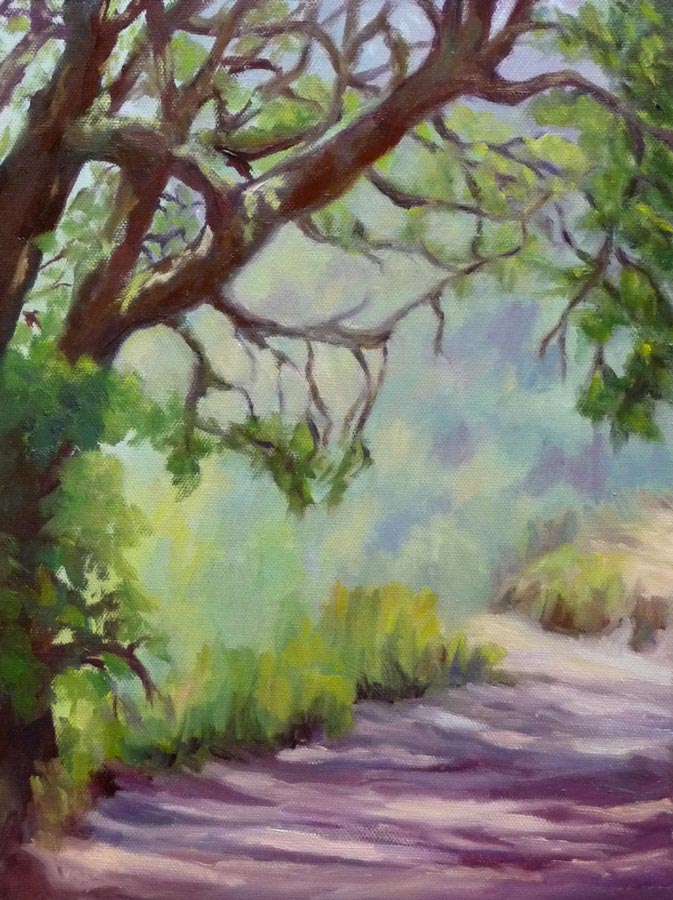
Tilden Trail, Oil on canvas, 9x12" (click images to enlarge)
Tilden Trail, Oil on canvas, 9x12

Last Sunday it was a perfect day for hiking in beautiful Tilden Park in the East Bay hills above Berkeley with my best friend Barbara. When we came upon this scene I had to stop and take photos to use as reference for a painting, along with my memories of how the scene felt to me.

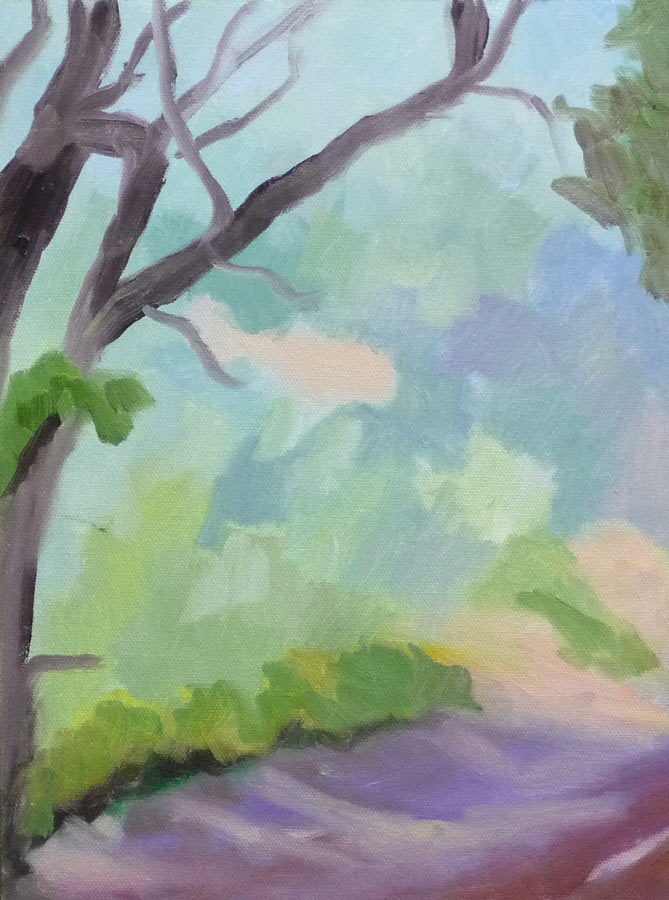
Late that night instead of going to bed I gave myself one hour to block in the basic shapes and get the painting started:

First draft of Tilden Trail painting

For a variety of reasons it was a whole week before I could get back to the painting. After spending this  afternoon and evening with the painting I think it’s finished (or nearly so). I really tried not to lose the things I liked in the first “draft” and for once (I hope) I stopped before it got overworked.

This is the first oil painting I’ve done that I’ve been happy with from beginning to end. I know I still have a long way to go with learning (which is good since learning is my favorite thing), but I’m happy that all the studying and practicing I’ve done is beginning to allow me to get an image on canvas that I can see in my mind and feel in my heart, like this one.

Categories
Oil Painting Outdoors/Landscape Painting Plein Air

My neighbors’ garbage

Garbage in the Sun, 10x8", oil on panel (click image to enlarge)

When my neighbors saw me painting their trash cans, with my easel set up in the driveway, they didn’t even look surprised. They know I’m a nutty artist and so they just apologized for interrupting my painting to throw some bottles in the recycling bin.

The truth is, I am easily amused and can find almost anything interesting to paint or draw. Seeing these  city-issued garbage cans glowing in the sun, transformed from their usual blah colors, seemed a perfect subject for a quick oil sketch last weekend.

When I showed the painting to my painting teacher Camille, she said I’d done a good job with showing that it was a sunny day, but that I should lose the detail and focus more on the difference in value between top, side and front, to better indicate the direction of light and dimensionality of the cans. And she’s right, of course.

What’s the weirdest, oddest, or nuttiest thing you’ve drawn or painted?

Categories
Art theory Landscape Oil Painting Other Art Blogs I Read Outdoors/Landscape Painting Plein Air

Dry Wetlands: Where’s the water?

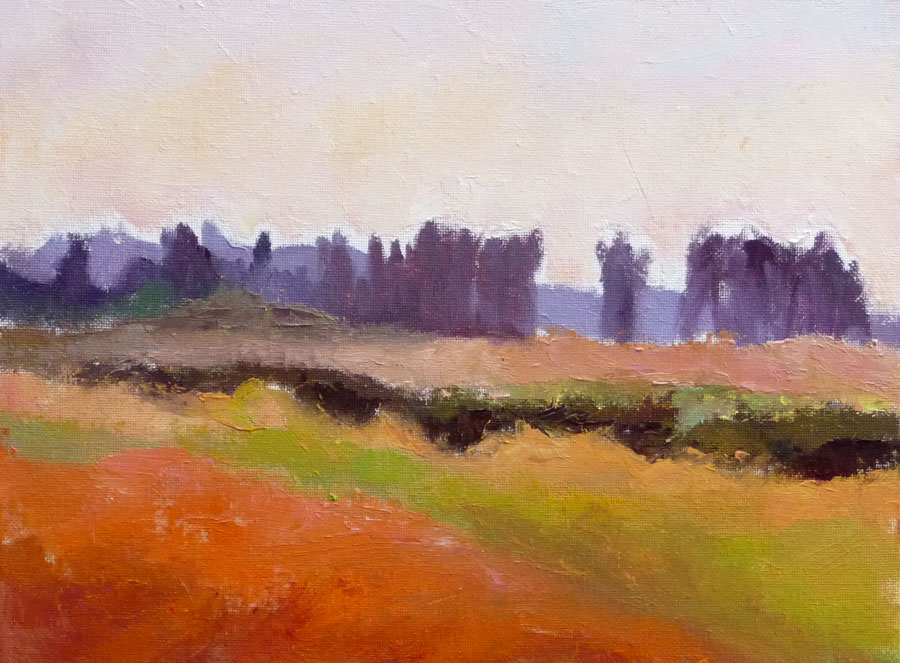
Shollenberger Wetlands, 12x9", Oil on panel (click image to enlarge)
Dry wetlands sketch, 12x9", Oil on panel (click image to enlarge)

Shollenberger Park is normally a watery paradise where you see swans, herons, egrets, pelicans, geese, turtles, frogs, lizards and the occasional harmless snake. But when I arrived there this morning with Camille Przewodek’s class, we were surprised to find cracked dry soil where the watery marsh used to be. Camille said she’d been painting there for years and had never seen it dry before. You can see many of her marsh paintings on her website here.

She set up for her demo in the hot sun, on land that used to be under water. Seeing her paint is like watching a magician, the way she creates the illusion of space, depth, atmosphere, weather, even time of day, all done with color relationships.

The smell from the dried up marsh was making me nauseous but nothing phases Camille when she’s painting. She never complains, whether it’s hot or freezing, windy or smelly; she just gets in the zone and paints. Her students know better than to whine about weather or anything else; or as one student pointed out:

“It’s called ‘PLEIN Air’ NOT ‘Complain Air’!”

About the paintings:
Both of these 1 to 2 hour plein air sketches were done at the marsh, trying to work on getting the big shapes and color relationships. I think my easel must not have been level today; the horizon seems to be slanting downhill on today’s sketch above.

Shollenberger Wetlands sketch, 12x9", oil on panel (click image to enlarge)

When I got home I tried to find out what happened to the water at Shollenberger but couldn’t find anything online. I did learn some interesting things about wetlands and what a valuable and important resource they are on the Petaluma Wetlands site.

I know we’re having a drought in California, but I don’t see how such a large body of water could dry up that quickly from being full just a few weeks ago.

I hope all the birds and fish and froggies are OK.  If you know what’s going, please do tell!

Categories
Landscape Oil Painting Outdoors/Landscape Painting Plein Air

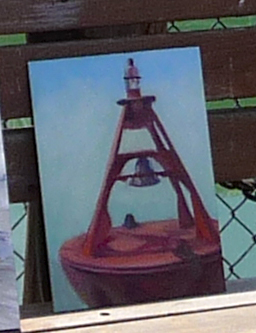
Is it called a “Bell Buoy?”

Old Bell Buoy, Oil on panel, 12x9" (click image to enlarge)

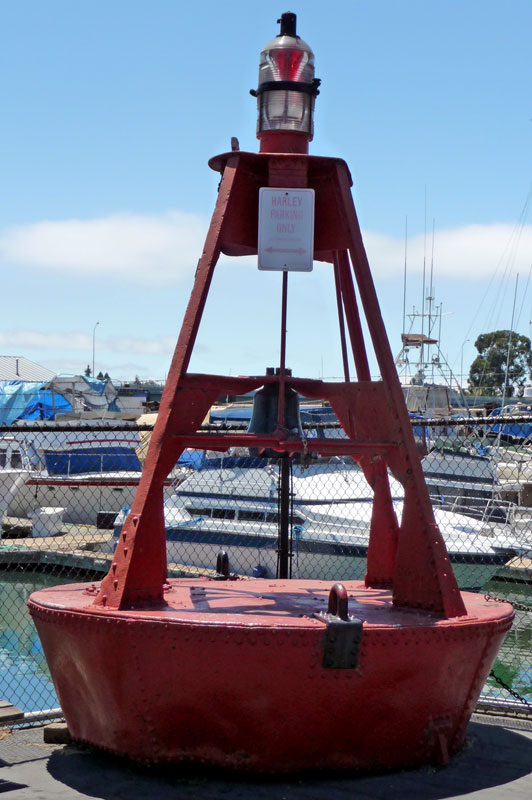
If this is a “Bell buoy” I wonder if there is any connection to “Bell Boys”–did the latter get named for the former? (A beacon of light with a bell to warn you of dangers?–probably not). At any rate, this is a buoy and it has a bell, so I suppose the answer is yes, but somehow it just sounds funny to me… I keep picturing hotel bell boys weaing red hats with a bell mounted on top.

I didn’t paint this aboard a boat in the middle of a foggy sea. This huge old buoy (about 20 feet tall) is actually parked in front of Quinn’s Lighthouse in Embarcadero Cove near Jack London Square in Oakland but when I started painting it was so foggy we could have been at sea.

I arrived at 10:00 a.m. and there were so many interesting subjects (Victorian buildings, gazebos, gardens, boats, Quinns) that I wandered for nearly an hour, trying to choose. I finally picked this and got to work with only two hours to make the painting before our 1:00 group critique.

I nearly finished the painting in the two hours, with just a few details to touch up once I got home. Someday I will learn to leave a plein air painting alone! I started touching up a little here and there and before I knew it, I’d mucked things up. Then I  spent the next several hours unsuccessfully trying to get back to what I had originally, which I’d really liked.

Plein air finish before studio "touch up"

Despite my efforts, I couldn’t quite get there.  I lost some of the darks, fresh bright lights and interesting color variations I had. Maybe when it’s dry I can do a little glazing and solve those problems, but without being there and painting from life, it’s just not the same, even with a good memory (which I don’t have) and a photo (which I do, below).

Photo of the buoy
Photo of the buoy
Categories
Landscape Oil Painting Outdoors/Landscape Painting Plein Air

Above Dead Fish Restaurant, Crockett

View from Dead Fish Restaurant

(Larger)
The Dead Fish Restaurant is on a hill in Crockett, California and just above it there is a wonderful new little park with amazing views of Mare Island (pictured above) a former military base and naval shipyard, Benicia, and the Carquinez Bridge.

I arrived at the site close to 4:00 p.m. and painted until around 6:00 when some persistent wasps (I think they’re wasps — they’re the yellow buzzing things attracted to meat at picnics) finally drove me away. One kept trying to crawl up my sleeve or into my rubber glove and bit me twice on the wrist.

To anyone watching from a distance I’m sure I appeared to be painting with great flourish as every stroke required swiping at the wasp to move him before I could put a bit of paint on the canvas. That combined with the sun glaring in my eyes and the heat and the fact that everyone else in the plein air group had already left, convinced me it was time to go home.

It’s too nice outside right now to be on the computer so I’m going to keep this short and go paint. I’ve made some changes and additions to my studio that I will post soon as well as some of the paintings and drawings done while I’ve been spending more time in the real world and less in the virtual one while my computer was in the shop. See you again soon!

About the painting: Oil on canvas on panel, 10″x12″, painted 75% on site and 25% in the studio.

Categories
Landscape Oil Painting Outdoors/Landscape Painting Plein Air

Port Costa’s St. Patricks Mission Church

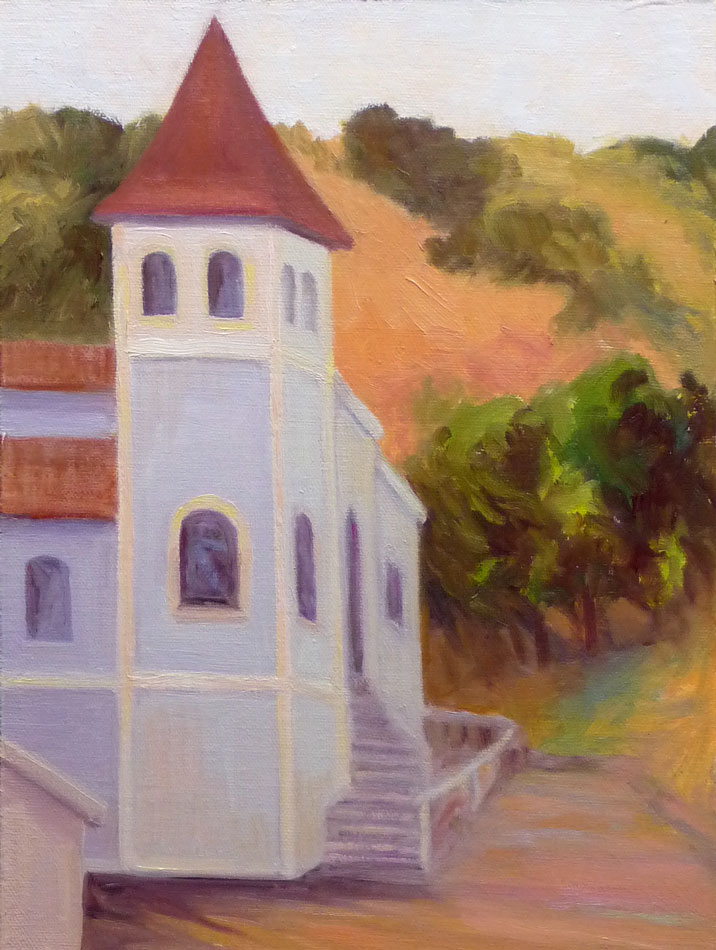
Port Costa St. Patrick's Mission

(Larger)

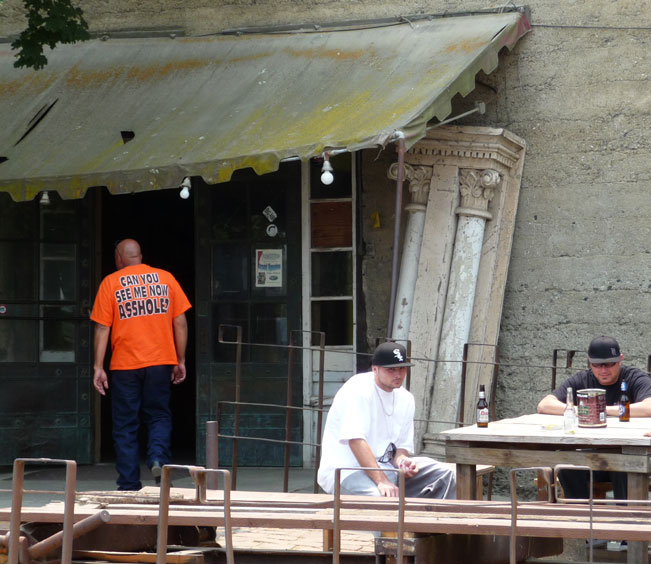
After gusts of wind blew dirt in my face,  a couple of trains roared by, and a bunch of motorcyle guys on Harleys rode up to have a nice morning beer at the saloon (below), I decided to move from where I originally set up in the unpaved parking lot at the end of the road in Port Costa. One of the motorcycle guys was wearing a DayGlow orange T-shirt that proclaimed, “Can you see me now ASSHOLE?!”

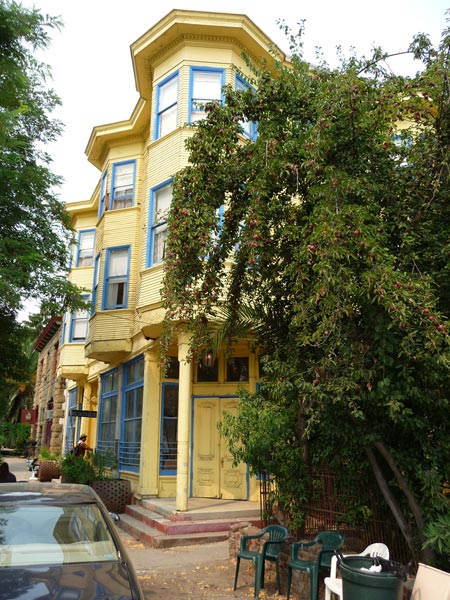
Porta Costa is a tiny town (pop. 250) founded in 1879 as a port for merchant sailing ships, with warehouses, saloons and hotels on waterfront wharves. A few of those original buildings are still there and (except for the church) appear not to have been painted or maintained much since then. This is the hotel that I was originally going to paint, which was originally a bordello and is supposed to be haunted:

I headed up the tree-lined street a couple of blocks and set up behind a watercolor painter from my plein air group who was also painting the church. Halfway into the painting session, automatic sprinklers turned on beside us, spattering the watercolor painter’s full-sheet painting, creating interesting textural effects on her church.  The occasional sprinkle was a welcome relief from the muggy heat for me, since water doesn’t affect oil paintings.

About the painting:

Oil on panel, 12×9″

I ran out of time before our group critique at 1:00 and didn’t get to paint in the beautiful tree that was in front of the church. I figured I could finish it from a photo at home, except that I forgot to take a picture of the church (duh!) I put in a few details from memory and skipped the tree.  The painting was done between 11:00 a.m. and 12:45 with the  sun straight overhead so there wasn’t much modeling or shadows except under things.

Categories
Life in general Oil Painting Outdoors/Landscape Painting Photos Plein Air

Cemetery Conversations on July 4th

Low Tide from Sunset View Cemetery

Version 1: Low Tide: S.F. Bay from Sunset View Cemetery, Oil on panel, 9×12″ (Larger)

UPDATE (one week later):

I did a little revising on the painting below, trying to work with the suggestions people offered. I think there are some improvements (I like the distant hills better and I toned down the sailboats and removed the sign and tried to make the town look more like buildings). I feel like I’ve taken it as far as it needs to go as a sketch.

Version 2:

Revised Cemetery View

Below is my painting buddy Peggy’s painting of the scene (the title is a reference to the view from a cemetery). She painted the clouds and water as they were at the end of our session. With plein air painting you’re always painting what you remember or what you anticipate.

Peggy Anderson: “Angel Island from the Afterlife”

:
What I really wanted on the Fourth of July was a quiet day at home but I’d made plans with a couple of painting friends to go up to the nearby Sunset View Cemetery to do some plein air painting. It was a typical July morning in the San Francisco Bay Area: cold, windy, foggy and cloudy, and even more so on top of the hill where I decided to paint, a spot called “Viewpoint Garden,” with a widescreen view of Albany, El Cerrito, and, shrouded in fog, Angel Island and Marin County across the bay.

Before I got my gear out of the car, a large Chinese family arrived and started heading up the path to the viewpoint. I asked if they were having a service there, and they sent their only English speaker, a young man, to talk to me. He said it was just a small family service and they’d be done in half an hour.

Flowers for the Dead not the Deer

While we were waiting at the edge of the garden, an elderly Asian man came up the path carrying a basket of flowers which he was putting in holders at numerous graves. I asked him if he worked there (thinking people paid to have flowers maintained at gravesites) and he said, “No, these are all my friends and family…over there is my wife, that’s my brother, that’s my best friend, and back there are my parents and two of my other brothers. They all wanted to have a nice view.”

He said that he was 91 years old and grew the flowers in his garden. He showed us how many bouquets were scattered around the grass, having been pulled out of their holders and chewed up my the local deer. He only grows flowers that deers won’t eat to bring to the cemetery on his weekly visits.

Burning Stuff for the Departed:

Meanwhile, the Chinese family were lighting things on fire (possibly paper models of stuff the deceased might need or always wanted in life but didn’t get, according to this article) in a large trash can, creating huge amounts of smoke, as well as burning incense, and taking turns bowing numerous times before the grave of their dearly departed.  I asked the elderly man if they were his family too and he exclaimed loudly, “NO! They’re Chinese, I’m Japanese!” (Oops.)

I suggested he talk more quietly so we wouldn’t bother the family but he continued speaking loudly (despite his two hearing aids), saying, “Oh, we’re not bothering them. Those Chinese people are always burning stuff here and I don’t like it!” Then he regaled us with his (mostly) interesting life history. By then the Chinese family had put out the fires and packed up and headed out, thanking us for waiting. We looked at the grave afterward and it was a man who’d died a year earlier.

Buried standing up?

We were trying to figure out why the graves were so close together in that area—just little placques in the ground a few feet apart. We decided it must be urns of ashes that are buried there, although at first I wondered if people were buried standing up to save space. While that’s unlikely, given the way we think of the dead resting in peace, it did strike me that it would be a perfect metaphor for my life, since I’m always on my feet, on the go, trying to fit so much into every day. It made me tired just to think about spending eternity doing the same.

Catching a Rapist:

Then Peggy  told us about a friend who’d helped catch a wanted rapist. She’d been hiking in a park and decided to use the Porta-Potty. The door was unlocked but when she opened it there was a man inside who gleefully exposed himself. She ran and called the police once she was safely away. The police arrived, arrested him and told her he had a history of multiple rapes. He’d been known to watch a woman park her car and go into the woods. Once she was out of sight he’d disable her car and then offer to “help” her with it when she returned. Yikes!

About the painting:

Despite a very good start, after several hours I’d made a mess of the painting, and eventually got so mad at having lost all of the good beginnings (and the whole day) I rather violently scraped the panel down and threw it away. I’d taken photos of the scene and decided to start the painting over again at home. A migraine on Saturday delayed it another day, but finally on Sunday I gave it another chance and finished it today.

What attracted me to the scene originally was the way the low tide left little stripes of water over mud in the little harbor but by the time I set up and did the initial drawing, the tide came in and it disappeared. I’d never tried to paint an urban view like this before and couldn’t figure out a good way to do it and scraped it off several times, after either getting too detailed or too vague.

Finally, working from the photo, I decided the only solution was to TURN THE PHOTO and the PAINTING UPSIDE DOWN and just paint shapes upside down! That seemed to help. I also really wanted to capture the look of a gray day with some sun and clouds and fog.  This was definitely a tough one and I don’t think I completed succeeded on any of my goals.

That sign sticking up at the bottom in the middle is for 99 Ranch Market, a Chinese supermarket in Albany whose sign really does reach that far above everything else. When I looked closely at my photo there was also a giant red gorilla balloon advertising a carpet store to the right of the sign, but I didn’t put that in the painting. It’s one thing to “Paint the dog before the fleas” but entirely another to paint the landscape before the red gorilla!

If you have any suggestions to improve the painting, I’d be interested to hear them. Here’s the original photo (click to enlarge it):

Categories
Flower Art Glass Oil Painting Painting Plants Still Life

Orchids in Green Bottle & Mental Spam

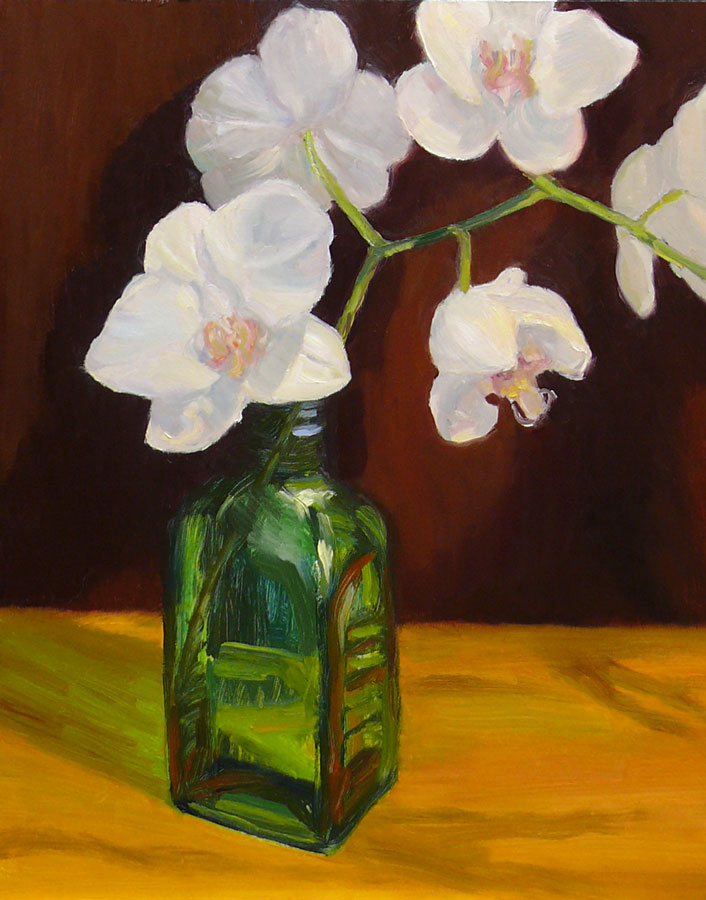
Orchids in Green Bottle
Oil on panel, 14×11″ (larger)

I love painting glass and was happy with the way this bottle turned out. I tried to use the same free and fun approach I take to painting glass in watercolor and it actually worked this time. I wish the flowers were as easy.

It’s easier to show off the beauty and delicate nature of flowers in watercolor than in oil paint, especially white flowers. In watercolor you don’t use white paint, but rather leave the brilliant white of the paper for white areas.

White oil paint can look blueish, cold, chalky and dull so in oil painting you have to create the illusion of warm glowing light by placing either dark or subdued, neutral, or grayed colors beside the white so in comparison it looks bright.  It also helps to add a little yellow or orange to white paint to warm it. I tried doing all of the above in this painting, but still struggled with the white flowers, scraping and repainting several times.

I read an inspiring and funny post on singer Christine Kane’s blog called “What Spam Can Teach You About Inner Peace.” It’s really worth reading if you have one of those annoying inner critics who says mean things about you or your artwork. While you’re there, check out another post of hers that is helpful for artists and/or self employed people, “How to Get Off the Hamster Wheel.”