Categories
Art theory Faces Other Art Blogs I Read People Portrait Sketchbook Pages

Drawing Famous Faces & Copyright Info for Artists

Faces-1-LM

Ink (Pentel brush pens) in Aquabee Deluxe 6×9 sketchbook
To enlarge, click image, select All Sizes

My painting group buddies Lea and Susie are taking a monthly portraiture class from local artist Myrna Wacknov. One of the homework assignments they’ve worked on during our painting group sessions is to take two sheets of watercolor paper and divide each into 8 sections using strips of tape. Then on one they draw the same person 8 times using different colors, techniques, lighting, etc. on each image. On the other they do eight different people but unify them in some way. Judith isn’t taking the class but jumped in anyway and is painting a sheet of 8 angelic portraits of George Harrison from an old Rolling Stone cover.

Then I found the book “In Character: Actors Acting” at the library, with 250 pages of photos of character actors’ faces showing every kind of expression and feeling. I couldn’t resist joining in. I bought a used copy of the book and plan to go through it, flipping it open to a page and making drawings or paintings in my sketchbook. This is the first one. There were two photos of this guy on the same page and I got distracted and accidentally drew his left eye from one photo and the right eye from the other photo. He was looking in different directions in the two photos–he’s not really wall-eyed, poor guy.

Copyright issues:
I did some research about whether I need copyright permission to use these photos in drawings. The answer is yes and no… BUT since I doubt anything I draw will look “substantially similar” to the original photo (or the person I’m drawing!), I’m probably OK.

Here’s what I learned on a page about copyright rules for illustrators:
Q: What are the rules when it comes to illustrating celebrities?
First of all, if you’re not working from your own photographs or memory, you need to obtain permission from the photographer who created the photo you will be using as reference material. (You do not need to get permission from photographers if you create portraits or caricatures based on dozens of photographs from different sources and you are careful to not to include elements that would make it obvious you copied from a particular photograph.)

Q: Can I use someone else’s photograph as reference material for a painting I’m creating?
If you’re copying a photograph, you must get the photographer’s permission…Even though it’s in a different medium, you’re violating the photographer’s copyright if you copy a photograph in your painting.
BUT….
To constitute a copyright infringement, a “copy” must be “substantially similar” to the original work. If your finished illustration looks different from any of the originals you used as a reference material, you shouldn’t need to obtain permission.

Categories
Life in general Other Art Blogs I Read

Who Needs Paint Anyway?

I was looking for videos of painting with oils on the web when I came across this crazy video. I don’t usually post stuff like this, but I just loved watching this guy quickly paint a portrait using nothing but ketchup and fries from McDonalds. Since I spent the day with my friend Richard while he tuned up my aging computer and then had pizza and a movie with friends tonight, my sketchbook has nothing worth showing so I thought I’d share this video instead.

Categories
Art theory Drawing Faces Other Art Blogs I Read People Photos Portrait Sketchbook Pages Watercolor

Painting vs Preparing to Paint (& Portrait Request)

Fake Dane's Portrait

Brown Micron Pigma ink and watercolor in large Moleskine Watercolor notebook
To enlarge, click images, select All Sizes

The other day I got a mysterious email from someone calling himself “Fake Dane.” He wrote, “Hey, I think your art is great. I was wondering if you’d be willing to sketch me from a picture. I’m assembling a collection that I’d post. Dane”

And he sent me his photo. If you want to draw him too, just click the photo below and select All Sizes when you get to Flickr and then you can print it out:

Fake Dane's Photo

I wrote back, “Sure, why not?” and did the sketch above. I was going for caricature so I hope he’s not offended. (UPDATE: He replied and said he really liked it and put it on his blog. There’s some funny drawings of him as a vampire there too.) If you want to do a drawing of him and send it to him too, there’s instructions in the “Please Read” sidebar on his blog.

It was a fun, quick painting project on a day in the studio that was mostly spent at the computer, trying to sort out photos and compositions for upcoming paintings, something I don’t particularly enjoy doing. And that made me think about the differences between…

Alla Prima/Plein Air vs carefully planned painting

When I’m planning a painting I consider focus, value, composition, color scheme, etc. I do thumbnails and value sketches. If it’s something requiring exact proportions, such as a portrait of someone’s child, pet or home, I’ll start with a drawing and then work from a photo, tracing it onto the watercolor paper. But even with more carefree subjects like flowers and still life or landscapes, that prep work saves a lot of frustration once painting is underway. I’ve learned that lesson the hard way.

On the other hand, my understanding is that people who regularly paint alla prima (in one setting) or plein air make the prep work quick and intuitive and let go of exactitude, painting their impression of the subject rather than a careful rendering. I’ve done some and it’s a lot harder than people like Kris Shanks, Nel Jansen, Ed Terpening, and others whose blogs I enjoy visiting, make it look.

What I’m trying to figure out is how to combine the two approaches, or how to avoid all the labored pre-planning. Judy Morris, the teacher of the workshop I took in February, said that her favorite part is planning and composing from photos, not the actual painting. For me it’s the opposite — while I enjoy drawing, I love painting more and don’t really enjoy spending a lot of time photoshopping compositions and sorting through photos at the computer. (She does the prep work manually, working with black and white photocopies and enlargements of the subject and background, which she cuts out and assembles.
On the other hand, if I don’t do the pre-planning (especially with watercolor) the whole painting ends up being a study that has to be done over. I guess with acrylics and to some extent oils, one can just keep working on and changing a piece until it’s right, but I’m not sure if that’s a great way to go either.

I’m hoping to find my own way of working that incorporates the best of both worlds.

Categories
Acrylic Painting Gardening Other Art Blogs I Read Outdoors/Landscape Photos

An Artful Life

I’m doing something different today, inspired by a visit to my best friend Barbara’s house today — I’m sharing some of her wonderful artwork and photos of her garden. She truly lives an artful life and every corner of her little house and garden has something to delight the eye and spirit.

Images can be enlarged by clicking them and selecting “All Sizes”

Left: Life size ceramic woman (celebrating retirement and gardening). Right: View from the front porch. Just beyond this is the lush vegetable garden.

When Barbara retired not too long ago, she completely redesigned the tiny rental cottage beside her 3-story house in North Berkeley, sold the big house, and moved into the cottage with her husband and teenage daughter. Barbara is an amazing gardener and artist.

Above: Cottage front. Barbara created this mosaic on the foundation of the cottage using broken pottery and her handmade ceramic chickens.

Left: Barbara’s mosaic studio she built herself from recycled doors, windows and other things. Right: Path in her garden

Two pretty corners in the garden. Left: A ceramic gardening woman holding a carrot and a tall mosaic garden mirror.

Left: Whimsical ceramic whistles in Barbara’s sunny kitchen and a graceful ceramic woman in the hallway window. She started by making ceramic whistles and then learned how to make Ocarinas. I wonder if the female sculpture was inspired by our figure drawing sessions.

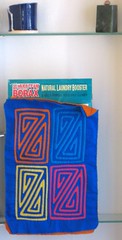
Two canvas painted “rugs” on the kitchen floor by the sink and fridge. I have rugs on my kitchen floor in those spots too, but they’re ugly things from the hardware store.

Above: Even the laundry room is artful. The detergent is hidden inside a tapestry cover.

Two of Barbara’s acrylic cactus paintings from back in the day (after she was a fabulous silversmith making exquisite silver jewelry when we first met, but before she became a teacher). During her years as a teacher she stopped painting and focused her art on quilting. Now she’s painting on her ceramics and plans to start painting on canvas again too.

I’m looking forward to some time painting in her garden. It’s about as close to heaven as you can get in Berkeley, especially when it comes with her homemade lemonade!

All art copyright 2007 by Barbara Edwards.

Categories
Art theory Cartoon art Other Art Blogs I Read People Sketchbook Pages

Cezanne in Provence

Cezanne in Provence

Ink in Handbook Journal notebook
To enlarge, click image, select All Sizes

Today I was tired after all the prep and then the party at last night’s opening for my show (which was great fun by all accounts). This morning I tried drawing little sketches of everyone who attended the opening in my AM/PM journal. It was hard to remember the details of people’s faces, though surprisingly easier for the people I’d just met than the ones I’ve known most of my life.

It occurred to me that if I tried to superimpose in my imagination a caricaturish outline on the faces and features of people I see, it might make it easier to draw them and might also be a good way to start to see and understand the essential components of each face that make it different from every other face.

So tonight while I was watching a documentary I’d TiVo’d a couple weeks ago — “Cezanne in Provence” — I saw the guy on the top left, Curator Philip Conisbee, and discovered I was doing exactly that — I could see the imaginary lines superimposed on his image that I wanted to draw. So I paused the program, grabbed my journal, and drew him. Then I did the same for other people I saw in the documentary, Cezanne, Monet, Cezanne’s grandson Philippe and art historian Nina Kallmyer (sorry for beard Nina, I went a bit too far with the shading).

I also jotted down some of the quotes by and about Cezanne: “He is a true artist but has far too many doubts about himself.” “He liked to be free and alone when he was painting.” “He was a hermit.” Cezanne said, “The pleasure must be found in the painting” when dismissing with disdain the importance of showing and success. “Vollard displayed 150 of Cezanne’s paintings (that he’d bought from the art supply store where artists traded their paintings for art supplies) and Cezanne didn’t come to the show. He stayed home painting.”

While I fantasized about painting today, I never did get in the studio other than to tidy up a bit. I think Cezanne might have been right. Preparing for a show sure diverts time and energy from painting!

Categories
Life in general Other Art Blogs I Read Watercolor

Yay! Show is Up!

show7

I had the most amazing experience tonight. Two very special people helped me hang the paintings for my show (well actually they climbed on ladders and hung the paintings while I nursed a beer to calm my nerves and said things like “Yep, you got it. Perfect!” or “Let’s move that one over there and this one over here” and they didn’t even get annoyed!) I’d been so worried about trying to hang the artwork in this rather challenging space and they made it look as classy and grand as a show you’d see in any gallery. I am so grateful and proud to have such caring and careful people in my life!

I have a hard time asking for help, never wanting to bother others. So when my dear friend Richard, who is a brilliant photographer and absolutely the best computer and audio technical guru around, volunteered to help me when he heard about the show I was amazed and thrilled because I know what a perfect job he does with anything he touches, as does my wonderful son Cody, who was the second to volunteer (after I asked him, but still…) Cody is my best art critique and has a dead-on eye for detail and is meticulous when it comes to the things he’s passionate about (including restoring to perfection fabulous “muscle cars from the 70s). With a team like these two, I knew the show couldn’t fail. I’m so proud and pleased at how it looks and how much fun it was to hang with my team.

Here’s a few photos taken at the end of the evening (in dim light and not the steadiest of hand).
show8 show6
Above, Richard after we finished hanging and he treated us to a slice of pizza.


Non-blurry versions available on my website.

Categories
Art theory Drawing Other Art Blogs I Read People Sketchbook Pages Subway drawings

Sketches & Picasso Exhibit

BART19

BART Rider – Ink in small Moleskine sketchbook

(To Enlarge, click Images, select All Sizes)

Peets

Peets Coffee water display – Ink in small Moleskine sketchbook

SFMOMA

Woman in the SFMOMA Cafe (loved her thick grey hair in a huge clasp)
Ink in small Moleskine sketchbook

BART17

Just before the earthquake Friday: BART Rider with Orchid just before the trains stopped. Ink in small Moleskine sketchbook

Friday, Susie and I met at the SF Museum of Modern Art on the opening day of Picasso and American Art. It was very interesting seeing Picasso’s groundbreaking paintings and the way American artists picked up his ideas and explored them in their own paintings. I think my favorites were the Willem de Kooning paintings; the first was quite derivative but you could see the development over the half dozen or so paintings spanning a couple of decades how his work progressed and matured into his own strong and unique voice.

More than anything, what I got from this show was the importance of an artist’s unique voice. I’ve been pondering what makes something “art” vs. decorative, pretty, marketable pictures; or what makes an artist a “real” artist. This exhibit helped me to understand that it’s not just technique, talent, or skill (all important things) — it’s also the expression of the artist’s unique view and personality that is essential. An artist doesn’t have to invent a new “ism” or create a whole new way of working like the impressionists, cubists, expressionists, etc. But a recognizable, unique and authentic voice or perspective that is courageously or confidently expressed (even if it’s ugly) seems like it might be the key.

Do you agree? Do you have an opinion of what makes an artist a “real” artist or art “real” art or do you think the whole question is irrelevant?

ADDENDUM: I must point out that my questioning this is all this in terms of my own place in the world: I’ve been painting and drawing and identifying myself as an artist for 30 years but there’s always that question in the back of my mind….that voice that says, “If you were a real artist you would…[fill in the blank].” I don’t meant to imply judgment on anyone else’s choice of style or work. Please see my comment in response to Katharine‘s comment for more.

Categories
Art theory Other Art Blogs I Read People Sketchbook Pages Watercolor

Focus!

PV-Beach

Ink and watercolor in Canson 7×10 Watercolor Sketchbook
To enlarge, click image, select All Sizes

I liked the Canson paper, it’s strong and very forgiving and heavily surface-sized — better than the Moleskine notebook — but not too thrilled with the colors I used in the sketch above in trying to use at least something the teacher suggested.

Puerto Vallarta Breakfast

Breakfast View – Ink and watercolor in small watercolor Moleskine
(to enlarge, click image, select All Sizes)

Breakfast at the workshop was at the open air buffet restaurant in our hotel, right on the beach, which was a lovely way to start the day, even if it was only half an hour after sunrise.

While I was drawing this a waiter came over to watch. I asked if he painted and he said he loved to draw but was unable to buy decent paint locally and mail order was impossible because Mexico charges 3 times the cost of the supplies in tariffs. He told me he draws pictures and then his 4 year old son colors them with crayons. He looked so admiringly at my little painting kit, amazed at what could be had in the U.S. I asked the class if they’d be willing to donate some paints for him and the teacher gave me her entire palette full of paint and three brushes. Other students gave watercolor paper and blocks. He was so grateful and everyone was really happy to have been able to help a fellow aspiring artist. I still feel happy remembering his sweet smile.

Tonight I spent the evening tonight typing up my pages of notes from the workshop. Here is one of most important thing I learned, which should be obvious but never really clicked for me before:

FOCAL POINT

I am often entranced by all the details in a subject and my paintings can suffer from lack of focal point or strong values. Forcing myself to chose a focal point BEFORE starting a sketch or painting and concentrating on values in that area at least, is going to make a huge difference in my approach and to the success of the painting.

  • A juror or curator for a show looks at each slide no more than 3 seconds and MUST BE ABLE TO SEE THE FOCAL POINT IMMEDIATELY. There should be the most contrast in that area (dark/light contrast or strong color contrast).
  • Before starting a drawing or painting, think about what interests you and attracts you to the subject and determine the focal point.
  • Put a painting in progress on the mantle and walk by it in the evening as the room gets dark to see if the focus is apparent
  • Hold the painting up to a mirror 10 feet away to look for problems with the drawing or painting, especially in portraits
  • Get the values right: Make a “Claude” mirror by spray-painting black the back of a sheet of plexiglass. It will reflect the image in values with the color neutralized. Or view the painting through red or gray film to show values without color.
  • She recommends as the best book on design in painting: “Probing the Hidden Order” by Marie McDonald Roberts.
  • Best spot in a painting for focal point is above horizon to the right because we read from right and up (this is the same spot as the “Divine Proportion” or “Golden Mean.”
  • To study focal points, very quickly go through a magazine putting red dots on the first thing you notice, then go back and study why your eyes went there. Usually contrast in value or color.

Next time I’ll post what I learned about Color Chords.

Categories
Life in general Other Art Blogs I Read Photos

Always doing

In trying to catch up with email and blog visiting, I discovered Suresh Gundappa‘s site with some of the most amazing photos I’ve seen, especially the one linked here that so brilliantly illustrates his powerful essay on how Westerners are so busy and in a hurry all the time that they are “driving themselves mad with their activity…” which really hit home.

I often complain that there’s never enough time to do everything I want to do, and make long lists of things to accomplish on days off and vacations. I’m so glad that when I go to Mexico in two weeks, I will be disconnected from all activity except relaxing and painting and that it will be goal-less painting. A week of just being. I haven’t done that in years.

Sorry…no pictures here today, but I hope you’ll scroll through Suresh’s images and words…there are some really thrilling photos there.

Categories
Drawing Other Art Blogs I Read People Sketchbook Pages Subway drawings

An Art Lesson on BART

BART15

Ink in small Moleskine

This morning I got on BART and spotted the guy on the left at the end of the car in his knitted Cat-in-the-Hat hat, except that he looked more like Mr. Natural from R. Crumb Comics than the Cat. I only had a couple minutes to draw him and then a bunch of people got on and I couldn’t see him anymore so I started drawing the hand of the guy sitting beside me holding a tiny iPod.

After a few minutes he smiled at me and then started helping me, pointing out where lines that I was drawing as curved were really straight and where I needed to add shading. My stupid pen ran out of ink so I pulled out another, with brown ink. He recommended I try UniBall pens (which I like but hadn’t used for sketching). He was clearly a talented artist and a wonderful teacher — his recommendations were right on and offered with great gentleness, kindness and caring. I asked about his art and he told me was formerly a graphic designer but now worked for Apple in “technology not art” and only rarely does his own art anymore and then only digitally with a Wacom tablet and Painter.

I’d been surprised by how crowded the San Francisco BART train was since I’d been quite late leaving for work. It was already around 9:45 but many more people than usual were getting on at each station. My “art teacher” turned to his friends behind us and as they chatted about Apple products I realized that all these people were on their way to MacWorld, which was opening today in San Francisco. I was sad to bid him farewell when I got to my stop. He was the kind of person I would love to have as a friend or a teacher and I’m sad I never even found out his name.