Categories
Art supplies Bookbinding

New Journals Bound, New Problems/Questions

Newly Bound Journals

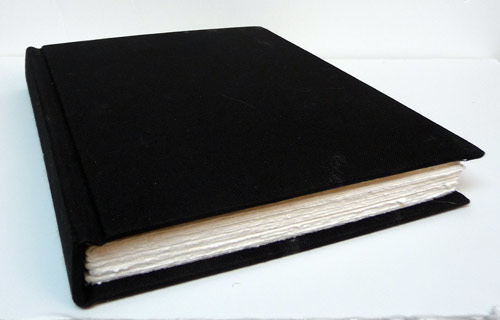
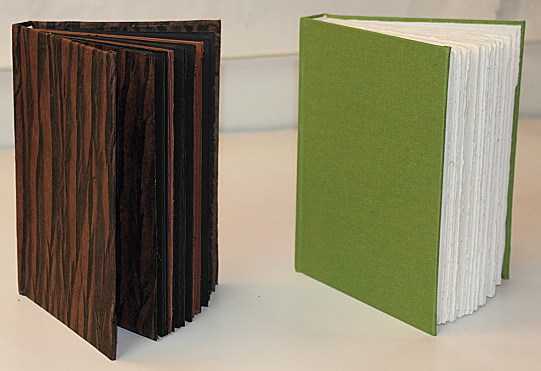
On the left is the new journal I bound for International Fake Journal Month and on the right is my next all purpose journal that I bound with Legion Multimedia 140 pound watercolor paper.

Since it had been a few months since my epic journal binding learning experience, I had to replay many of the videos and look at my notes to figure things out. And I made a bunch of new mistakes to learn from.

I have one big, confusing question. (UPDATE: See Comments for answer from Roz and note from Shirley) When I punched sewing holes I followed Roz’s video, along with Shirley’s tip to use a phone book to support the signatures. I punched four holes just like Roz did in her video demo, instead of the five I punched last time. But when it was time to sew the signatures together I couldn’t figure out how an even number of holes could work. When you have an odd number of holes and you start on the outside of the folded signature you always end up on the outside at the end of each row so you can attach each signature to the next. But with four, if you start on the outside you end on the inside. I’m guessing Roz was preparing a different sort of book.

Fortunately I had torn down extra sheets, thinking I’d bind two journals but I put aside the set I’d punched with four holes and punched five holes in the second set. Either I’ll find out how to bind with four holes or I’ll go back and make one more hole in each signature before binding them.

I also used Shirley’s tip to glue up the binding board and then place it down on the book cloth instead of putting glue all over the cloth and that was sooo much easier.

Some new mistakes I’ve learned from this time:

  • MEASURE TWICE, CUT ONCE! (or in my case measure 3 times just to be sure).
  • After gluing down the board pieces to the book cloth, I should have burnished them with the bone folder to ensure a consistently strong bond (a few small wrinkles showed up in the cover where it didn’t bond 100%).
  • Don’t make the book so thick; use fewer signatures so it is lighter and less tiring to hold when sketching standing up.
  • When you use “self-endpapers” that doesn’t mean adding yet another folded sheet, making the book even thicker. It means just gluing the book block directly to the covers (I think–correct me if I’m wrong). I had picked an ancient map print to use as end papers in the green journal but decided I didn’t like it at the last minute. I liked Shirley’s idea of just using colored drawing paper instead.
  • Make the  sewing thread long enough so you don’t have to join it in the middle (thus having to once again struggle with knot-tying from diagrams that are totally confusing).
  • Don’t use white thread and white headband ribbons on black books.

Now I’m coming to the end of my journal bound with 90 lb Arches cold press paper. I will be sad to put “The Mutt” as I named it, on the shelf, as it has become a trusted friend and companion. And I really came to enjoy the paper, once I started using my Lamy Safari fountain pen to draw with.

Soon I’ll be getting to know a new journal, with new paper and new possibilities. I think I shall name it Froggie, given its green color, warts, and all. Someday maybe I’ll make a journal that is elegant and give it a posh name but for now, mutts and toads R Us.

Mechanical FrogAnd I’ll write more about the black/brown journal in April when I start using it for International Fake Journal Month.

Categories
Art supplies Bookbinding Drawing Ink and watercolor wash Painting Sketchbook Pages

Testing Paper for Journal Bookbinding + Junk Drawer Still Lifes

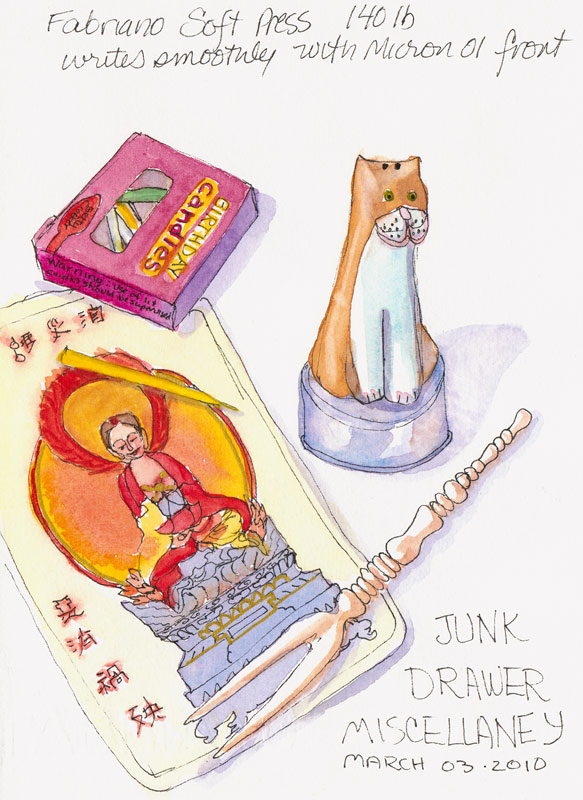
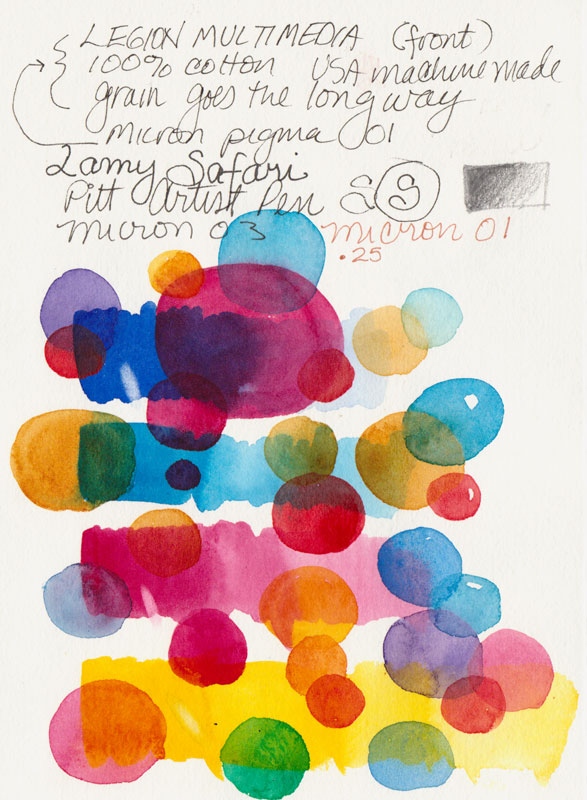
Junk Drawer #1, Legion Multi-Media Paper, ink & watercolor
Legion Multi-Media Paper, ink & watercolor

I used random items from my junk drawer as still-life subjects to test paper for binding my next journal.  The paper I’ve chosen is Legion Multimedia Aquarelle 300 gsm (a little thinner than 140 lb). An employee at my local Artists & Craftsman store suggested it when I was unsuccessfully seeking the Fabriano Soft Press 140 lb recommended by Shirley of Paper and Threads.

Legion Test #2
Legion Test #2

Legion Multimedia/Aquarelle

I was delighted to find that the texture of the Multimedia/Aquarelle  paper is perfect for writing on with the finest of pen points (unlike my current journal’s Arches CP paper). It took watercolor washes and multiple layers of glazes beautifully without buckling, pooling, or pilling. Color lifted off easily when rubbed with a damp brush.

The paper is nicely sized to prevent the paper from soaking up the paint, but not so extremely sized as the Arches 90 pound cold press that practically resists the ink.

It has two deckle edges and is relatively inexpensive. The Legion Multimedia/Aquarelle paper cost $2.69 a sheet at my Blick store while the Fabriano Soft Press 140 lb paper was $4.99 a sheet. Unlike the Fabriano, this paper is also available in 90 lb weight which I will try next, but I think that will have to be a special order through Artists & Craftsman since Blick only carries the 300 gsm paper.

Dick Blick’s website says about the Legion Multimedia paper:

“Use any painting and drawing media you choose on this fine quality, crisp white paper! Multimedia/Aquarelle Paper consists of 100% cotton fiber, is acid-free, and has a neutral pH. The paper is 140 lb (300 gsm) weight, and has an uneven textured surface. Available in two different surfaces — Cold Press and Rough. Cold Press is available in sheets and pads, Rough is available in sheets only, and comes in 200 lb (380 gsm) weight.”

I tested the paper for grain direction and it runs the long way, making it possible to tear it down for a journal just the size I like: 5.5″ x 7.5″, with no waste, which is not possible with the Fabriano whose grain runs the short way.

I finally was able to buy a sheet of Fabriano Soft Press (which has a similar surface texture, between hot press and cold press) and tested it too:

Fabriano Soft Press 140 lb: Test #1

Fabriano Soft Press

The Fabriano Soft Press paper had some things in its favor but ultimately the cons outweighed the pros in my mind. It seems like good sturdy paper, and the paint lifted OK without surface damage, but it was slightly less pleasant to write on with a fine-point pen, even though the surfaces of the two papers are very similar.

Since the grain runs the short way (which means the pages will need to fold the short way) you either end up wasting some of the paper or have fewer size options for the book. Also, the paper is thicker and stiffer, which means fewer sheets per book or a thicker, heavier book. And it is more expensive.

But what bothered me the most was the sizing. According to Blick:

“Fabriano papers are synthetically sized both internally and externally so that no animal by-products are used.”

In fact, Fabriano uses an acrylic sizing as opposed to the organic sizing (gelatin) that other companies use. I found that juicy washes on this paper took forever to dry and I assume it has to do with the non-porosity of acrylic sizing.

Fabriano Soft Press Test #2

Despite waiting and waiting and finally using a hair dryer before adding the next layer of glaze, the paint still wasn’t dry and glazes bled into each other.

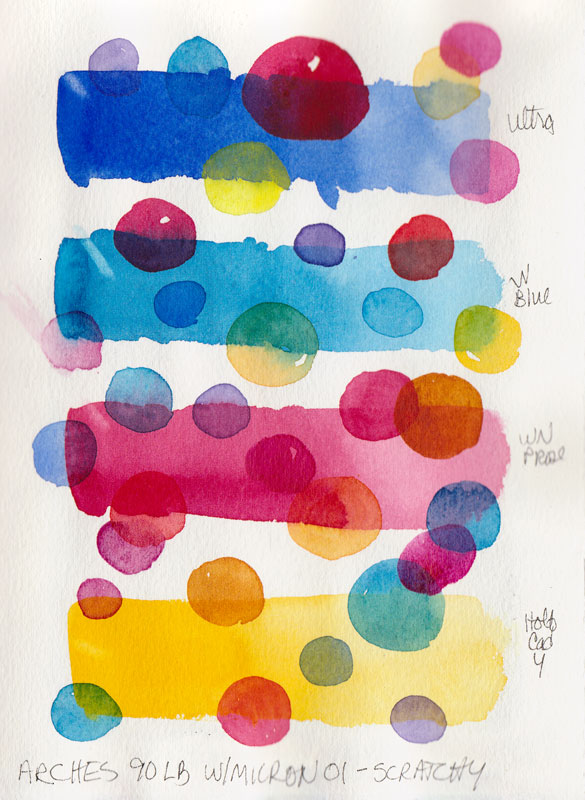
I also tested the Arches 90 lb Cold Press in my journal (below). Washes, glazing, lifting worked fine, but just isn’t pleasant to use with a fine point pen.

90 lb Arches Cold Press test

I’m looking forward to binding my new book and then giving the Legion Multimedia Aquarelle paper a true test of its journal-goodness and whether it really is the “perfect” watercolor journal bookbinding paper for me.

Categories
Art supplies Bookbinding

Bookbinding a Watercolor Sketchbook Journal: Learning from My Mistakes

The Mutt: My first casebound sketchbook

The most important thing I learned in binding my first hardbound sketchbook journal is that the process is very forgiving and not rocket science. In fact, despite making every possible mistake along the way, it still turned out as a quite usable little mutt of a book.

Inside the Mutt
Inside the Mutt

I took notes as I worked: reminders what NOT to do next time, which parts to skip, what really matters and what doesn’t. And now, using the medical school approach for teaching surgery (“See one, do one, teach one”) I’ll share what I’ve learned. Fortunately this isn’t brain surgery, since I’ve literally only seen one and done one.

UPDATE: I have refined the process described below; the most up-to-date version is always available as a download on the Resources page here. You may also find my more recent bookbinding posts by selecting “Bookbinding” from the Categories pull down menu on the right. Now, to continue on with the original post…

Side view
Side view

I will simply refer you to the resources I used and try to serve as a sort of docent on the journey through the process. If you are an experienced bookbinder PLEASE share any suggestions, advice or corrections and I will update this post with them.

Open and ready to play
Open, not perfect, but ready to play

I’ve divided the post here to hide the details since it’s long…

Categories
Art supplies Gouache Ink and watercolor wash Life in general Sketchbook Pages

Waiting for the Book to Press

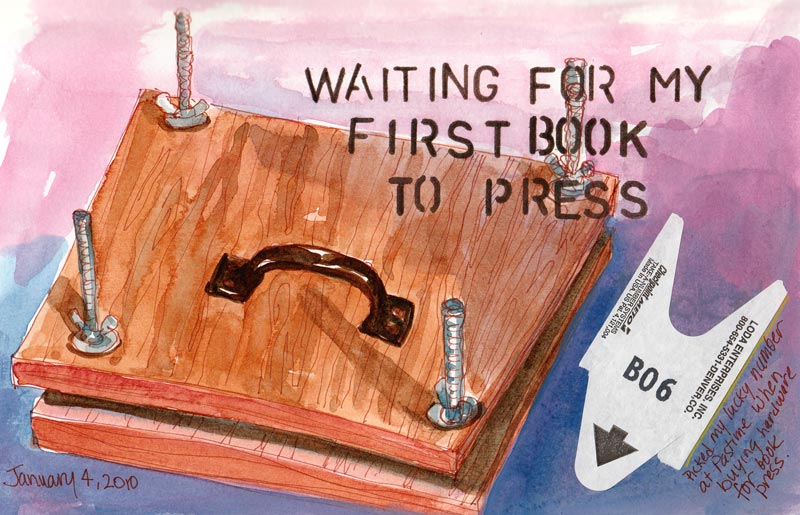
Waiting for the Book to Press, mixed media
Home-made book press, ink, watercolor, gouache, stencil, hardware store ticket

I made a book press as part of the process of learning to bind my own sketchbook. This of course required a trip to the wonderful Pastime Hardware store.  I was so excited that the ticket I pulled from the little red take-a-number thingee for the helpful hardware guy (or in this case gal) had both my initial and my birth month/”lucky” number on it so I saved it for posterity in my sketchbook. (I put quotes around “lucky” since the number has never actually been lucky for anything but I call it my lucky number anyway.)

Just like any project that requires tools, measuring, fractions, or spatial relations, building this simple press was not easy for me. First I had to saw the wood. I didn’t want to have to go to Home Depot (ick) to get someone to do it for me I had a piece of fake oak shelving I’d bought but hadn’t used.

So I used my funky little hand saw (that I bought when I became a home owner and thought I should have a basic set of tools in a toolbox “just in case”) to cut the shelf in half into two one0-foot square pieces. It took forever and my cut was wobbly, uneven and made a mess of the veneer.

Then I measured in from each corner one inch and drilled holes, guessing how big they should be. Unfortunately, since my cut wasn’t even, the holes didn’t line up right and they were too small. So when I assembled all the pieces the boards were all tilty and got stuck. I finally got it all apart again and redrilled the holes larger. This solved the problem and the press worked fine.

Like every step in the bookbinding process, I learned something valuable along the way. In this case I learned I should have clamped the two boards together and just drilled right through both of them to make the holes line up.

In my next post I’ll offer some resources for do-it-yourself bookbinding including the tips I learned from my mistakes.