Categories
Flower Art Landscape Oil Painting Painting Still Life

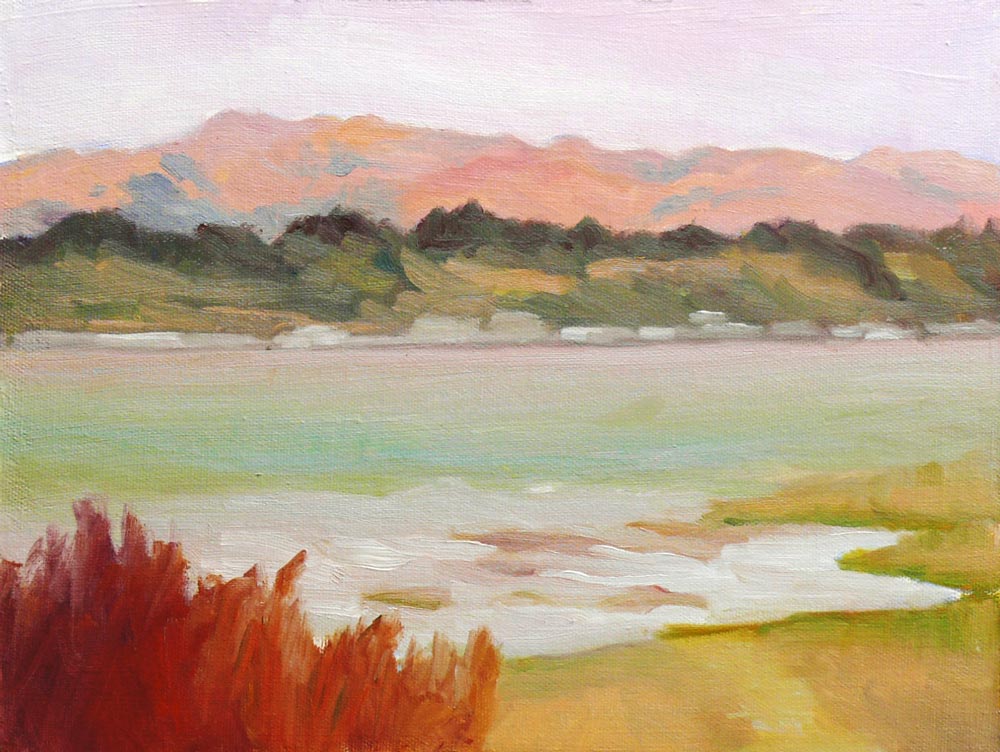
Birthday & Benicia’s Matthew Turner Park

20080601_1040-Benicia-MTurnerPark
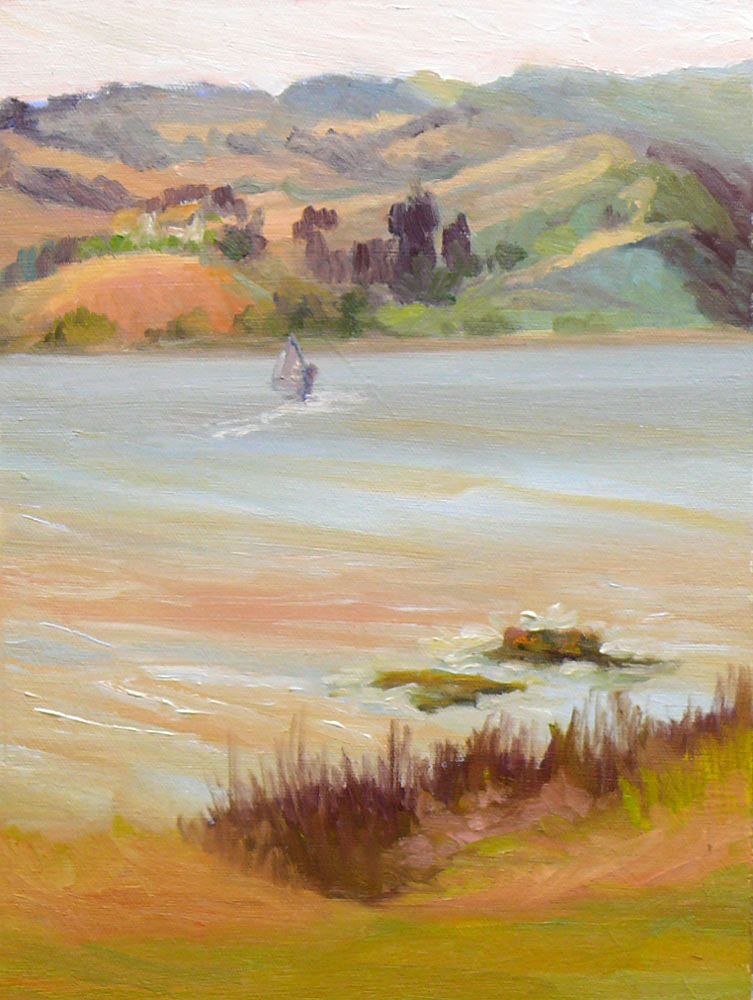
Oil on 12×9″ panel (Larger)

Yay! First day of June, and I get to celebrate my (mid-month) birthday all month long. Because it’s a really big birthday, this year I’m going to celebrate all year instead of “just” all month! It’s also the birthday of Jana’s Journal and Sketch Blog, now entering it’s third year.

To kick off my wonderful yearlong celebration, this morning I went to a paintout at Matthew Turner Park in Benicia followed by a visit to the opening of the Outsiders show at Arts Benicia Gallery. Today’s paintout was organized by the Benicia Plein Air Painters, also known as “Da Group.” Da Group is led by Jerry Turner, one of the founders and a prolific member of the Outsiders. It was a very well-attended opening, and a terrific show. There are photos of the paintout and the opening here.

In my painting above a windsurfer scooted by as I was finishing (well, running out of time, actually) so I stuck it in the painting. I’m not sure you can tell what it is, and whether it should be better defined. There’s lots more I could do to the painting, but I’m finding it pleasurable to call plein air studies done without trying to perfect them back in the studio; just appreciating them for the studies they are and all the wonderful sights, sounds, scents and memories of the experience that they contain.

Here’s my first block-in of the scene. My focal point was the orange hill with a little house on top across the water. Those black spots are little bugs who nose-dived into the wet paint (or were blown in by the strong winds today).

20080601_0940-Benicia-wip
(Larger)

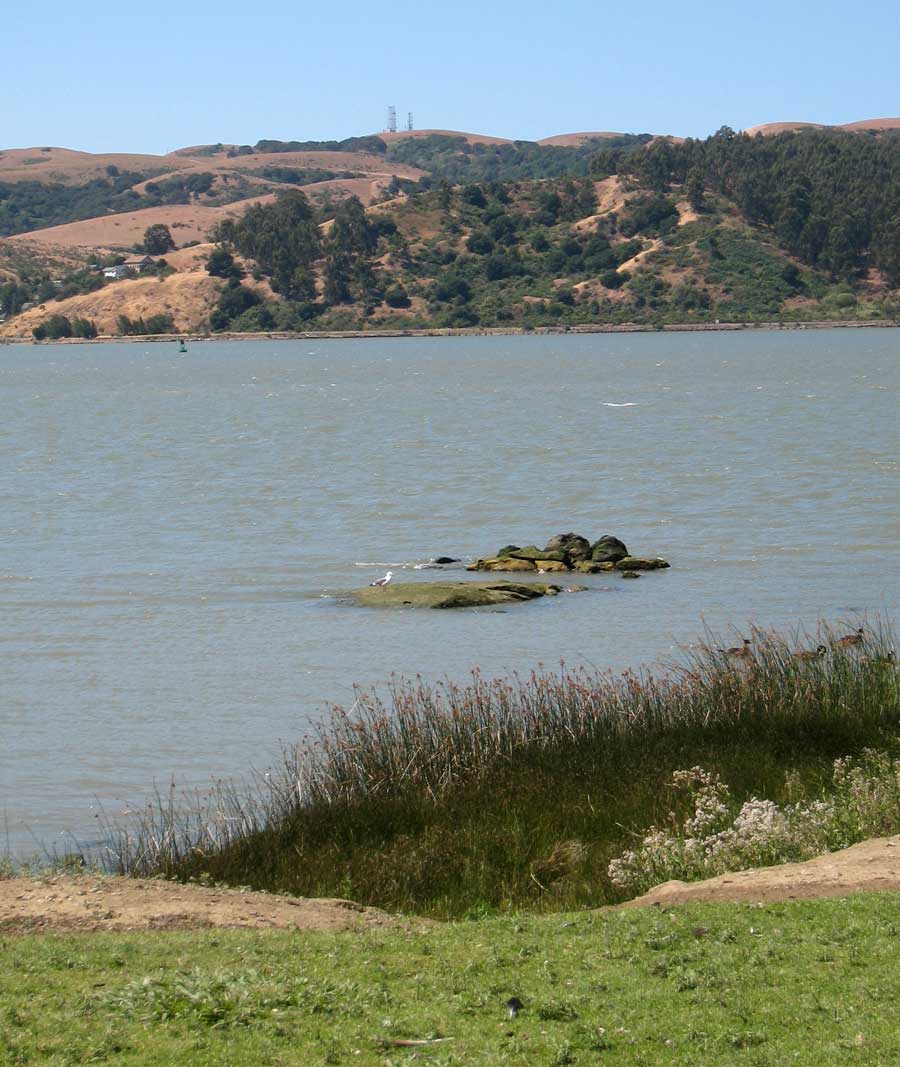
Here’s a photo of the scene. You can barely see the little house on the hill.

20080601_1022-Benicia-photo
(Larger)

I wrote about this great little park and posted an earlier painting I did there last December here. I remember how much harder it was to paint that day, and how much more I understand now. Progress! Yay!

Categories
Art theory Flower Art Oil Painting Painting Still Life Studio

Passable Painting Passages

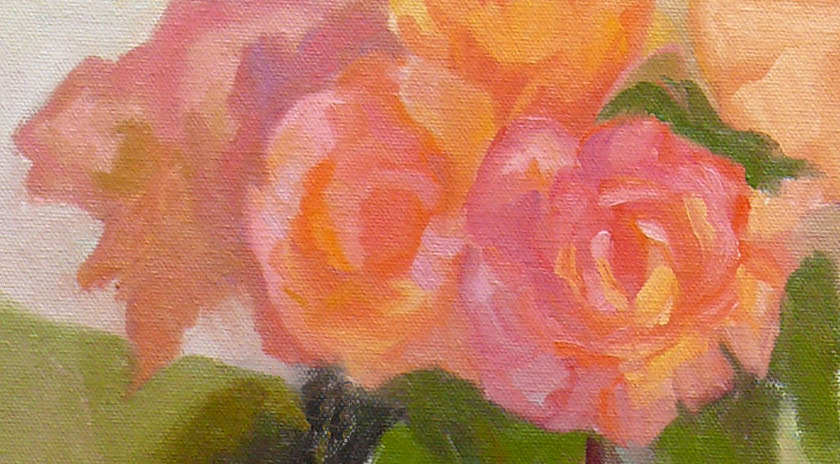
Roses detail

(Larger)

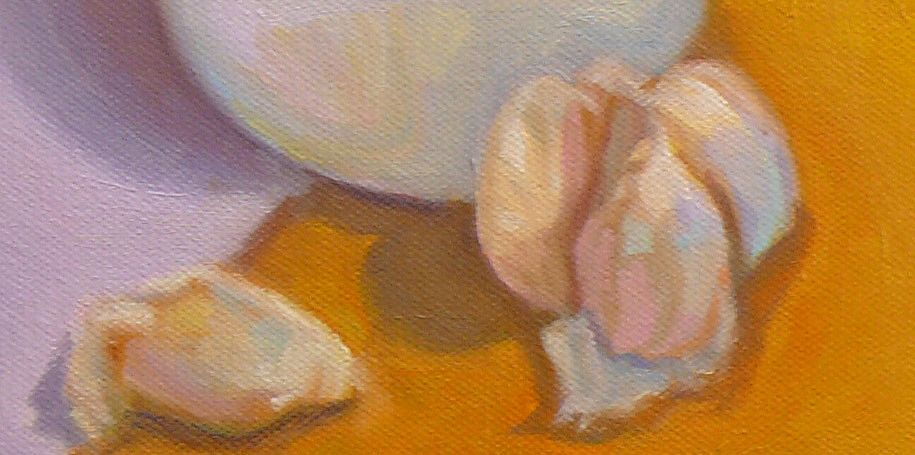
Garlic detail

(Larger)

I’m learning to appreciate the bits of paintings that work while letting go of the parts that won’t/can’t be fixed. These two sections pleased me, even though the original paintings as a whole were not successful. In both cases I started off boldly, got the big shapes blocked in and immediately painted the two segments above.

Then I got tired, the sun went down and the room in the light changed, the flowers opened in the heat, the floodlight I was using burned out and I didn’t have another, the setup got moved (thanks kitties…see below) and although I tried to fix both paintings over and over I finally decided to cut my losses once again and move on.

I learn so much with each painting, whether it works as a whole or not. I’ve started putting labels on the backs with the year, a serial number and a few words about what worked, what didn’t and what I learned. It will be fun at the end of the year to review my progress.

Fiona taking up modeling:
Fiona wants to be a model

Rose set up day one (and on my bulletin board art by Pete, Alison and John Sonsini‘s wonderful portraits):
Rose setup day 1

Categories
Landscape Life in general Oil Painting Outdoors/Landscape Painting Plein Air

Cemetery Painting on Memorial Day & War Euphemisms

View of Benicia from Alhambra cemetery

Oil on panel, 9×12″ (larger)

On Sunday I painted at the small, historic Alhambra Cemetery in Martinez, where we had an amazing view of marshes and Benicia across the Carquinez Straits. An elderly Japanese church group and their pastor were  holding a memorial service for the fallen soldiers buried there but didn’t mind us painting among the graves. Since the residents were buried between 1851 to 1999, I’m sure they “fell” in many different wars.

War Euphemisms
I hate all the euphemisms used about war that gloss over the the sacrifices and suffering. The two that particularly irk me are “in harm’s way” and “fallen” soldiers.

When I hear politicians talking about soldiers “in harms way” I can’t help but thinking, “Yeah, and you sent them there!” “In harms’ way” is in passive voice which removes all responsibility from the phrase. It sounds as if they just ended up there by accident, like “I was taking a walk and found myself on Harms Way when I meant to be on Walnut Way.”

The same is true of “fallen soldiers.” No verb or anyone taking responsibility there either. The soldier just accidentally wandered onto Harms Way and then, Oops, down he fell.

G.I. Joe
When my son Cody was in Kindergarten he desperately wanted a G.I. Joe lunch box. We were walking through the supermarket and he saw them on the shelf and started whining and begging for one. I grabbed the plastic box, showed him the explosive picture on the cover and began ranting: “You see this? That’s a bomb going off! You see this G.I. Joe guy? That bomb is about to kill him and tear him to shreds! That guy has a mommy and his mommy is going to cry and cry forever because her little boy got blown up by a bomb. And no, I’m not going to buy you a lunch box with a picture of someone’s little boy getting killed on it!”

I still have my “War is not health for children and other living things” pendant and poster from the Viet Nam war, which destroyed so many of the boys I knew in high school. I feel such sadness and compassion for the soldiers and their families whose lives are being destroyed by our current war.

This isn’t meant to be a political blog so I’ll stop my rant by offering a prayer for peace and for healing for all those who are suffering because of war, regardless of which war or what side they’re on.

About the painting and the site: To get into the cemetery you have to first stop by the the Martinez police department to pick up the key to the entry gate which is kept locked. Although I ran out of time and hadn’t fully developed the bottom 1/3 of the painting, the sky, or the water, my other plein air group members said they liked it as is and to leave it, so I did. What interested me about the scene and what I wanted to paint was the pinky-golden hills and I was actually happy with the way they turned out — a first for me and hills.

I’m learning to appreciate and treasure the smallest passages that succeed in my paintings, even if the painting as a whole doesn’t work. They give me hope and a glimpse of successful days to come.

Categories
Oil Painting Painting Still Life

Avocado Study & Painting Fleas

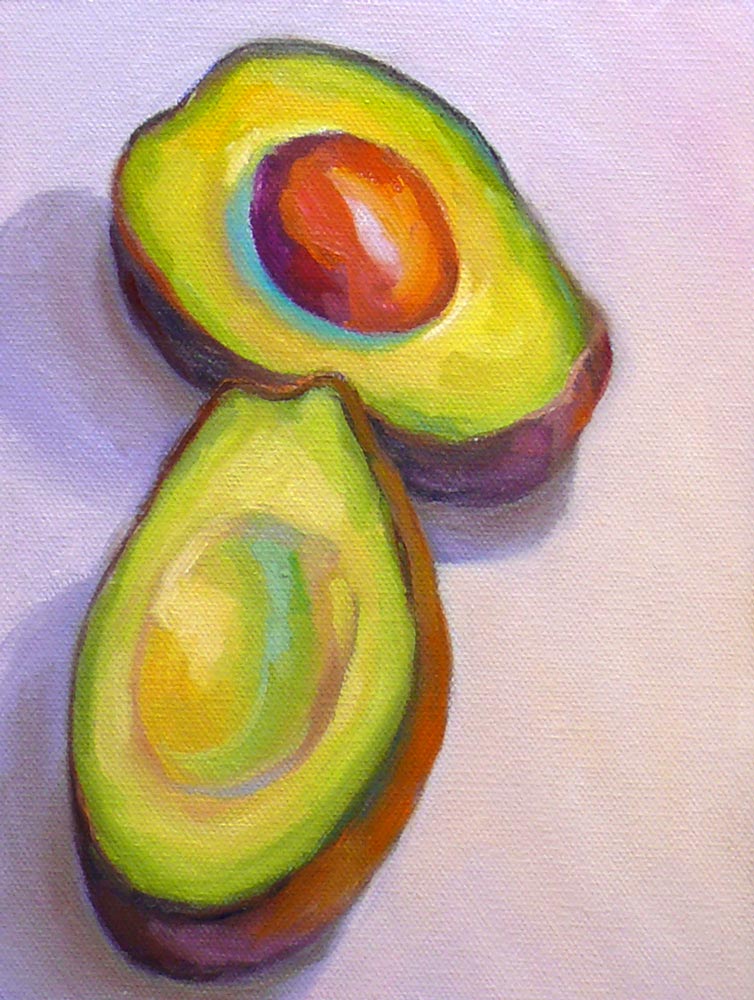
Avocado finished study

Oil on panel, 10×8″ (larger)

Paint the dog before the fleas” is something that painting teacher Elio Camacho told me over and over again when I started painting details in a scene before I had the big shapes blocked in. After messing up a painting yesterday by getting lost in the tiny details too soon, I really tried to focus on big shapes and color today.

I read this quote today that reaffirmed what I wrote in my last post about assimilating knowledge. It’s by Marques de Lozoya in the book Joaquin Sorolla by Blanca Pons-Sorolla:

“There is a moment in every artist’s career which usually follows many years of strenuous effort, in which experiences are accumulated in an intuition of marvelous clarity; the artist’s vision becomes precise and clear; the paths that lead to success are firmly perceived and easily and happily pursued, without any effort at all…”

Sounds good, doesn’t it! It gives me hope. I’d occasionally felt that intuition, clarity and happiness with watercolor and I look forward to finding it with oils too. At least I’m more frequently understanding where I’ve gone wrong.

Click “continue reading” below to see the steps I took for this study today. (If the link isn’t visible below, just click on the image above and you can see the steps on Flickr.

Categories
Oil Painting Painting Photos Plein Air Sketchbook Pages Watercolor

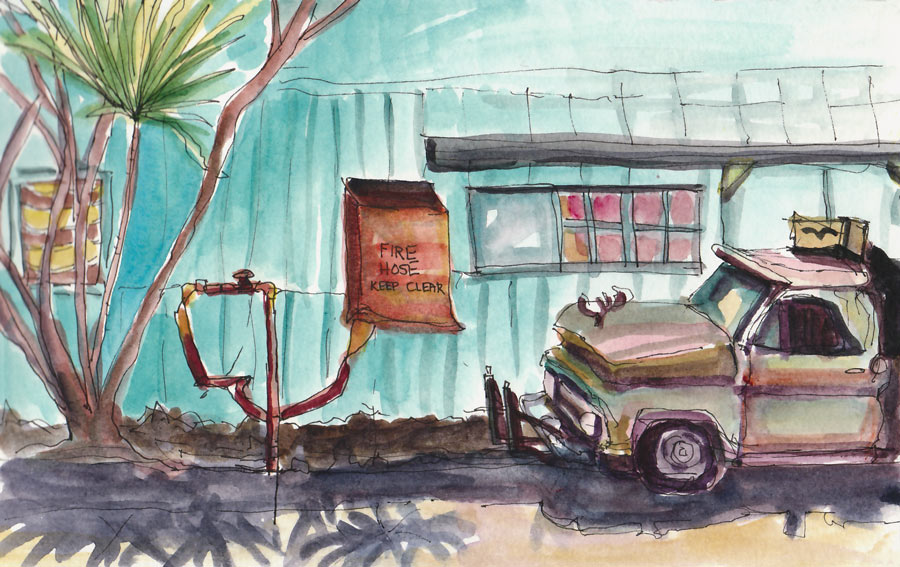
Firehoses on 5th Ave (Oakland)

20080428_Firehose-wc

Ink & watercolor (Larger)

Saturday I painted wtih the East Bay Plein Air Painters at the foot of 5th Avenue in Oakland. It’s an amazing little enclave of funky art studios, rusty old boats in a beat-up marina, and industrial buildings not far from Jack London Square.

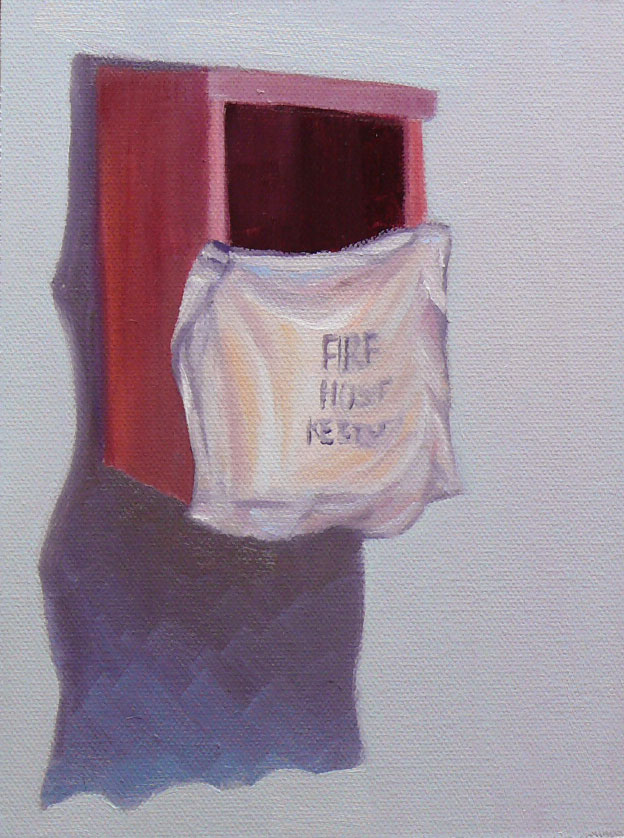
I arrived very late, being unable to push myself this weekend to move quickly or arise early. I did this one little watercolor sketch sitting in the hot sun and took a lot of photos. I was fascinated by the many varieties of fire extinguisher equipment on all the old waterfront shacks (I’m easily amused, I suppose) and painted the oil below from one of the photos I took on Saturday, working from the image displayed on my computer screen.

20080428_0559-Firehose-oil

Oil on panel, 8×6″ (Larger)

Here’s a photo from the 5th Avenue Marina, or, as it says in the photo, the “Oakland Riviera”:

Click image to enlarge and see the soldiers on the missile. I’ll be posting more of my photos and paintings from 5th Avenue soon.

Categories
Art theory Oil Painting Painting Studio

Back to Basics – Color Vocabulary

Painting Blocks to Paint Blocks

Painting blocks to use in light and color-study still-life as explained in this previous post. (Newly gessoed panels drying in little rack behind the blocks).

After jumping head first (or was it feet first?) into oil painting, and then flailing about, trying to find my way, I realized it was time to go back to basics. Just as with writing or speaking, a basic vocabulary is essential to expressing oneself.

But I was trying speak “oils” using the vocabulary of color I’d learned with watercolor, assuming that Red is Red, whether it’s watercolor or oils. Unfortunately, I’m finding that’s like assuming if you can speak English you can speak French since they use the same alphabet.

Testing Colors to Choose a Palette

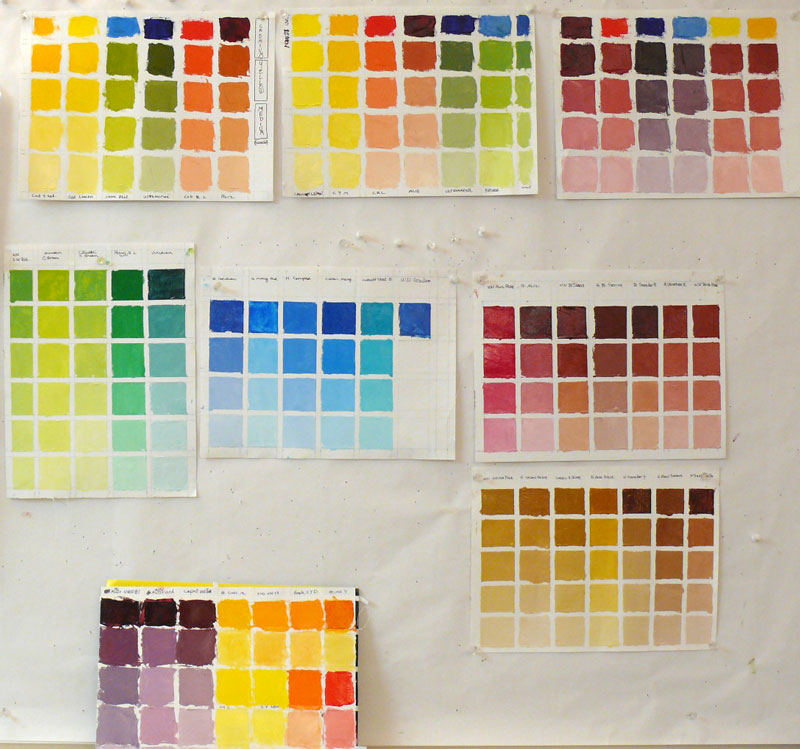
Oil painting tests of different brands of color to choose my basic palette
(Click Images To Enlarge)

When I first started painting with watercolor, I made dozens of color charts, testing the various pigments to learn about their natures, alone and mixed with other colors. In watercolor this is really essential since there are so many characteristics that affect the flow of the paint: whether it charges into neighboring paint or resists it; whether it’s opaque or transparent; sedimentary (leaving little spots of sediment), staining or lifts easily, how it mixes with other colors and more.

I hadn’t done this with oil painting. But watching Camille Przedowek demonstrate a couple of weeks ago, I was struck by her huge “vocabulary” of color. She was quickly mixing up and painting with colors I couldn’t even name! I realized my oil painting color vocabulary is about that of a 4-year old from a foreign country.

(CLICK “Continue Reading” to read and see the rest…)

Categories
Art theory Landscape Life in general Oil Painting Outdoors/Landscape Painting Plein Air

Am I Having Fun Yet? Uh, no.

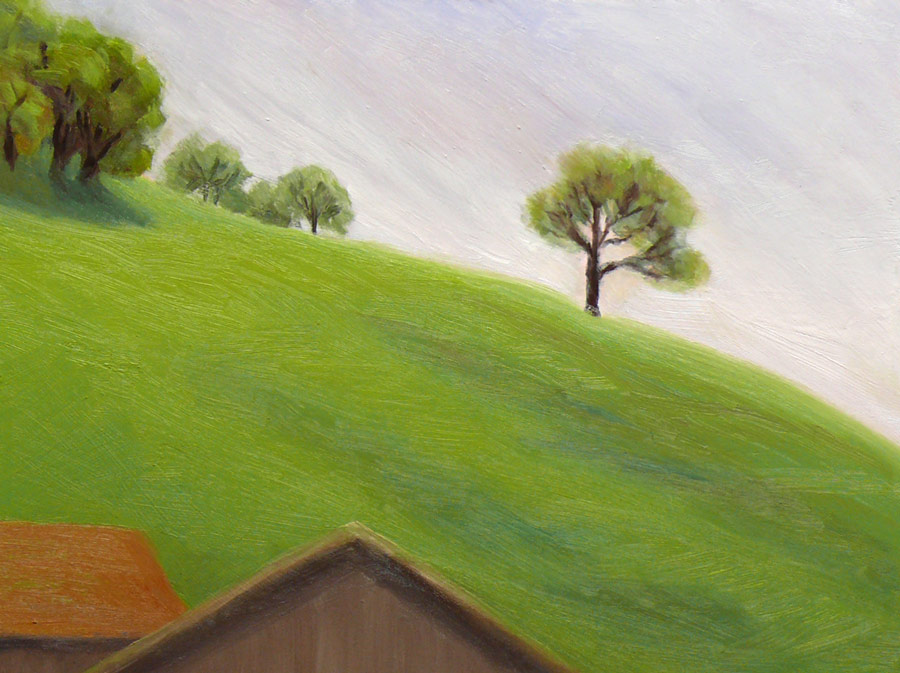
Borgas Ranch

Oil on panel, 9×12″ (reworked from original plein air) (larger)

Saturday was the first plein air paint-out of the season for the East Bay Plein Air Painters. We went to Old Borges Ranch, a charming historical old ranch with a blacksmith shop, old barns, farm animals, all surrounded by the brilliant green hills of springtime. It was very cloudy and I decided that what I wanted to focus on was trying to observe and paint the effect of the cloudy, cool, diffused light.

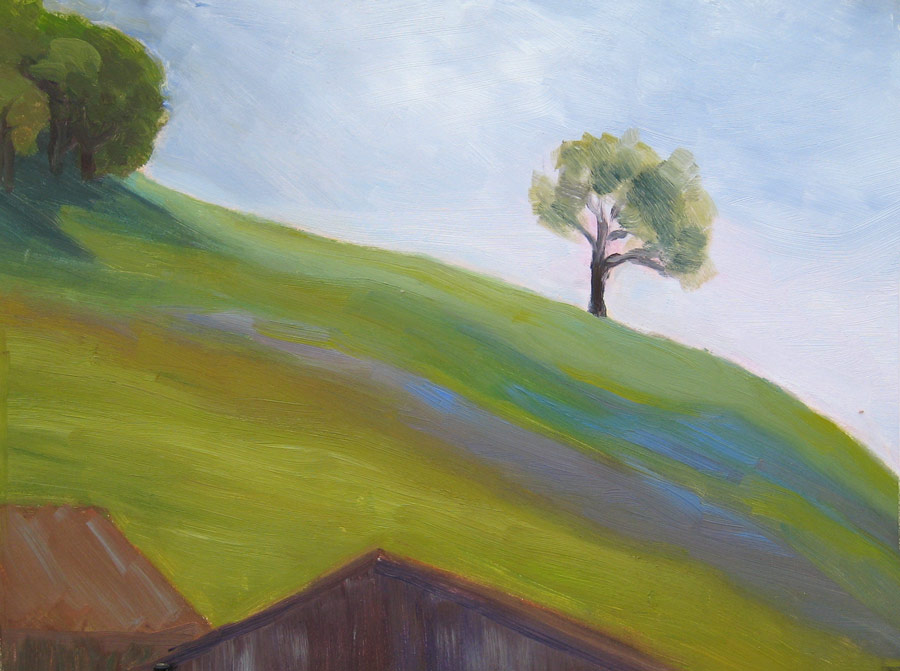
After wandering around trying to pick a spot, by the time I was ready to start painting I only had two hours left before our group critique. This is the same painting as above after two hours:

Borgas Ranch - @ 2 hours

Oil on panel, 9×12″ (original plein air) (larger)

I probably should have left it alone and moved on. But I was frustrated with the way I seem to always be painting hills (I’m sick of painting hills!) and they always look flat. So after the critique, I went back and started working on the painting again, determined to figure out how to make the hills not look flat. I stood there painting for 2 more hours and although I made some discoveries about paint application and brush strokes, I hadn’t improved the painting at all (just the opposite).

What I’d planned to do after the paint-out at 1:00, was to take a walk on the beautiful trails and do some sketching of the interesting sights but it was too late when I finally gave up on the painting at 4:00 because I had a long drive home and had to get ready for a dinner party that evening.

Today, even though I tried to ignore it, the painting and my frustration about it continued to bug me. I finally decided to work on it some more until I either got it or killed it. I guess I did a little of both.

The truth is that today oil painting isn’t feeling like fun. I’m missing the watercolor sketchbooking and drawing for fun I did all the time before I took up oils. I’m jealous of all the people I see while I’m plein air painting who are taking a hike in pretty places instead of torturing themselves trying to paint them. I’m missing filling up my sketchbook with fun, wonky drawings and loose watercolors. I’m longing for working from still life set ups or photos where the light doesn’t change and where it’s not always a rush against time.

I also know that I’m persistent if nothing else, and that I’m not giving up the struggle. But it’s time to have more fun with my art. After all, I’m doing this for my own creative pleasure, and as much as I love learning, sometime a woman just needs to play, too.

Categories
Landscape Oil Painting Outdoors/Landscape Painting Photos Plein Air

Alpine Lake, Mt. Tam: Beautiful place, Ugh!ly paintings

Alpine Lake, Mount Tamalpais

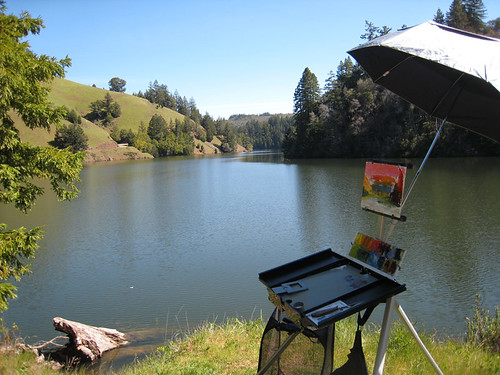
It couldn’t have been a more perfect day, weather-wise, or a more beautiful site. Maybe it was the beauty and grandeur of the location that made it so hard to get a decent painting. Four of us met this morning on Mt. Tamalpais to paint and stayed until 6:00 p.m But despite the perfect conditions, nobody had a good painting day. Peggy threatened to throw her easel in the lake and take up singing instead of painting.

I’m posting the bad paintings because a reader asked me to show the ones I call “scrapers” before I trash them or scrape the paint off to reuse the panel. On my easel above, was the first layer–the blocking in–of painting #1, in which I “pushed” (exaggerated) the intensity of the colors I was seeing, knowing it’s easier to tone them down than brighten them in oil painting.

I liked the initial bright colors but wasn’t successful in taking it to the next stage, as you’ll see from the picture below. This was where I left off when I gave up after the sun moved and the light and shadows changed and I was just making a mess.

Alpine Lake, Mount Tamalpais 1

And this one (below) was even worse! The drawing is wrong and the silly, carrot colored-rabbit foot shaped hills on the left kept growing without my noticing and I lost all my darks. The third painting was so terrible I scraped it off on site.

Alpine Lake, Mount Tamalpais 2

Although I feel like I’ve taken a couple of steps backwards today, I will just assume that means that I’m going to have a big leap forwards soon. My paintings were complete rubbish but I was happy just being there. I found pleasure in small things: mixing a good color, the fresh paint thinner in my brush washer can, excellent company and no bugs, rain or wind so it was safe to use my umbrella without worrying about the wind pulling it (and my easel) over.

My only regret was not taking a hike like all the other people strolling by us. I felt envious of them when I heard them talking about the nearby waterfall and the wonderful trails.

I’m going to start taking a lunch time hike when I paint in beautiful locations. I think it will be good for my painting, my mind, and my butt, which wouldn’t fit into my painting jeans this morning! Must have been all the medicinal chocolate I ate the past few weeks to calm my stress at the day job.

Categories
Art theory Landscape Oil Painting Outdoors/Landscape Painting Plein Air

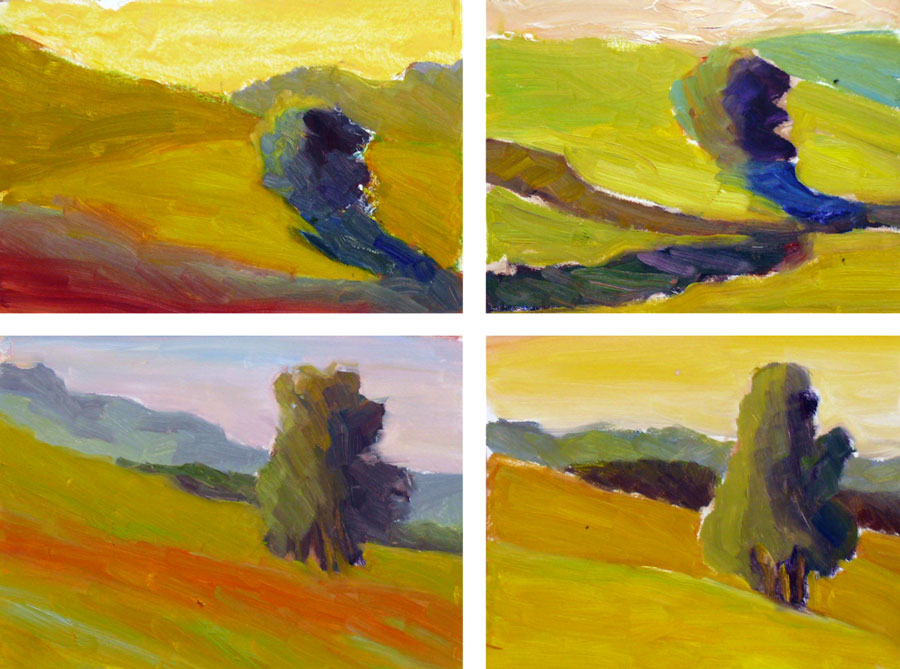
Plein Air “Grunts” with No Green for St. Patricks Day

Quick starts plein air

Oil on panel, 12″x16″,  (larger)

In Camille‘s class today we painted at Helen Putnam Regional Park in Petaluma. Our instructions were to paint four small, very quick (about 20 minutes) starts (sort of like rough drafts in oils) on one 12×16″ panel. If I understood correctly, we were to try to capture the color temperature of a bright sunny day, the relationships between the hues and values, and the relationships between the distant, mid and close up values and colors. And all of this without using green to paint the extremely bright and vibrant lime green hills.

I’m at the point now with this work where I feel like I’ve been living in a foreign country long enough (the land of plein air oil painting) that some of the words the natives (my teachers) speak are starting to be understandable. I still can only respond with grunts (see above “painting,” — definitely no more than a few grunts!) but I kind of get what my teachers are saying.
I’m starting to see the vivid colors in nature beyond the local colors (green tree, red apple). And I’m maybe starting to understand why you might paint a sky a pale yellow before over-painting it with very light blue, or a green hill orange first because it’s in the bright sun, and then modify that orange with something that, when compared to the color next to it, reads as green.

Categories
Oil Painting Other Art Blogs I Read Painting Still Life Studio

Red Onion, Wrench & Lighting Still Lifes

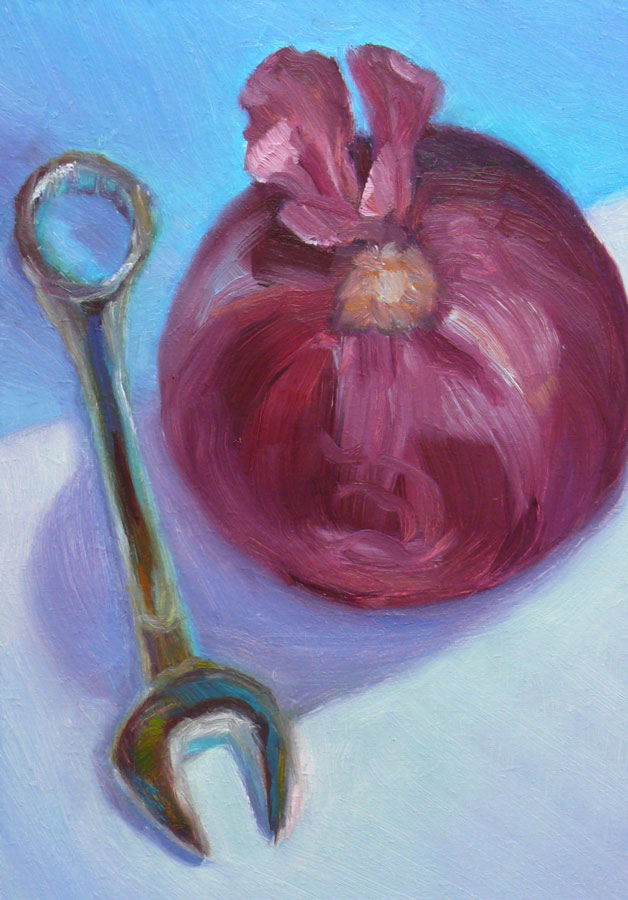
Red Onion & Wrench

Oil on panel, 8×6″ (larger)

My favorite part of this quick oil sketch are the little flag or wing-like thingees on the top of the onion. I had a variety of problems with this painting, some of which I solved and some I didn’t.

I still haven’t gotten still life lighting worked out. I was about to build a set up like I saw on Carole Marine’s blog here and here, but discovered that while the pvc pipe she used is very inexpensive, the fittings are not. It was going to cost around $50 for the fittings and pipe so I decided to go back to using my 3-sided cardboard box still life “stage.” But my overhead full-spectrum fluorescent lights are right next to the table beside my easel, so it’s hard to block out the overhead light to prevent light sources coming from different directions.

I’ve also been experimenting with different kinds of light bulbs to direct at the still life, from color balanced fluorescents and incandescents to halogen. I even bought some sheets of colored photographic “gels” to use as filters on the lights to create a warm or cool light. So far nothing has worked as well as painting outdoors;  Mother Nature is the best.But in my neighborhood near the San Francisco Bay where it’s often foggy and windy and the light changes constantly, outdoor still life painting can be frustrating.

If you have any tips on lighting still lifes, I’d be most grateful to hear about them!