Categories
Art Bay Area Parks Colored pencil art Drawing

Bird Head Bobbing (Why?): Meadowlark Translation

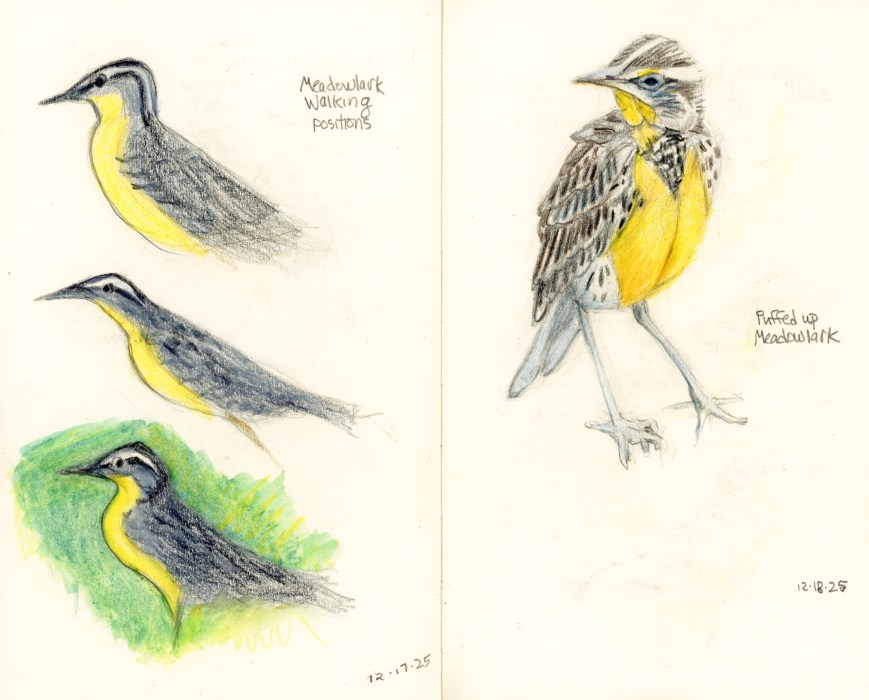
Meadowlarks head bobbing and puffing up

Have you ever noticed the weird way birds walk, bobbing their heads back and forth? Watching the birds in the video below about the return of meadowlarks to my beloved park, Point Isabel, I once again wondered why birds do that.

Instead of letting the thought go as usual, I decided to follow my curiosity. And that lead me down unexpected rabbit holes, to some fun drawing, joy and surprises. (Yes, I’m easily amused.)

Video by Mary Barnsdale at Pt. Isabel, Richmond CA

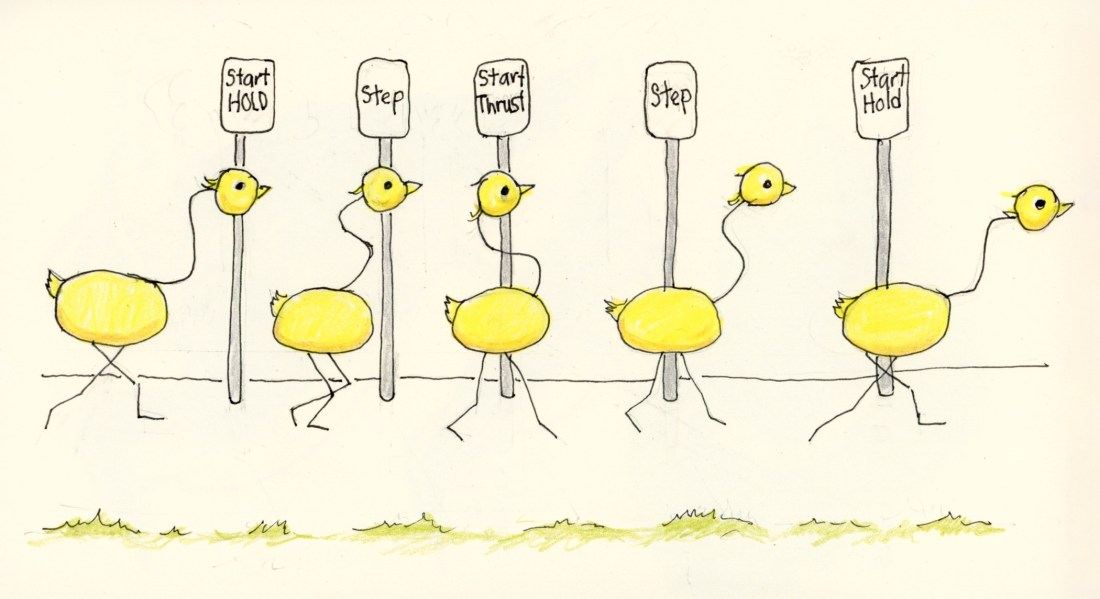
First, I learned that the head bobbing is called “translation” (huh?). Yep, same word, (almost) completely different meaning. “Translation” as used in biomechanics means “moving an object linearly from point A to point B, no turning.”
Translation and Optical Stabilization

I wondered if birds were doing something similar to spotting—what dancers and ice skaters do to avoid dizziness when spinning. Dancers focus their eyes on one spot as their body turns, then quickly snap their head to focus on that spot again.

But nope. As you can see in my diagram above, the bird’s head stays still in one place as its body and feet move forward. Then the head snaps forward to catch up. They do this for image stabilization, not to prevent dizziness.

When humans move forward and the scenery changes (or when seeing something move towards us), our eyes constantly make micro-moves to focus. (See this YouTube video for more about human vs bird vision when walking and flying.)

But birds’ eyes, on the sides of their heads, can’t move like that. They have to move their heads instead. Without “translation” their vision would be super blurry, and they wouldn’t be able to spot food or predators.
Meadowlark sketch in colored pencils
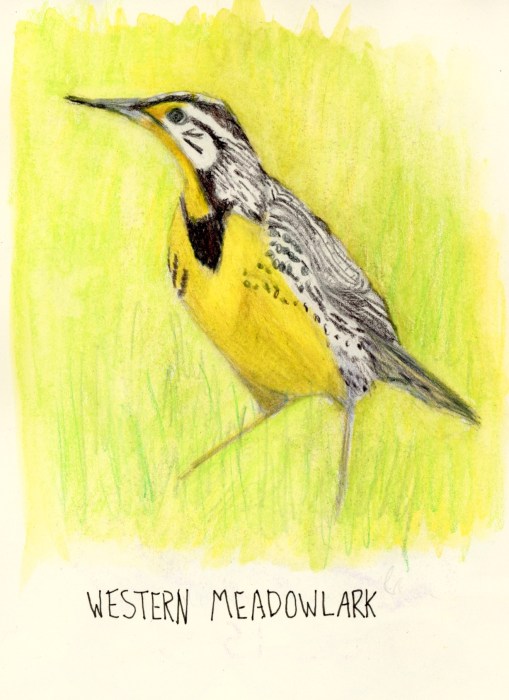
Western Meadowlark, colored pencil in A4 sketchbook

Nerding out (birding out?) even more: Birds have from 13-25 neck vertebrae. Meadowlarks have 14, twice as many as humans and giraffes who only have 7! Birds’ necks are so flexible they can look behind themselves without moving their bodies (think owls)!

Nature and evolution are so amazing.
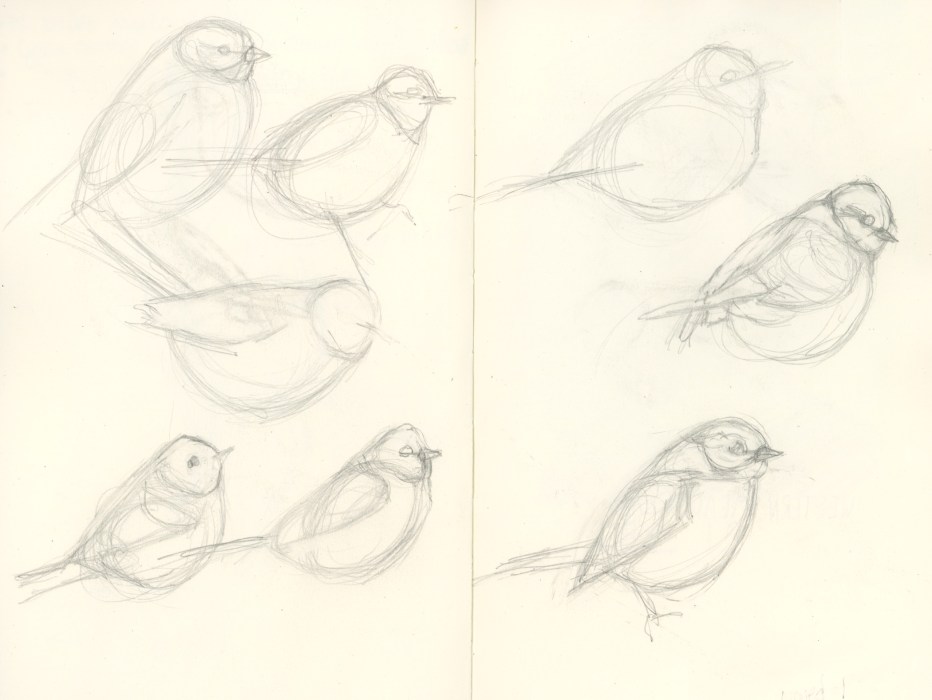
Bird sketching practice

PSA: We humans also do a forward head bob when we stare at screens, sometimes spending all day in that position. For every 1 inch our head is forward of our shoulders, the load on the neck increases by ~10 pounds. That puts 30-50 pounds (when head is 2-4″ in front of shoulders), leading to headaches, neck pain, muscle imbalances, etc. Bob it back!

Bonus (?) for making it to the end: For the past year I’ve sketched a quickie self portrait every night, right before bed. This is what happened after the day I’d spent immersed in bird things. Totally silly and improbable anatomy!
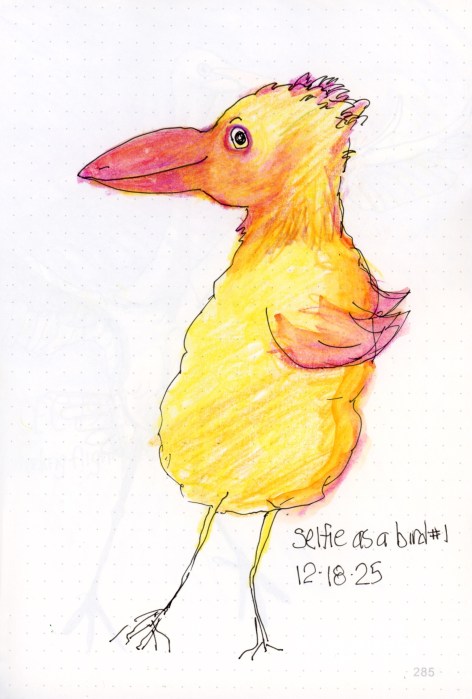
Selfie as a bird
Categories
Animals Bay Area Parks Drawing Ink and watercolor wash Life in general Sketchbook Pages

Happy Turkey (Vulture) Day; One More Thing to Be Thankful For

Turkey Vulture drawn from taxidermy specimen, ink & watercolor, 5x8"
Turkey Vulture drawn in ink from taxidermy specimen, ink & watercolor, 5×8″

So here it was the day before Thanksgiving and I wanted to draw a turkey. I called around trying to find a live one to sketch but failed. Then I tried to find a taxidermy turkey. No luck. The ranger at the Tilden Nature Center said they did have a collection of taxidermy birds including owl, songbirds, turkey vulture…but no turkey.

Wait! Turkey Vulture! It’s a bird, it’s named Turkey so why not? I called back to confirm they had it in stock (they rent it out: $10 for two weeks) and then drove up to Tilden Park.

Turkey Vulture: It's Value, ink & watercolor 5x16"
Turkey Vulture: It’s Value, drawn from specimen with notes from display case, ink & watercolor 5×16″

Here are a few interesting things about Turkey Vultures:

  • Turkey vultures (nicknamed “buzzard”) have a 5-6 foot wing span; “there is no more graceful bird in flight” but they have weak legs so walk awkwardly
  • In order to fly they need a run into the wind to lift off and can fly 60 miles per hour
  • Vultures are the “garbage collector of the bird world” and eat everything from dead mouse to moose.
  • If they are in danger and can’t run, they vomit their foul-smelling meal at their enemy.
  • Be thankful for them: “Without vultures, much of the world would be cluttered with the bodies of dead decaying animals.”

I’m Thankful For…

Along with turkey vultures, here are some things I’m grateful for:

  • YOU, my dear blog visitor and reader,
  • my much-loved friends and family, and
  • the freedom, security, comfort, and good health that allow me to live this wonderful creative life.

I know none of the above is guaranteed or permanent so I try to be grateful every day, not just Thanksgiving. What are you thankful for?

Categories
Animals Drawing Sketchbook Pages

Baby Bird Steps Out

Baby bird steps out and I have questions

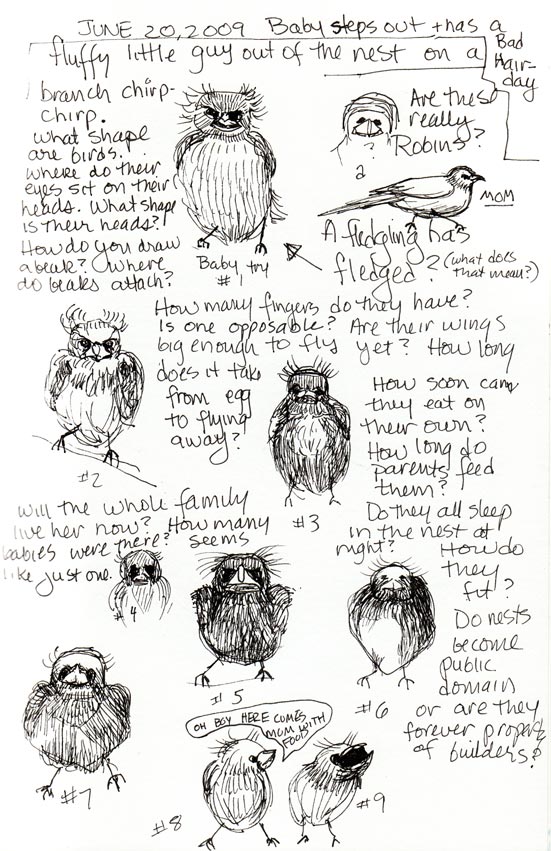
The day before the baby bird in the nest outside my window left the nest for the first time, his entire extended family of California Towhees chirped loudly all day, making a metallic “chip” sound, calling to him and to each other. The next day there he was, sitting in the tree on a branch near my window, looking right at me. He was bigger than I expected and was definitely having a bad hair day.

And now, quiet. No more constant activity of  bringing food, standing guard, warning off interlopers. The nest is empty and the chirping is over.  After watching them for days raised so many questions, which I scattered in my sketchbook among my 10 attempts to sketch the baby. My favorite was #8 when he turned his head to see mom bringing food and then opened wide to eat that yummy stuff.

I’d always thought birding was for boring old folks but now that I’m a boring old folk myself, I’m finding it quite interesting. Since my knowledge of birds is pretty limited, I initially assumed these guys were robins, since they sort of looked like them but without the red breast. Then I found the Cornell Lab of Ornithology All About Birds website where you can search by many different criteria to identify a bird, including their sounds.

That’s how I learned that these guys are California Towhees which I confirmed by listening to them here. If you click the link and go listen to their sounds, you’ll understand how I came to feel that a community of chirping Towhees was as annoying as a neighbor’s constantly barking dog. I’m guessing they were all calling to the baby, “Come out, it’s safe, we’re standing guard, come out, come out, and try your new wings!”

I’m glad the incessant metallic chip, chip, chip sound only lasted one day, but I miss watching the birds being busy in the tree outside  my window and so do my cats.