Categories
Oil Painting

Painting in Progress

Painting In Progress - Vege Still Life

Oil painting in progress on 16×12″ board
Click images to enlarge, select “All Sizes”

1st Layer, 1st Oil Painting

Previous first layer of same painting

I’ve been trying to figure out how to resolve this dilema: Since I started posting daily sketches and small paintings to my blog about 8 months ago I haven’t been working on any larger paintings, preferring the immediacy of plein air painting and direct sketching and painting daily. Now I’m working on paintings that take more than one session to complete, in both watercolor and oils. On days like this when I’ve spent my art time working on a painting in progress, what do I post at the end of the day? Do I post the work in progress, an older sketchbook piece, or nothing at all? Today I decided to post what I worked on today plus the two reference photos (below) I’m combining to make the painting.

RawSaveP1010201 __ Vege still life setup 2

This painting has been my practice piece to relearn how to paint with oils. Today was a huge breakthrough. First I read an article about oil painting without using solvents that gave me some good clues and then I finally received the book I ordered, Janet Fish: Paintings. In looking her paintings and at my books of two other oil painters whose work I love,  Alice Neel and Jane Freilicher, I got inspired and  started painting. Instead of the frustration and left-brained how-to thinking that I’d been experiencing with oils I was able to just paint and enjoy the seeing deeply. That’s how it is when I’m painting with watercolors: I don’t have to think too hard, just work intuitively. Pretty exciting!!!

Categories
Block Printing Every Day Matters Watercolor

Lantern again (EDM 95) on frustrating day

New Years Lantern

Block print, printing ink & watercolor, 5×4″
(To enlarge click image, select “All Sizes”)

This week’s Everyday Matters challenge was to make a holiday card image. I thought a lantern glowing in the dark would be a good image for my cards this year. I’d carved and printed a linoleum block a few weeks ago and the ink was finally dry enough to paint with watercolor so tonight I painted three of the prints, trying to find the right combination of colors. I think this is the one.

I actually send New Years cards, not Christmas cards, since I started opting out of the winter shopping holidays over 10 years ago and celebrating the new year is more meaningful to me. Though it sometimes feels a little odd to be so out of step with the rest of the known world, it works for me, and allows me to enjoy the season without the stress.

I had such high hopes for painting and making monoprints today, but even though I got up at 6:30 it just didn’t happen. The morning flew by and then I had to go out to get framing supplies. I needed the Blick store people to cut the giganto foam core board down to size. First there were math challenges figuring out how to cut the 10 pieces I needed from the various sizes of foamcore board, then there was problems with their cutter, a missing screwdriver to change the blade, various incompetencies, long lines, etc. Two hours later, with lots of extra free foamcore board that they cut wrong and had to redo but gave me anyway, I headed to the hardware store for glass. The glass was dirty and hard to clean but finally, the framing that had to be done today was finished. Then it was time for dinner and poof the day was gone.

At least I got to noodle around adding color to the lantern. I have the afternoon tomorrow to paint and I will!

Categories
Sketchbook Pages Still Life Watercolor

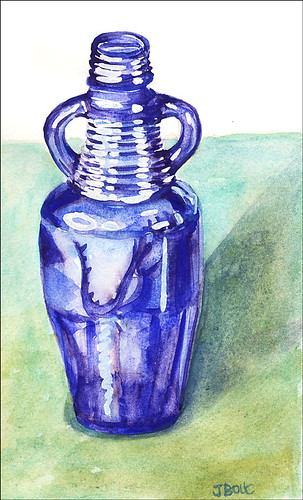
Blue Thrift Shop Bottle

Little blue thrift shop bottle

Kremer Pigments watercolors in large Moleskine watercolor notebook
(To enlarge, click images, select All Sizes)

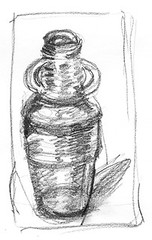
Bottle value sketch

Quick value sketch before painting

I wanted to play with monotypes tonight but was too tired after working all day so decided to do a small watercolor sketch instead. I don’t know what this bottle held originally–nothing fancy, I’m sure. But I just love it’s proud stance, and hands-on-hips attitude. I found it at Thrift Town, a sort of thrift shop department store where I’d gone looking for a used doctor’s lab coat to wear while painting in oils to protect my clothes. They didn’t have any lab coats even though they said they did on the phone. Instead I found a soft denim old lady’s house coat in the bathrobe department which works perfectly and looks more like a traditional painter’s smock.

I used Kremer pigment watercolors for this painting even though I knew they weren’t quite the right choice. My regular Winsor Newton cobalt and ultramarine blues would have been more appropriately transparent and glowing, but I went with the more opaque and sedimentary (or is it flocculating?) Kremer pigments, just to see what would happen. They’re fun to work with and after several layers of glazes, gave the background an interesting texture. The Moleskine paper was pooping out though, starting to pill and dissolve so it was time to stop messing around and go to bed.

Categories
Oil Painting

More color studies

Color-Study-Secondaries

Secondary colors and their darkened, neutralized (grayed) cast shadows in oil

Color-Study-Primaries

Primary colors and their darkened, neutralized (grayed) cast shadows in oil

I’d hoped to have more to post tonight than these 8×10 color studies, but nothing else is finished. Also, the colors don’t look quite right on screen–the paintings’ backgrounds are brighter and not so mustardy or greyed looking. [If you want to know more about the process for mixing the colors for the cast shadows click on Comments where I describe it in response to Toni’s question.]

The 5-day weekend that had stretched out so luxuriously ahead of me a few days ago is gone now, and I barely accomplished half of what I’d hoped to do in the studio. But I’ve also done some really important things that I’d been slacking on the past few months, like sleeping, eating properly and exercising AND I spent hours in the studio every day, making progress and enjoying the process.

Now it’s time to clean oil paint off of a dozen brushes and then head off to bed so I get another good night’s sleep then back to the office tomorrow.

Categories
Animals Plein Air Sketchbook Pages Watercolor

At the Dog Park

Watercolor and Micron Pigma Brush Pen in Raffine 6″x9″ Sketchbook

Yesterday I’d planned to spend the day in the studio but it was such a surprisingly nice day that I decided to go sketch at the dog park which is only about a mile from my house. Pt. Isabelle is a 23 acre park where dogs are allowed off leash and can run, swim and play. It’s on the S. F. Bay with stunning views of the Golden Gate Bridge. I sat on a bench along the path and watched the passing parade of canines and their owners. One very large dog turned out to be a miniature horse, the size of a Great Dane, and she caused quite a stir. I overheard her owner telling the gathering crowd that they take her places in their mini-van and that she sleeps outdoors but comes in the house and hangs out with the family. That brought back fond memories of my favorite childhood book, Pippi Longstocking, whose horse lived with her indoors.

Every dog that passed by took a turn peeing on the post beside my bench but none would hold still long enough for me to draw them. I filled several pages with partial dogs and then switched to doggie stick figures, just trying to capture their gestures and shapes. It was a hoot eavesdropping on the conversations I heard with owners and their dogs: “Now, Isis, I told you not to do that…stop it now Isis or else you’ll be sorry when you get home, Isis, stay, no, stay, I told you to stay….” It reminded me of the Far Side cartoon that goes:

What you say: Oh Ginger, that was a bad thing. You’re a bad, bad dog, Ginger.
What a dog hears: Blah Ginger, blah blah blah. Blah blah blah blah, Ginger.

After I’d finished the second picture it got really windy and foggy so I headed home, happy to be in the studio having enjoyed what may have been the last nice day before winter hit. Today it rained all day.

Categories
Oil Painting

Color studies in oil

I’ve been doing color and oil painting studies today from a new, terrific and appropriately named book: “The Oil Painting Course You’ve Always Wanted” by Kathleen Lochen Staiger. Unlike all the other oil painting books I’d found that had ugly paintings and sloppy instructions, this new book breaks it down from the most basic level to advanced in a logical and systematic way. Incorporated throughout is excellent information on drawing, values and color theory, and how they apply in the real world to making art with any medium. I thought I knew a fair amount about these things, but I’m amazed how much I learned today. I’m excited about working through the entire book.

I explain the purpose of the exercises below each. My apologies if it’s all boring.

(To enlarge images, click on them and select “All Sizes”)

Neutralize

(Above) Making greyed (neutralized) versions of colors without changing their value by mixing in the complimentary* (explanation below) color which has first been adjusted to the same value as the original.

Greys-Shadows

(Above) Top half: Mixing blacks and greys by combining dark complimentary* colors (a mixed black will be richer and more interesting than a black straight out of the tube).
Bottom half:
Mixing shadow colors by first darkening the color and then adding it’s compliment* which has been matched to the same value (on the right of each swatch).
Lighten-darken

(Above) Darkening colors by adding a darker pigment of the same hue (adding Burnt Sienna to darken orange; Yellow Ochre to darken yellow)
(Below) Experimenting with various brush techniques.

Brush-work

*Complimentary Colors: Complimentary colors are opposite each other on the color wheel and any two complimentary colors will contain all three primaries. Red, yellow and blue are the three primary colors. For example, orange is mixed from the primary colors red and yellow so orange’s compliment (the primary missing to complete the triad) is blue (red+yellow+blue=all 3 primary colors) which is found opposite orange on the color wheel. Green is mixed from yellow and blue so its compliment is red. Violet is made of red and blue so it’s compliment is yellow. Since pairs of complimentary colors contain all three primaries, mixing them together results in a grey color.

Categories
Every Day Matters Sketchbook Pages Still Life Watercolor

Spoons: EDM #94

Spoon - EDM 94

Watercolor, Noodlers Ink, and a dab of ProWhite in 9×12″ Aquabee Sketchbook
(To enlarge, click image, select “All Sizes“)

This week’s Everyday Matters challenge is “Spoon.” The large pink-handled cooking spoon and the tablespoon with the dull black plastic handle are the last remaining implements from my mother’s early 1960s kitchen complete with built in pink electric oven and stove. When half the pink handle broke off the big spoon I was sad, but it actually created a handy edge for propping it in pots. I use the black-handled tablespoon for everything I eat with a spoon. I love the way the handle feels in my hand and the way it holds just the right amount of cereal and milk. The slotted spoon is a good sturdy tool that’s always handy for serving veges.

The big wirey spoon is great for draining and lifting out a whole potful of raviolis like I did tonight. I used to use a special plastic pasta tool, part spoon and part fork, for that purpose but it now serves a different purpose. I slip it horizontally between the two handles of kitchen cabinet doors to keep the cats out of the trash. I’d first tried to install baby safety locks on that cabinet, but the instructions were impossible and I’m hopeless when it comes to measuring. I always end up skipping the ruler and trying to eyeball things, which never works. I got the little plastic hooky thingy in the wrong place, and then stripped the screw when trying to remove it, so now it is a permanent feature of my cabinet door, hanging there limply to remind me of my failure.

Anyway, these are all good sturdy tools that may be homely but they do their jobs well!

Categories
Sketchbook Pages Watercolor

ATM in the dark

ATM at night

Click here to enlarge
Ink & Watercolor in Hand Book Co. 5.5 x 5.5″ Journal

I noticed this Mechanics Bank ATM glowing in the dark on a side street off San Pablo Avenue in Albany (CA). I turned down the street, hoping to find a spot to park and paint it. There was a woman sitting in a car in the perfect parking spot across the street so I pulled in behind her, assuming she was waiting for someone. Finally a guy arrived with a box of pizza and got in the car. After another five minutes waiting for them to each eat a slice they finally strapped in and drove away. I pulled up and started painting. The light was horrible in my car so I just mixed colors by guesswork and put them down. (I’ve now solved this problem I think–I bought a strap-on LED headlight at REI tonight that tilts and will light up my paper and palette.)

I was half done with when two young women parked right in front of the ATM, got out of their car, and headed to the liquor store behind me. I got out of my car too, and approached them saying, “Excuse me…I know this will sound strange but I’m painting a picture of that (pointing to ATM) and your car is blocking my view. Would you mind moving it across the street?” They didn’t seem at all amused or confused by my request. They just said they’d only be a minute and went into the liquor store. They appeared to be on a serious mission, probably for cigarettes, and they did return shortly and moved their car.

I thought I’d finished the little sketch but when I got home I could see that the walls of the bank were way too light so I added darker paint to the walls.

Categories
Animals Watercolor

Armadillo

Armadillo

Pentel Pocket brush pen ink and watercolor on Arches watercolor paper 11×7 inches
(To enlarge, click image, select All Sizes)

The armadillo photo I used as a reference was prominently featured in a PC Magazine ad for a laptop computer. The ad said the computer has “Shock Absorbing Design, Hard Disk Drive Protection and a Spill-Resistant Keyboard, all of which better protect you from the hazards of mobile computing.” From my memories of all the squashed armadillos on the roads the last time I drove across Texas, I didn’t get the impression they were all that protected from the hazards of mobility! It’s been a long time since I drove across the U.S., which I’ve done several times. Maybe now that coast to coast it’s all one long walled-in highway lined with the same fast-food chains and big box stores, you don’t see the variety of squished critters from state to state anymore. I guess that’s one good thing about the interstates.

I drew the armadillo with my Pentel Pocket Brush Pen on a piece of watercolor paper I’d previously prepared for another project with wet-in-wet washes of Permanent Rose, Lemon Yellow and Cobalt Blue. I didn’t end up doing the other project so decided to draw on it tonight. I thought I’d done a decent job with the drawing until I set the painting and drawing side by side and saw that I’d elongated his body by an extra third. I’ll be using this image again in a monoprint project so I’ll get another chance to get the proportions right.

Categories
Oil Painting Still Life

1st layer of 2nd oil painting

1st Layer, 1st Oil Painting
Work in progress: Oil on board, 15 x 12 ”
(To enlarge, click image, select “All Sizes”)

This is the first layer: I expect there will be two or three more. Before I started this, I set up my palette, grabbed a library book with some oil painting technique exercises and tried doing the first exercise, copying a value study of layers of mountains. It was boring and awful. I finished it and tossed it, feeling discouraged. Then I decided to stop worrying so much and just start painting. I grabbed the photos I took the other day and used the veges and bowl from this one:
Vege still life setup 2

and next I think I’ll add the tablecloth from this one:
RawSaveP1010201

I ran out of time before I could start the background.

The biggest hurdle for me to get over is using white paint. For 20 years of painting with watercolor, I’ve learned to preserve the white in my paper instead of using white paint and to use more water to make colors lighter. There’s a big taboo about using white paint with watercolor–it’s considered “cheating” in some circles. I didn’t think I cared about that, that my preference for leaving the white of the paper had more to do with wanting the luminance and clarity that you don’t get with opaque white paint on top of transparent watercolor.

But when it came time to actually mix up colors using white paint, it felt like what I imagine an alcoholic might feel after being sober 20 years and then being told now it’s ok to drink and reaching for that first bottle. (Except I know there’s really no comparison–terrible things don’t happen from using white paint). But I was definitely stressing over it, which was interesting for me to observe. I received a couple answers to my worries about using white paint that I posted online. One person on Wet Canvas told me to paint a white object to get over it and Nel wrote and told me to “Use white paint happily and freely in oils!” She should know–her recent oils are scrumptious.

It’s going to be interesting switching back and forth between oil and water and monoprinting. I think I’ll try the same composition in watercolor tomorrow too–especially if this oil is still to wet to work with.