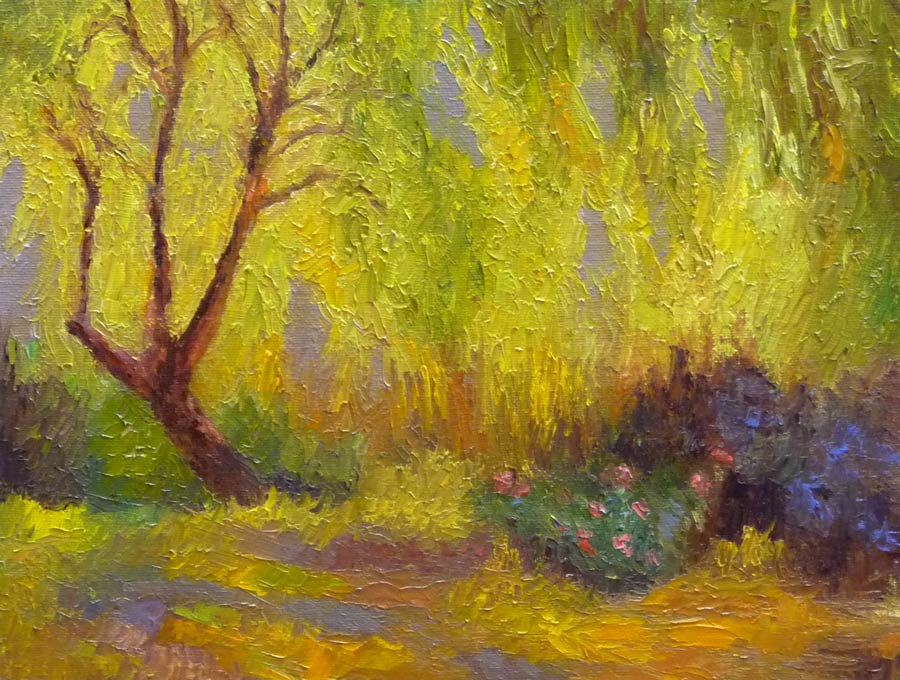
An artist friend once said that in her opinion, the definition of ” plein air” is “bad landscape painting.” While I have seen some really great plein air landscapes, I’m finding that its challenges often lead to results that look clunky and kindergartenish. It takes a lot of practice to be able to successfully capture a scene in the two hour window you have before the light changes and everything looks completely different.
When starting a plein air painting (or any painting for that matter) it is recommended to first simplify the scene down to its most basic elements, the largest shapes of value and color. However, because I love detail so much, something inside me often rebels at simplifying and then I find myself with an incoherent mess.
I like to think of plein air painting as akin to figure drawing, rather than a way to achieve finished works of art: It’s good for you, but not an end in itself. But if I spend my painting time mostly working plein air, I end up with lots of crappy paintings and frustration from working small. And that leads to messing around with the painting at home instead of leaving it alone.
Painting process
Below is the sketch that I painted at Lake Temescal on Sunday. It was a gorgeous day and although the lake was smooth and reflective and beautiful, the backlit trees along the lake were calling out to be painted. Below is the original version of the scene painted plein air.
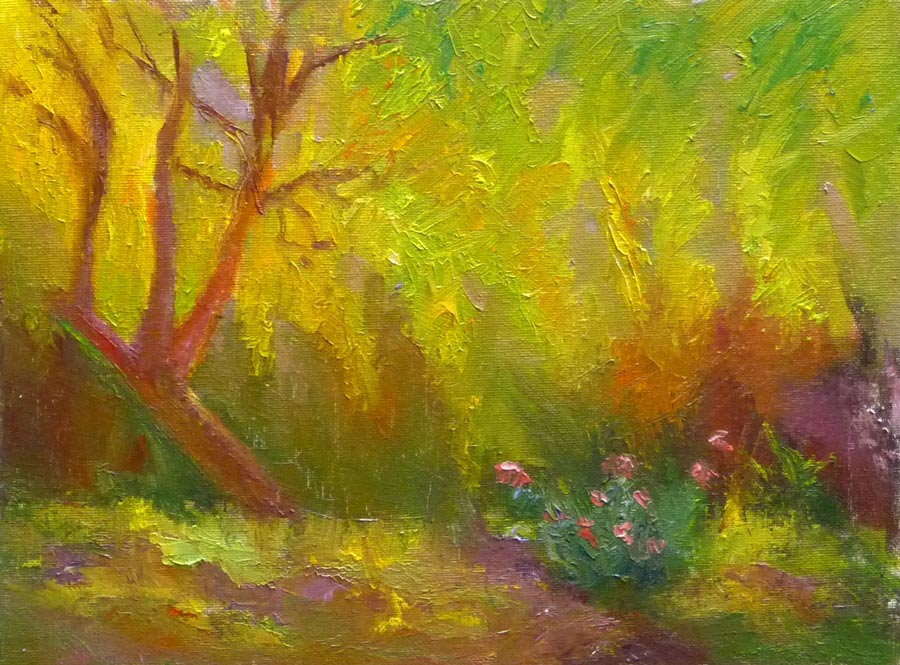
When I brought it home I broke my rule (that I have yet to follow): Leave plein air paintings alone, call them sketches and move on. Instead, after dinner I started messing with it, using a photo reference.
Today I studied the painting, still dissatisfied, trying to figure out what was wrong. I converted photos of the scene and my painting to “grayscale” in Photoshop and compared them. Immediately I could see that the photo had strong value contrast and that my painting did not. I worked on it some more, adding some dark accents. Here are the photos:


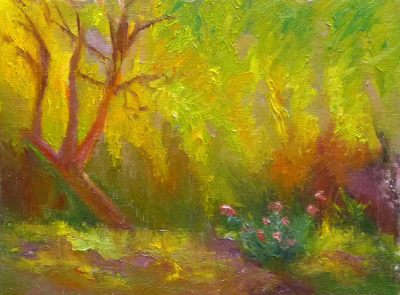
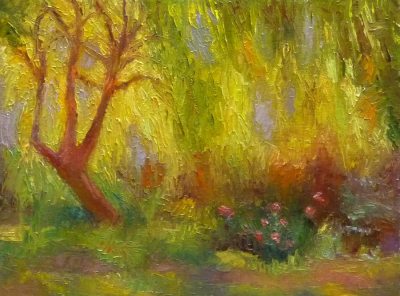
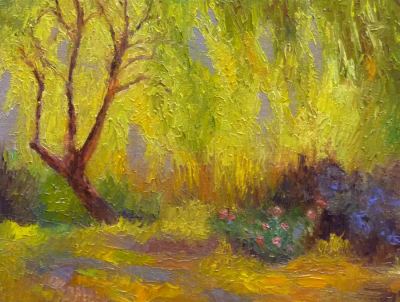
When a painting isn’t working I turn it into a little laboratory for learning, pushing it until it’s total crap or I’ve learned what I was trying to learn, or both. I think I should have just left this one as a happy color study.
 Jana Bouc, Artist